

Obverse
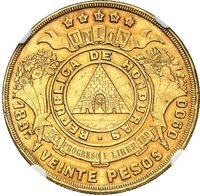
Description:
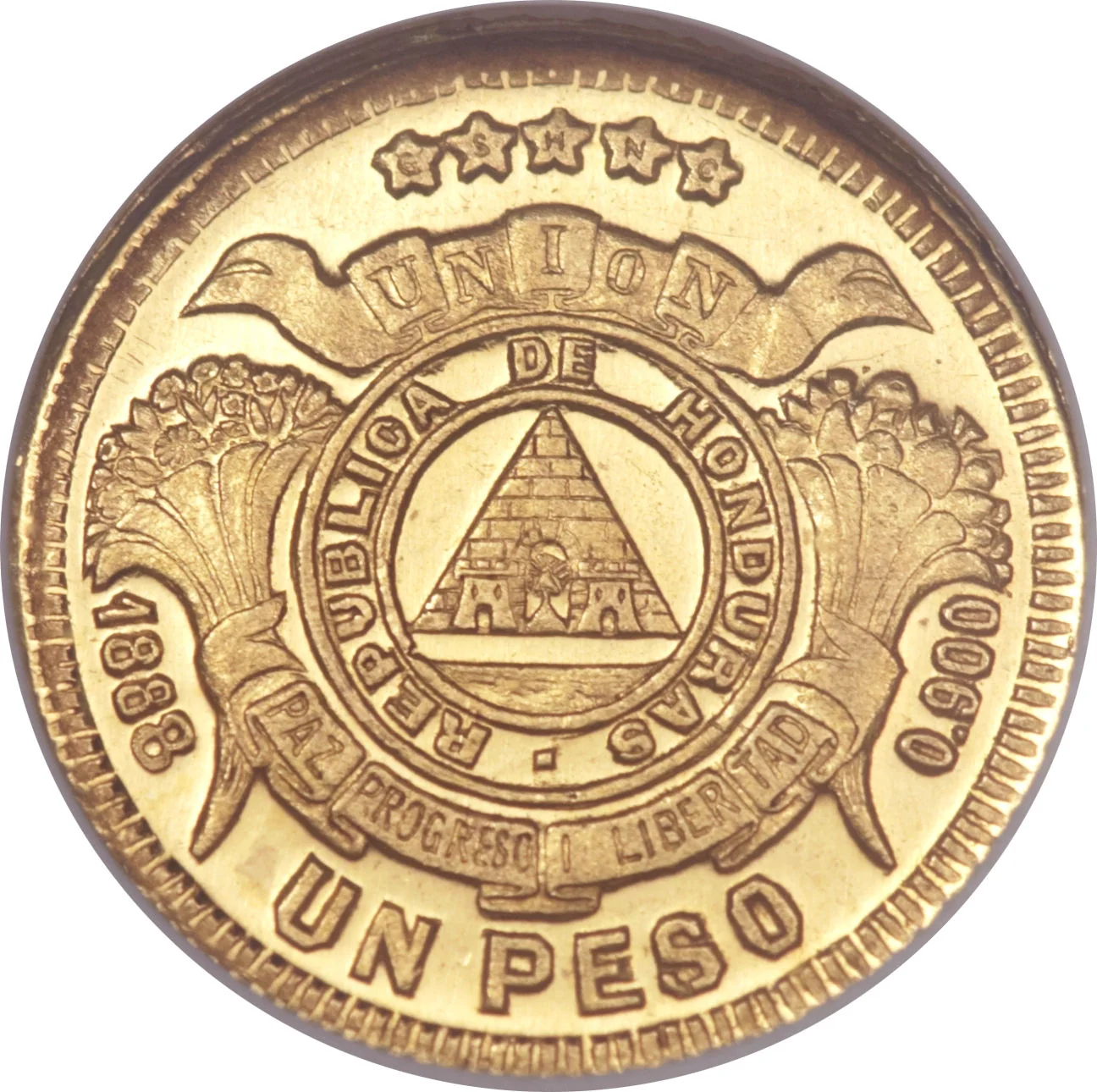
Coat of arms with legend. Date, value, and fineness below.
Inscription:
REPUBLICA DE HONDURAS
1888 UN PESO 0.900
1888 UN PESO 0.900
Translation:
REPUBLIC OF HONDURAS
1888 ONE PESO 0.900
1888 ONE PESO 0.900
Script: Latin
Language: Spanish
Engraver: Jean-Baptiste Frener
Reverse
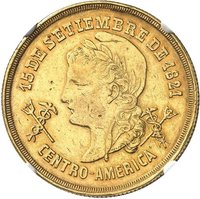
Description:
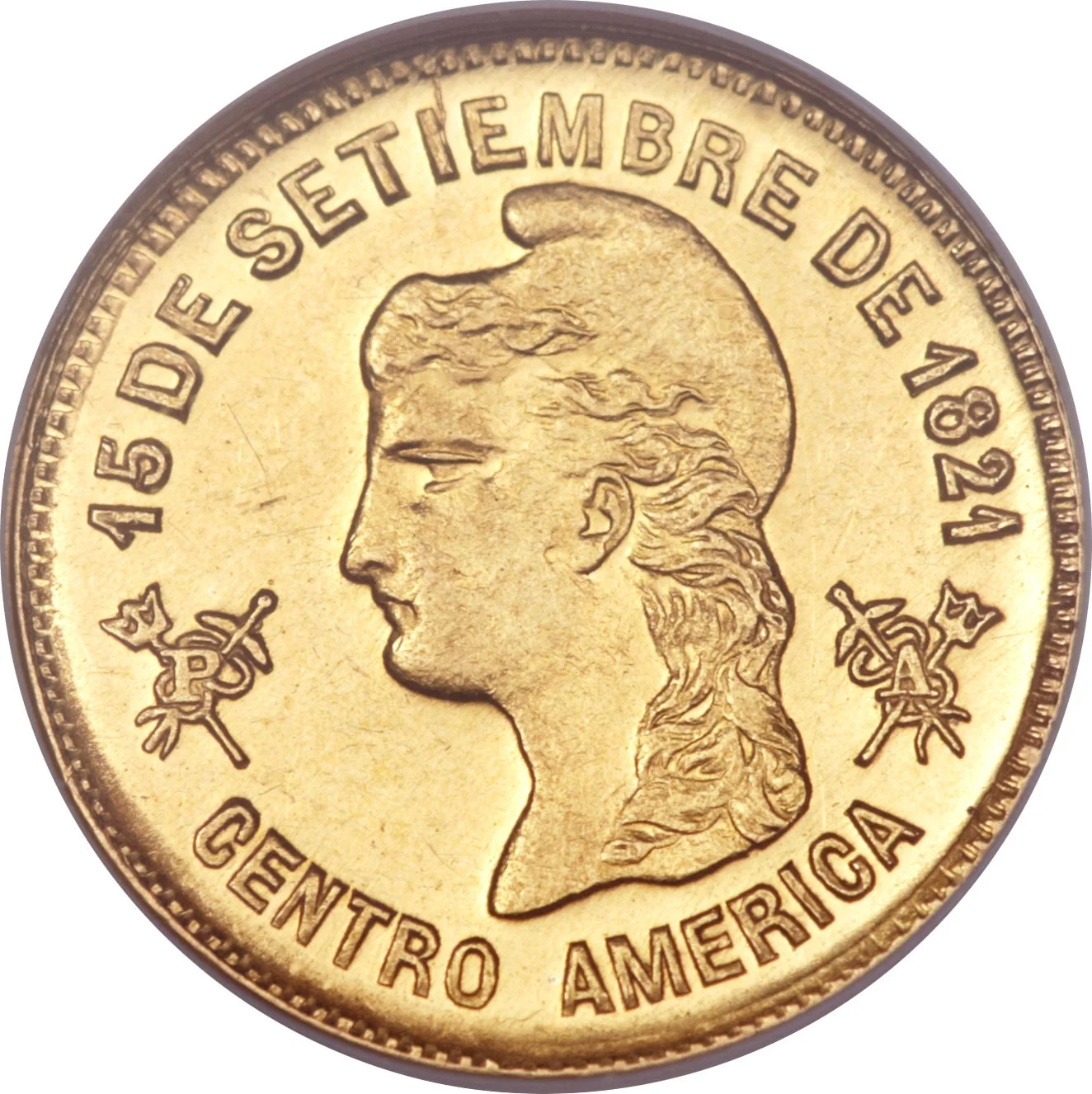
Liberty departed in legend.
Inscription:
15 DE SETIEMBRE DE 1821
CENTRO AMERICA
CENTRO AMERICA
Translation:
Fifteenth of September of 1821
Central America
Central America
Script: Latin
Language: Spanish
Engraver: Jean-Baptiste Frener
Edge
Reeded
Categories
| Symbol> Allegory |
| Symbols> Coat of Arms |
Mints
| Name | Mark |
|---|---|
| Casa Nacional de la Moneda | — |
Mintings
| Year | Mint Mark | Mintage | Quality | Collection |
|---|---|---|---|---|
| 1920 | — | — | ||
| 1922 | — | — | ||
| — | — | — | ||
| 1888 | — | — | ||
| 1889 | — | 5 | ||
| 1895 | — | 43 | ||
| 1896 | — | — | ||
| 1899 | — | — | ||
| 1901 | — | — | ||
| 1902 | — | — | ||
| 1907 | — | — | ||
| 1914 | — | — | ||
| 1919 | — | — |
Historical background
In 1888, Honduras was entrenched in a period of profound monetary instability, operating without a unified national currency. The economy relied on a chaotic mix of foreign silver coins, primarily the Mexican peso and the US dollar, alongside a limited and depreciated issue of domestic silver coins (centavos and pesos) from the Tegucigalpa mint. This fragmentation created significant challenges for commerce and government finance, as exchange rates fluctuated and confidence in the circulating medium was low. The situation was exacerbated by the country's heavy dependence on foreign loans, particularly from British capital, which had led to a default on sovereign debt in 1873 and placed external pressure on its fiscal policies.
The root of the instability lay in the chronic fiscal deficits of the Honduran government, which repeatedly resorted to debasing the coinage to generate short-term revenue. By reducing the silver content in newly minted coins while mandating they hold the same face value, the authorities sparked inflation and public distrust. This practice, combined with the influx of foreign coins of varying purity, made everyday transactions cumbersome and hindered economic development. The lack of a strong, centralized banking system further compounded the problem, leaving the nation without effective mechanisms for currency control or credit regulation.
Consequently, the currency situation of 1888 reflected broader themes of political turbulence and economic dependency common in late-19th century Central America. The monetary disorder was both a symptom and a cause of weak state institutions, as successive governments struggled to assert sovereignty over the nation's economic foundations. This environment set the stage for future attempts at reform, including the eventual establishment of the peso as the official currency in the 1890s and later the creation of the Lempira in the 1930s, efforts to finally achieve the monetary stability that proved so elusive in the late 1880s.
The root of the instability lay in the chronic fiscal deficits of the Honduran government, which repeatedly resorted to debasing the coinage to generate short-term revenue. By reducing the silver content in newly minted coins while mandating they hold the same face value, the authorities sparked inflation and public distrust. This practice, combined with the influx of foreign coins of varying purity, made everyday transactions cumbersome and hindered economic development. The lack of a strong, centralized banking system further compounded the problem, leaving the nation without effective mechanisms for currency control or credit regulation.
Consequently, the currency situation of 1888 reflected broader themes of political turbulence and economic dependency common in late-19th century Central America. The monetary disorder was both a symptom and a cause of weak state institutions, as successive governments struggled to assert sovereignty over the nation's economic foundations. This environment set the stage for future attempts at reform, including the eventual establishment of the peso as the official currency in the 1890s and later the creation of the Lempira in the 1930s, efforts to finally achieve the monetary stability that proved so elusive in the late 1880s.
💎 Extremely Rare