

50 centavos – Honduras
Add to wishlist
Honduras
Obverse
Description:
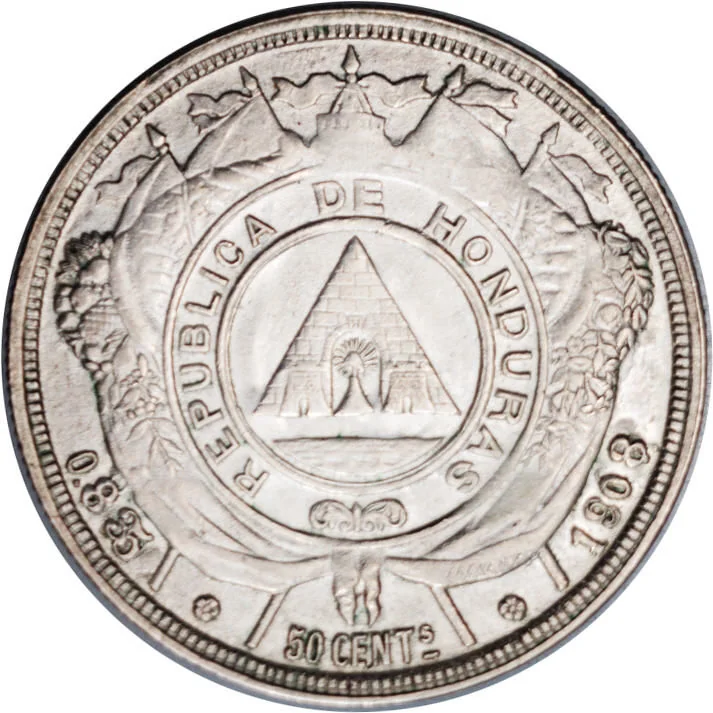
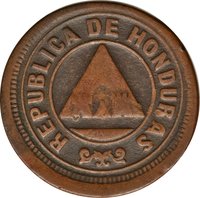
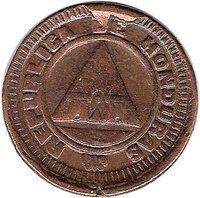
Coat of arms with legend; fineness, value, and date below.
Inscription:
REPUBLICA DE HONDURAS
0.835 50 CENTs 1908
0.835 50 CENTs 1908
Translation:
REPUBLIC OF HONDURAS
0.835 50 CENTS 1908
0.835 50 CENTS 1908
Script: Latin
Language: Spanish
Engraver: Jean-Baptiste Frener
Reverse
Description:
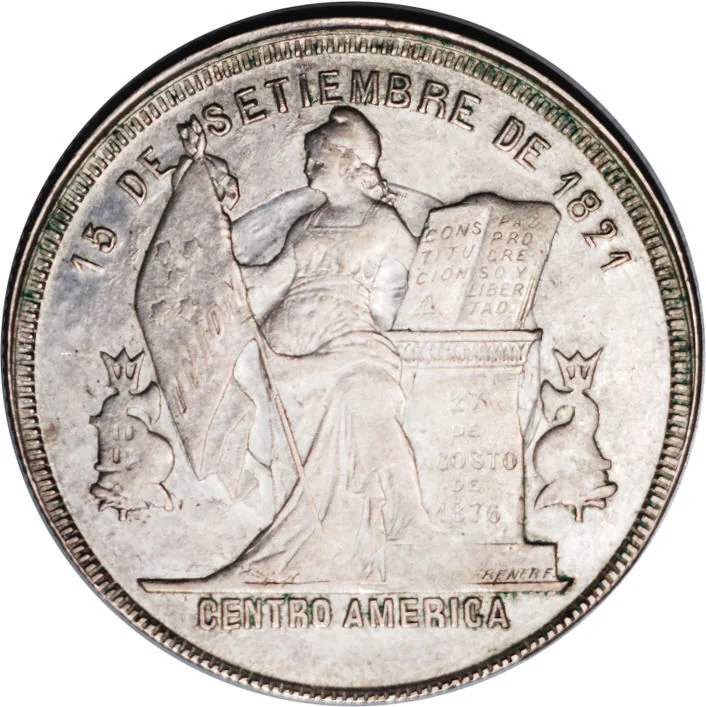
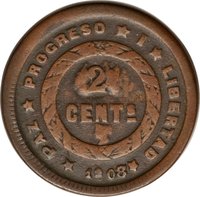
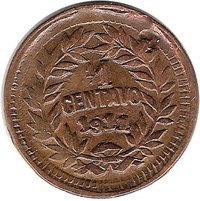
Liberty holding a flag marked "UNION" and five stars, her left arm resting on a column and the Constitution. Tridents with P and A flank her. Legends above and below.
Inscription:
15 DE SETIEMBRE DE 1821
CONSTITUCION
PAZ, PROGRESO Y LIBERTAD
UNION
27 DE AGOSTO DE 1876
P A
CENTRO AMERICA
CONSTITUCION
PAZ, PROGRESO Y LIBERTAD
UNION
27 DE AGOSTO DE 1876
P A
CENTRO AMERICA
Translation:
Fifteenth of September of 1821
Constitution
Peace, Progress and Liberty
Union
Twenty-seventh of August of 1876
P A
Central America
Constitution
Peace, Progress and Liberty
Union
Twenty-seventh of August of 1876
P A
Central America
Script: Latin
Language: Spanish
Engraver: Jean-Baptiste Frener
Edge
Mints
| Name | Mark |
|---|---|
| Casa Nacional de la Moneda | — |
Mintings
| Year | Mint Mark | Mintage | Quality | Collection |
|---|---|---|---|---|
| 1908 | — | 908 | ||
| 1911 | — | 90 |
Historical background
In 1908, Honduras found itself in a precarious monetary situation characterized by a chaotic and devalued currency system. Following decades of political instability and heavy borrowing from foreign banks, the country's primary circulating medium was the silver Honduran peso, which had severely depreciated against the gold standard. More critically, the financial landscape was dominated by a flood of low-value, privately issued banknotes from various domestic banks. These notes were often inconvertible into specie (hard currency) and of dubious value, leading to widespread public distrust and economic inefficiency.
This monetary anarchy was a direct result of the "Ley de Bancos de Emisión" (Law of Issuing Banks) of 1902, which had granted note-issuing privileges to multiple commercial banks with minimal government oversight. The system invited abuse, as banks printed excessive currency to finance loans to the very government and allied elites, fueling inflation. By 1908, the situation had reached a crisis point, severely hampering domestic commerce and foreign trade, as international merchants refused the unstable Honduran currency.
Recognizing the need for reform, the government of President Miguel R. Dávila took decisive action in 1908. It initiated a process to centralize and stabilize the currency, which culminated in the creation of the Banco de Honduras later that year. This new bank was granted a monopoly on note issuance, marking the first major step toward a uniform national currency. While full stabilization was a gradual process, the reforms of 1908 laid the essential groundwork for the eventual introduction of the Honduran lempira in 1931, finally establishing a stable and unified monetary system.
This monetary anarchy was a direct result of the "Ley de Bancos de Emisión" (Law of Issuing Banks) of 1902, which had granted note-issuing privileges to multiple commercial banks with minimal government oversight. The system invited abuse, as banks printed excessive currency to finance loans to the very government and allied elites, fueling inflation. By 1908, the situation had reached a crisis point, severely hampering domestic commerce and foreign trade, as international merchants refused the unstable Honduran currency.
Recognizing the need for reform, the government of President Miguel R. Dávila took decisive action in 1908. It initiated a process to centralize and stabilize the currency, which culminated in the creation of the Banco de Honduras later that year. This new bank was granted a monopoly on note issuance, marking the first major step toward a uniform national currency. While full stabilization was a gradual process, the reforms of 1908 laid the essential groundwork for the eventual introduction of the Honduran lempira in 1931, finally establishing a stable and unified monetary system.
✨ Legendary