


Obverse
Description:
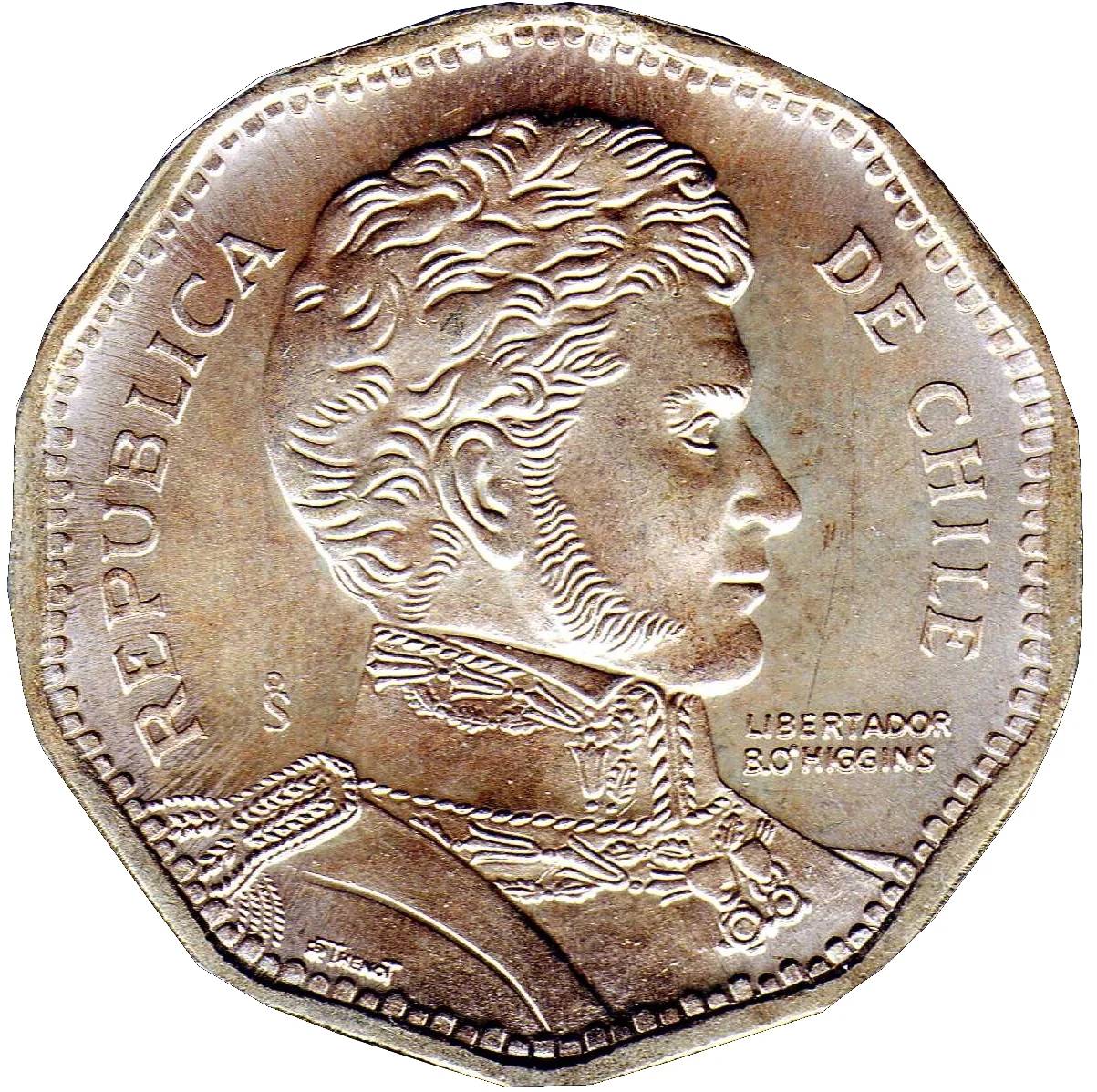
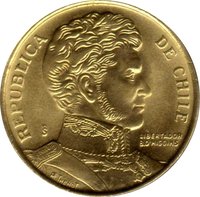
Portrait of Bernardo O'Higgins facing right.
Inscription:
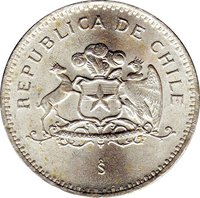
REPUBLICA DE CHILE
So
LIBERTADOR
B. O'HIGGINS
R.THENOT
So
LIBERTADOR
B. O'HIGGINS
R.THENOT
Translation:
REPUBLIC OF CHILE
So
LIBERATOR
B. O'HIGGINS
R. THENOT
So
LIBERATOR
B. O'HIGGINS
R. THENOT
Script: Latin
Language: Spanish
Engraver: René Thénot
Reverse
Edge
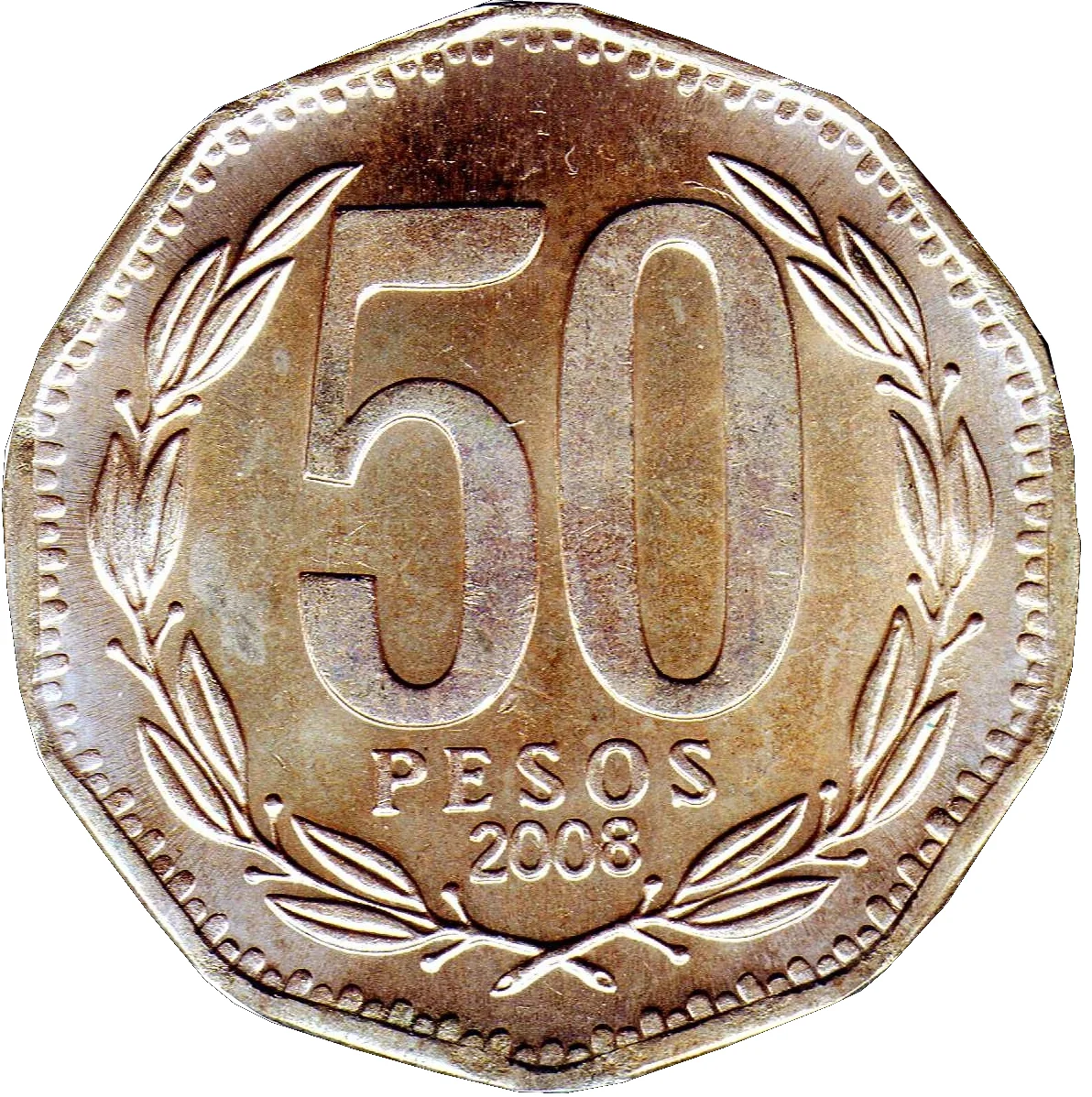
Smooth with 23 ellipsoid dents
Categories
| Person> Military leader |
| Person> Politician |
| Symbol> Wreath |
Mints
| Name | Mark |
|---|---|
| Royal Canadian Mint of Winnipeg | — |
| Casa de Moneda de Chile | (So) |
Mintings
| Year | Mint Mark | Mintage | Quality | Collection |
|---|---|---|---|---|
| 1981 | So | 12,000,000 | ||
| 1982 | So | 14,000,000 | ||
| 1985 | So | 400,000 | ||
| 1986 | So | 1,000,000 | ||
| 1987 | So | 4,000,000 | ||
| 1988 | So | 4,800,000 | ||
| 1989 | So | — | ||
| 1991 | So | 10,845,000 | ||
| 1992 | So | 10,500,000 | ||
| 1993 | So | 14,600,000 | ||
| 1994 | So | 14,300,000 | ||
| 1995 | So | 14,300,000 | ||
| 1996 | So | 8,100,000 | ||
| 1997 | So | 17,400,000 | ||
| 1998 | So | 6,200,000 | ||
| 1999 | So | 29,300,000 | ||
| 2000 | So | 4,500,000 | ||
| 2001 | So | 19,000,000 | ||
| 2002 | So | 14,000,000 | ||
| 2005 | So | 4,000,000 | ||
| 2006 | So | 53,000,000 | ||
| 2007 | — | 27,000,000 | ||
| 2008 | So | 10,000,000 | ||
| 2009 | So | 19,600,000 | ||
| 2010 | So | 33,000,000 | ||
| 2011 | So | 19,000,000 | ||
| 2012 | So | 15,000,000 | ||
| 2013 | So | 38,000,000 | ||
| 2014 | So | 22,000,000 | ||
| 2015 | So | 61,000,000 | ||
| 2016 | So | 19,000,000 | ||
| 2017 | So | 65,000,000 | ||
| 2018 | So | 41,000,000 | ||
| 2019 | So | 14,000,000 | ||
| 2021 | So | — | ||
| 2022 | So | — | ||
| 2023 | So | — | ||
| 2024 | — | — |
Historical background
In 1981, Chile's currency situation was defined by the rigid implementation of a fixed exchange rate regime, a cornerstone of the "Chicago Boys" economic model under the military government of Augusto Pinochet. Seeking to crush hyperinflation and impose monetary discipline, authorities had pegged the Chilean peso to the US dollar in 1979 at a rate of 39 pesos. This policy initially succeeded in stabilizing prices and controlling inflation, which fell dramatically. However, it also made the peso significantly overvalued, as domestic inflation, though lower, remained higher than US inflation, eroding Chile's international competitiveness.
The overvalued peso created severe economic distortions. It fueled a massive import boom and consumer spending spree, while crippling non-copper exports, leading to a widening current account deficit. Simultaneously, domestic financial liberalization had created a bubble of easy credit and speculative lending. By 1981, the economy was acutely vulnerable; the fixed rate required high domestic interest rates to attract sustaining capital flows, which stifled investment and increased debt burdens. The global recession and a sharp drop in copper prices further exposed these weaknesses, leading to a dramatic loss of foreign reserves as the Central Bank intervened to defend the unsustainable peg.
Consequently, 1981 marked the beginning of a profound economic crisis. The rigid currency regime collapsed in mid-1982, forcing a massive devaluation and plunging Chile into its worst recession since the 1930s. The banking sector required a state-led bailout, and unemployment soared. The events of 1981-82 thus represent a pivotal failure of an orthodox monetary experiment, demonstrating the perils of maintaining a fixed exchange rate in the face of major external shocks and fundamental macroeconomic misalignments.
The overvalued peso created severe economic distortions. It fueled a massive import boom and consumer spending spree, while crippling non-copper exports, leading to a widening current account deficit. Simultaneously, domestic financial liberalization had created a bubble of easy credit and speculative lending. By 1981, the economy was acutely vulnerable; the fixed rate required high domestic interest rates to attract sustaining capital flows, which stifled investment and increased debt burdens. The global recession and a sharp drop in copper prices further exposed these weaknesses, leading to a dramatic loss of foreign reserves as the Central Bank intervened to defend the unsustainable peg.
Consequently, 1981 marked the beginning of a profound economic crisis. The rigid currency regime collapsed in mid-1982, forcing a massive devaluation and plunging Chile into its worst recession since the 1930s. The banking sector required a state-led bailout, and unemployment soared. The events of 1981-82 thus represent a pivotal failure of an orthodox monetary experiment, demonstrating the perils of maintaining a fixed exchange rate in the face of major external shocks and fundamental macroeconomic misalignments.
Series: 1981 Chile circulation coins

🌱 Very Common