


Mintings
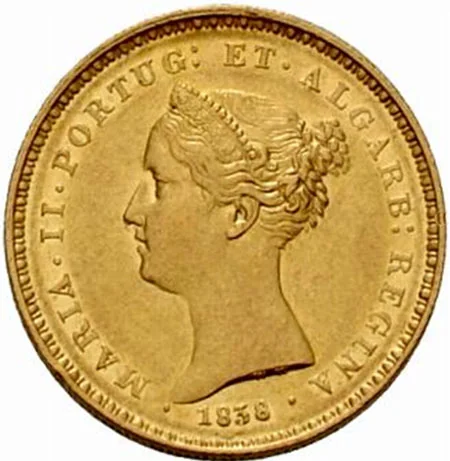
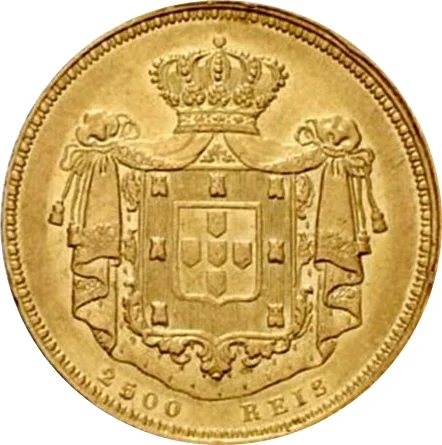
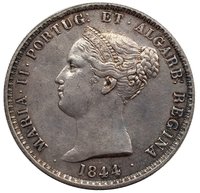
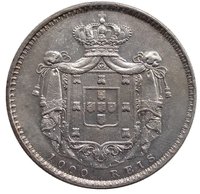
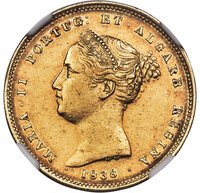
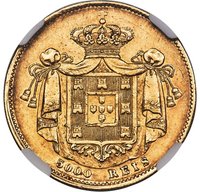
| Year | Mint Mark | Mintage | Quality | Collection |
|---|---|---|---|---|
| 1838 | — | 1,114 |
Historical background
In 1838, Portugal's currency situation was a complex and unstable legacy of the Liberal Wars (1828-1834). The victorious liberal government, led by Queen Maria II, faced a dire fiscal crisis. The state was deeply in debt from the conflict, and the economy was severely disrupted. Crucially, the monetary system was a chaotic mix of old and new: the pre-war real (plural réis) remained the official unit of account, but its value had been massively eroded by decades of wartime paper money issuance, coin debasement, and foreign currency circulation, particularly British gold and Brazilian coins.
The central challenge was the lack of a uniform, trusted metallic currency in daily circulation. To address this, the government was actively implementing a major monetary reform initiated in 1835-1836. This reform introduced a new decimal system, making the real equal to 1,000 réis (a milestone réis), and mandated the minting of new gold, silver, and copper coins. However, in 1838, this process was still incomplete. The public remained skeptical of paper notes, and the new metallic currency was not yet produced in sufficient quantities, leading to persistent shortages of reliable specie for commerce.
Consequently, the practical economy operated with a confusing multiplicity of values. Merchants and citizens had to constantly negotiate the exchange between the old réis, the new decimal réis, various foreign coins, and depreciated paper. This environment of monetary uncertainty stifled trade, investment, and tax collection, posing a fundamental obstacle to Portugal's post-war political consolidation and economic recovery. The currency situation of 1838 was thus a critical battlefield in the larger struggle to build a modern, functional state.
The central challenge was the lack of a uniform, trusted metallic currency in daily circulation. To address this, the government was actively implementing a major monetary reform initiated in 1835-1836. This reform introduced a new decimal system, making the real equal to 1,000 réis (a milestone réis), and mandated the minting of new gold, silver, and copper coins. However, in 1838, this process was still incomplete. The public remained skeptical of paper notes, and the new metallic currency was not yet produced in sufficient quantities, leading to persistent shortages of reliable specie for commerce.
Consequently, the practical economy operated with a confusing multiplicity of values. Merchants and citizens had to constantly negotiate the exchange between the old réis, the new decimal réis, various foreign coins, and depreciated paper. This environment of monetary uncertainty stifled trade, investment, and tax collection, posing a fundamental obstacle to Portugal's post-war political consolidation and economic recovery. The currency situation of 1838 was thus a critical battlefield in the larger struggle to build a modern, functional state.
✨ Legendary