

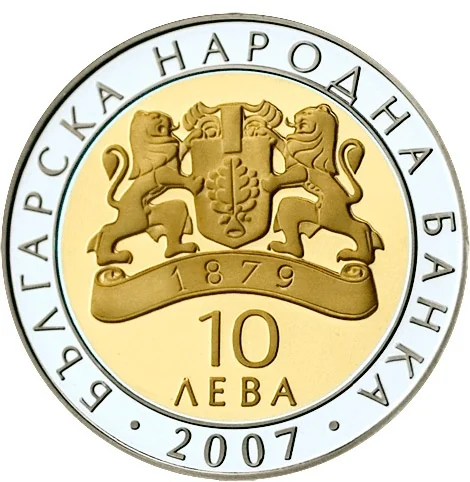
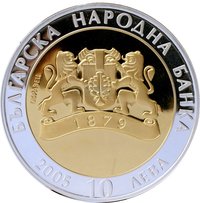
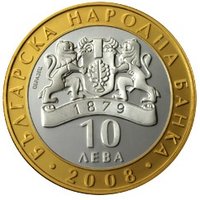
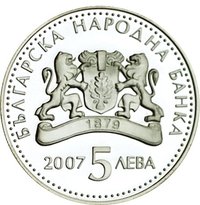
Obverse
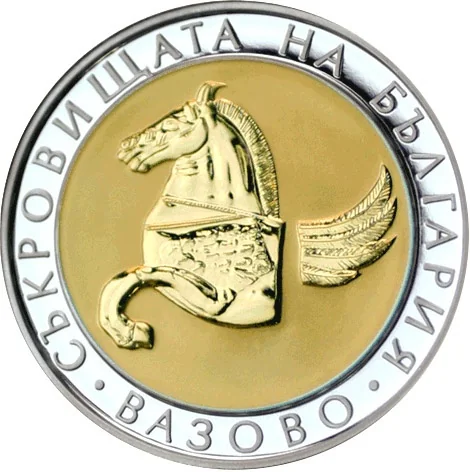
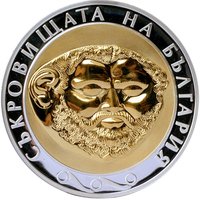
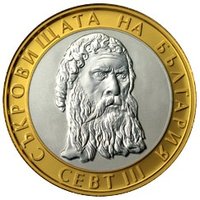
Reverse
Description:
Pegasus, discovered in Vazovo village within the Razgrad region's gilded center.
Inscription:
СЪКРОВИЩАТА НА БЪΛΓΑΡИЯ
· ΒΑЗОВО ·
· ΒΑЗОВО ·
Translation:
THE TREASURES OF BULGARIA
· BAZOVO ·
· BAZOVO ·
Script: Cyrillic
Languages: Church Slavonic, Bulgarian
Edge
Categories
| Mythology> Fantastic animal |
| Animal> Horse |
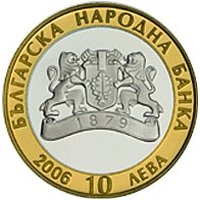
| Symbols> Coat of Arms |
Mints
| Name | Mark |
|---|---|
| Bulgarian Mint | — |
Mintings
| Year | Mint Mark | Mintage | Quality | Collection |
|---|---|---|---|---|
| 2007 | — | 10,000 | Proof |
Historical background
In 2007, Bulgaria's currency situation was defined by its unique and highly successful implementation of a Currency Board Arrangement (CBA), established in July 1997 to end a period of hyperinflation and banking crisis. This system rigidly pegged the Bulgarian lev (BGN) to the German Deutsche Mark and, following its introduction, to the Euro at a fixed rate of 1.95583 BGN per EUR. The CBA mandated that the Bulgarian National Bank could only issue new lev currency if it had full foreign exchange reserves to back it, eliminating discretionary monetary policy and imposing strict fiscal discipline. This framework was crucial for restoring macroeconomic stability, achieving low inflation, and building international credibility.
The year 2007 was particularly significant as it marked Bulgaria's accession to the European Union on January 1st. This event intensified the focus on the country's future path toward adopting the Euro. While the CBA provided stability and was seen as a preparatory mechanism for Eurozone entry, it also meant Bulgaria had no independent monetary tools to respond to economic shocks, relying instead on fiscal policy and structural reforms. Furthermore, the fixed peg contributed to maintaining low interest rates but also fueled a rapid credit boom and a worrying current account deficit, exposing economic vulnerabilities.
Consequently, the core currency debate in 2007 revolved around the timing and conditions for Euro adoption. While EU membership made eventual euro adoption obligatory, Bulgaria did not immediately join the Exchange Rate Mechanism II (ERM II), the required "waiting room." Authorities prioritized maintaining the proven stability of the CBA while working to meet the Maastricht convergence criteria, particularly focusing on lowering inflation to the required level and addressing macroeconomic imbalances. Thus, the currency situation was one of a stable but inflexible peg, serving as both an anchor for past recovery and a stepping stone for future integration, all while managing the overheating risks of a booming economy.
The year 2007 was particularly significant as it marked Bulgaria's accession to the European Union on January 1st. This event intensified the focus on the country's future path toward adopting the Euro. While the CBA provided stability and was seen as a preparatory mechanism for Eurozone entry, it also meant Bulgaria had no independent monetary tools to respond to economic shocks, relying instead on fiscal policy and structural reforms. Furthermore, the fixed peg contributed to maintaining low interest rates but also fueled a rapid credit boom and a worrying current account deficit, exposing economic vulnerabilities.
Consequently, the core currency debate in 2007 revolved around the timing and conditions for Euro adoption. While EU membership made eventual euro adoption obligatory, Bulgaria did not immediately join the Exchange Rate Mechanism II (ERM II), the required "waiting room." Authorities prioritized maintaining the proven stability of the CBA while working to meet the Maastricht convergence criteria, particularly focusing on lowering inflation to the required level and addressing macroeconomic imbalances. Thus, the currency situation was one of a stable but inflexible peg, serving as both an anchor for past recovery and a stepping stone for future integration, all while managing the overheating risks of a booming economy.
💎 Very Rare