

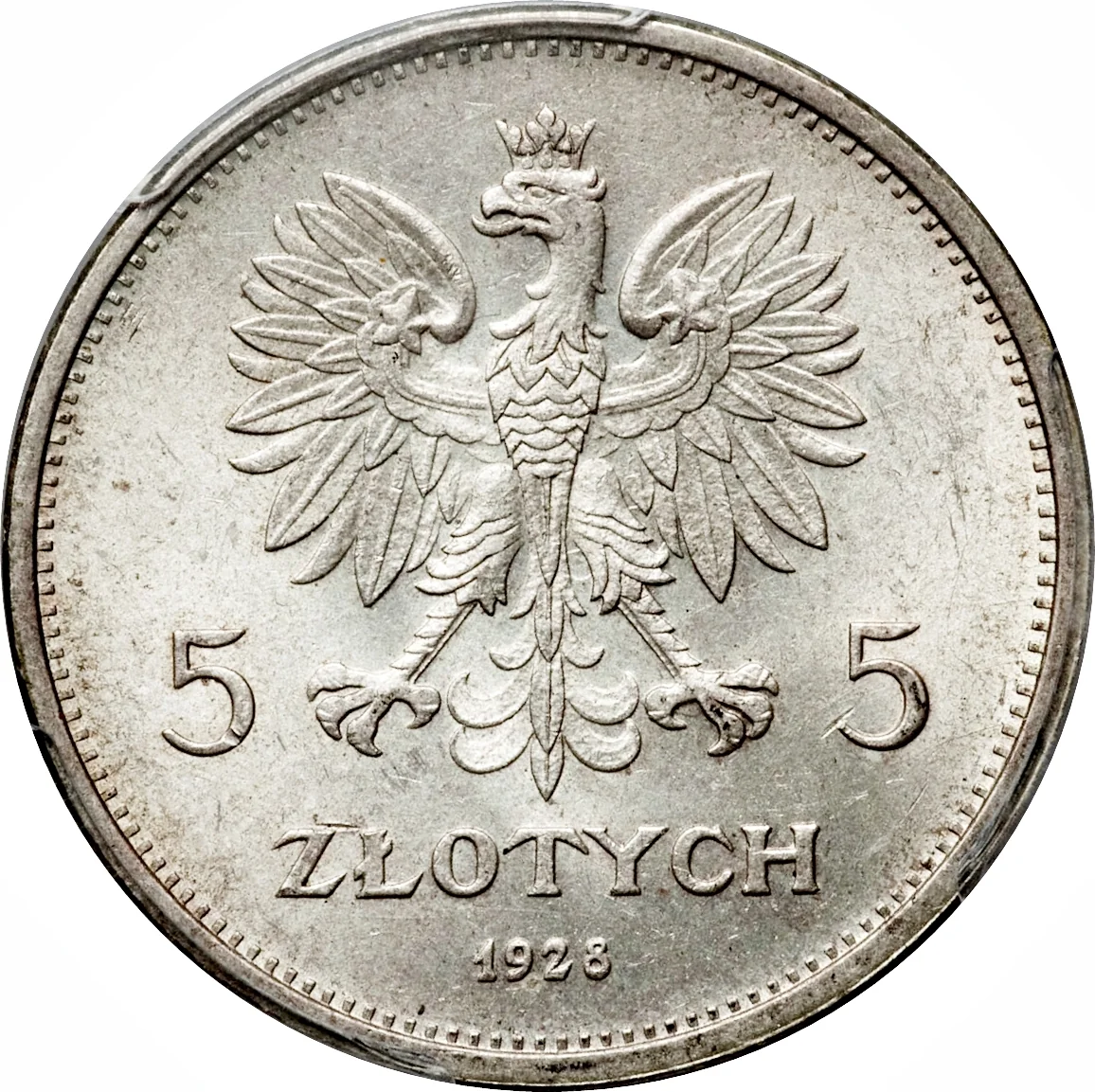
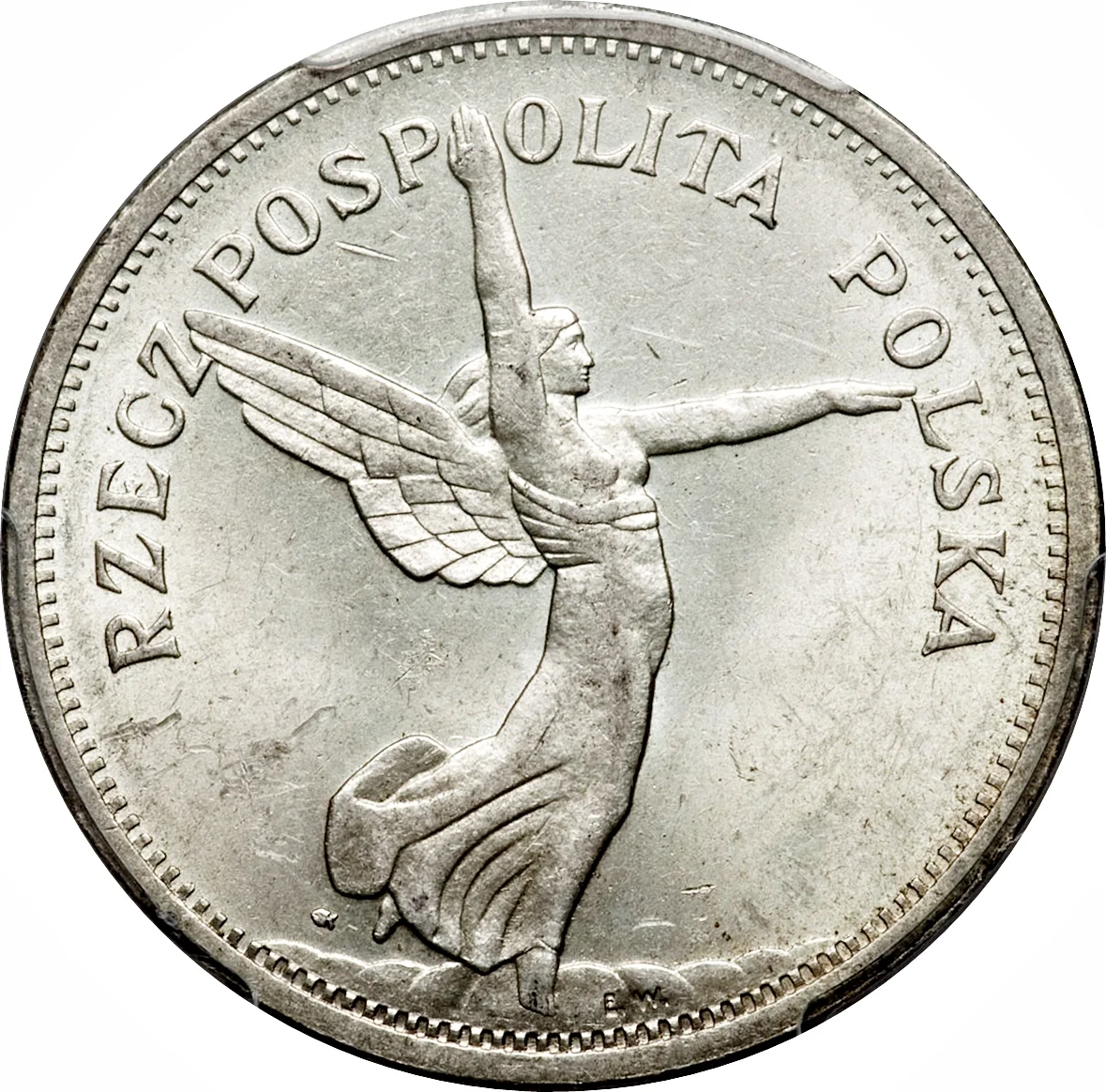

Obverse
Reverse
Description:
Nike facing right, standing on her right leg, left arm extended right, right arm raised.
Inscription:
RZECZPOSPOLITA POLSKA
Script: Latin
Edge
Lettering
Legend:
SALUS - REIPUBLICAE - SUPREMA - LEX
Mints
| Name | Mark |
|---|---|
| Royal Mint of Belgium | — |
Mintings
| Year | Mint Mark | Mintage | Quality | Collection |
|---|---|---|---|---|
| 1928 | — | 10,000,000 | ||
| 1930 | — | 5,900,000 | ||
| 1931 | — | 2,200,000 | ||
| 1932 | — | 3,100,000 |
Historical background
Following the devastation of World War I and the subsequent Polish-Soviet War, the newly independent Second Polish Republic faced severe monetary chaos in its first decade. The country inherited multiple currencies from its former partitioners (German marks, Austrian crowns, and Russian rubles), leading to rampant inflation and economic instability. In 1924, Finance Minister Władysław Grabski enacted sweeping reforms, establishing the Bank of Poland and introducing a new national currency, the złoty, which was pegged to gold at a rate of 1 USD = 8.9 złoty. However, this initial stabilization proved fragile, as budget deficits financed by money printing and a lack of foreign confidence soon led to renewed inflation and pressure on the gold peg.
By 1928, the government, under the influence of Józef Piłsudski's sanacja regime, sought to permanently anchor the currency and attract foreign investment. The key event was the Currency Reform of 1928, which legally re-established the gold standard. The new złoty was defined as containing 0.592 grammes of pure gold, a devaluation from the 1924 standard, setting a formal parity of 1 USD = 8.9 złoty and 1 GBP = 42.4 złoty. This move was intended to signal monetary discipline and integrate Poland into the international financial system, requiring the Bank of Poland to hold sufficient gold and foreign exchange reserves to back the currency.
The 1928 reform achieved its goal of short-term stabilization and restored confidence, facilitating international loans and modest economic growth in the late 1920s. However, the Polish złoty entered the global gold standard at an arguably overvalued rate, which made Polish exports less competitive. This structural weakness, combined with the country's underlying fiscal pressures and the onset of the Great Depression in 1929, would soon place immense strain on the system. By the mid-1930s, Poland was forced to abandon the gold standard, revealing the 1928 reform as a temporary stabilization rather than a permanent solution to the nation's economic challenges.
By 1928, the government, under the influence of Józef Piłsudski's sanacja regime, sought to permanently anchor the currency and attract foreign investment. The key event was the Currency Reform of 1928, which legally re-established the gold standard. The new złoty was defined as containing 0.592 grammes of pure gold, a devaluation from the 1924 standard, setting a formal parity of 1 USD = 8.9 złoty and 1 GBP = 42.4 złoty. This move was intended to signal monetary discipline and integrate Poland into the international financial system, requiring the Bank of Poland to hold sufficient gold and foreign exchange reserves to back the currency.
The 1928 reform achieved its goal of short-term stabilization and restored confidence, facilitating international loans and modest economic growth in the late 1920s. However, the Polish złoty entered the global gold standard at an arguably overvalued rate, which made Polish exports less competitive. This structural weakness, combined with the country's underlying fiscal pressures and the onset of the Great Depression in 1929, would soon place immense strain on the system. By the mid-1930s, Poland was forced to abandon the gold standard, revealing the 1928 reform as a temporary stabilization rather than a permanent solution to the nation's economic challenges.
⭐ Somewhat Rare