

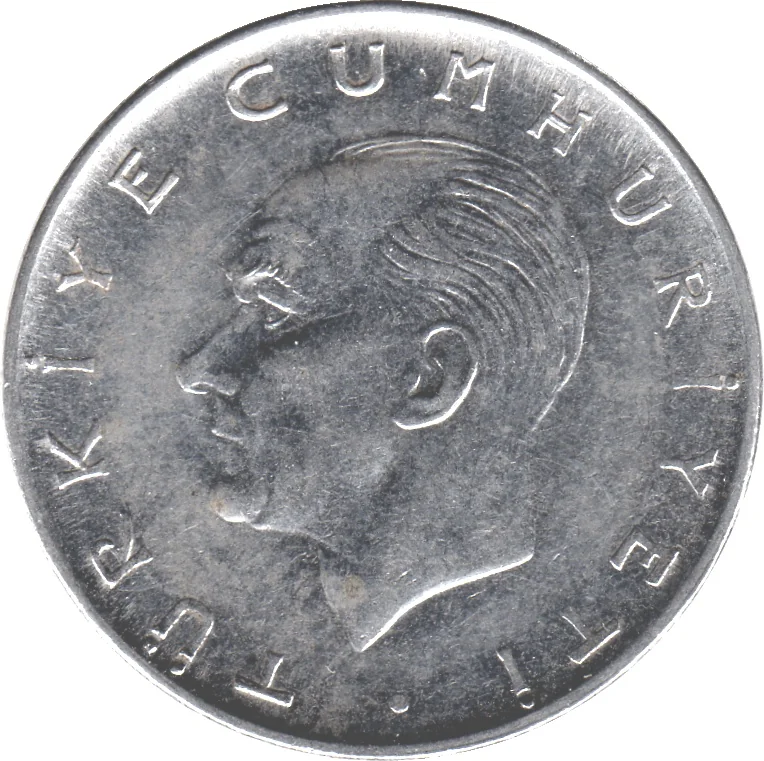
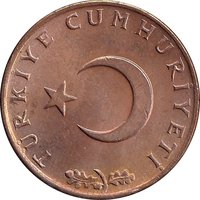
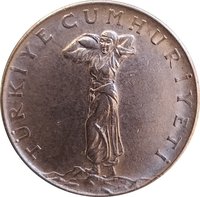
Obverse
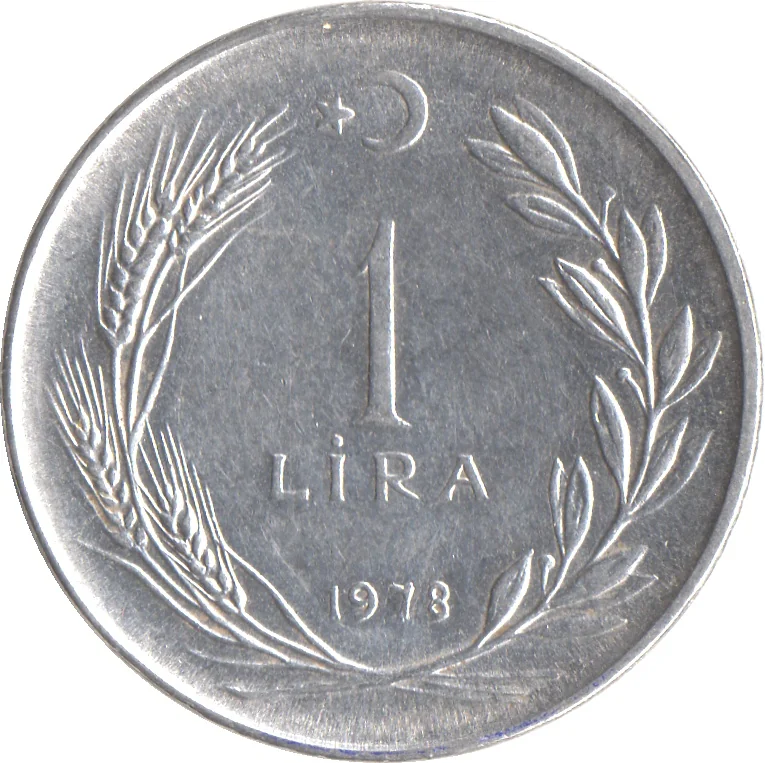
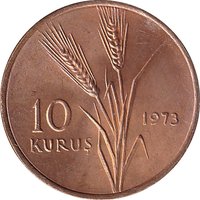
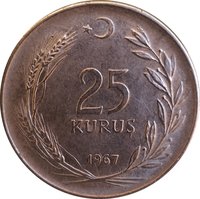
Reverse
Edge
Incuse pattern with inscription
Legend:
TÜRKİYE CUMHURİYETİ
Translation:
REPUBLIC OF TURKEY
Language: Turkish
Categories
| Person> Politician |
| Symbol> Wreath |
Mints
| Name | Mark |
|---|---|
| Turkish State Mint | — |
Mintings
| Year | Mint Mark | Mintage | Quality | Collection |
|---|---|---|---|---|
| 1959 | — | 7,452,000 | ||
| 1960 | — | 11,436,000 | ||
| 1961 | — | 2,100,000 | ||
| 1962 | — | 4,228,000 | ||
| 1963 | — | 4,316,000 | ||
| 1964 | — | 4,976,000 | ||
| 1965 | — | 5,348,000 | ||
| 1966 | — | 8,040,000 | ||
| 1967 | — | — | ||
| 1968 | — | 12,728,000 | ||
| 1969 | — | 6,612,000 | ||
| 1970 | — | 8,652,000 | ||
| 1971 | — | 10,504,000 | ||
| 1972 | — | 26,512,000 | ||
| 1973 | — | 12,596,000 | ||
| 1974 | — | 11,596,000 | ||
| 1975 | — | 20,348,000 | ||
| 1976 | — | 23,144,000 | ||
| 1977 | — | 30,244,000 | ||
| 1978 | — | 22,156,000 | ||
| 1979 | — | 9,289,000 | ||
| 1980 | — | 3,585,000 |
Historical background
In 1959, Turkey's currency situation was characterized by severe economic strain and a heavily controlled foreign exchange regime, operating under the shadow of a persistent balance of payments crisis. The Turkish lira, officially pegged at 2.80 to the US dollar since 1960 (a rate set just after this period), was fundamentally overvalued, maintained through strict state controls rather than market forces. This created a thriving black market for foreign currency, where the dollar traded at a significant premium, reflecting the true scarcity of hard currency and undermining official economic policies.
The root causes were structural: years of state-led industrialization under an import-substitution model, beginning in the early 1930s, had led to chronic trade deficits. By the late 1950s, the economy was plagued by high inflation, depleted foreign exchange reserves, and a heavy reliance on agricultural exports, which were vulnerable to price fluctuations. The Menderes government, facing mounting external debt and pressure from international creditors, was compelled to seek stabilization. This culminated in the 1958 devaluation and stabilization program, agreed with the OECD and IMF, which was the defining monetary event of the era, setting the stage for 1959's conditions.
Consequently, 1959 was a year of fragile transition under this new austerity program. The reforms had officially devalued the lira and unified multiple exchange rates, but the economy was still adjusting to the shock. Tight monetary policies and import restrictions were in effect to curb the deficit, leading to slowed growth and public discontent. The currency regime remained inflexible and dependent on external aid, with Turkey's economic sovereignty significantly constrained by its agreements with international institutions and creditor nations, a dependency that would shape its political and economic trajectory for decades to come.
The root causes were structural: years of state-led industrialization under an import-substitution model, beginning in the early 1930s, had led to chronic trade deficits. By the late 1950s, the economy was plagued by high inflation, depleted foreign exchange reserves, and a heavy reliance on agricultural exports, which were vulnerable to price fluctuations. The Menderes government, facing mounting external debt and pressure from international creditors, was compelled to seek stabilization. This culminated in the 1958 devaluation and stabilization program, agreed with the OECD and IMF, which was the defining monetary event of the era, setting the stage for 1959's conditions.
Consequently, 1959 was a year of fragile transition under this new austerity program. The reforms had officially devalued the lira and unified multiple exchange rates, but the economy was still adjusting to the shock. Tight monetary policies and import restrictions were in effect to curb the deficit, leading to slowed growth and public discontent. The currency regime remained inflexible and dependent on external aid, with Turkey's economic sovereignty significantly constrained by its agreements with international institutions and creditor nations, a dependency that would shape its political and economic trajectory for decades to come.
🌱 Very Common