

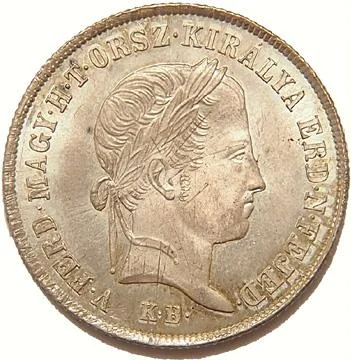
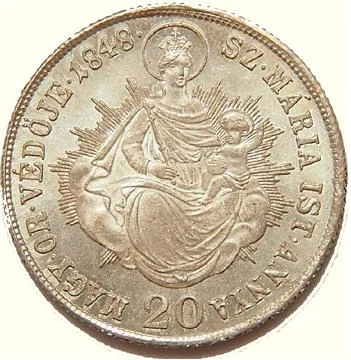
20 kreuzers – Hungary
Add to wishlist
Hungary
Context
Year: 1848
Issuer: Hungary
Period:
(1848—1849)
Ruler: Ferdinand V
Currency:
(1754—1857)
Demonetized: Yes
Material
References
KM: #
Numista: #28029
Value
Bullion value: $10.28
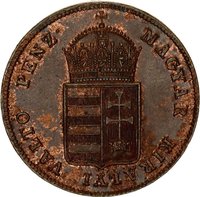
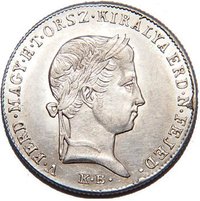
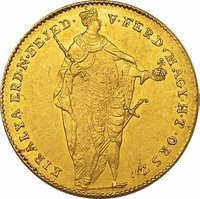
Obverse
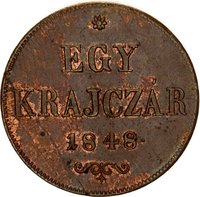
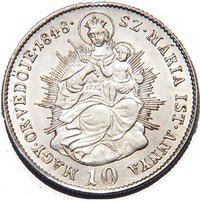
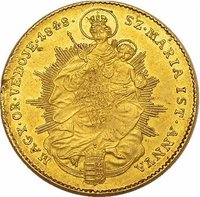
Reverse
Edge
Reeded
Mints
| Name | Mark |
|---|---|
| Kremnica | K B |
Mintings
| Year | Mint Mark | Mintage | Quality | Collection |
|---|---|---|---|---|
| 1848 | K. | — |
Historical background
In 1848, Hungary's currency situation was intrinsically tied to its political struggle within the Habsburg Empire. The Hungarian Revolution of March 1848 sought independence and established its own government, which immediately faced the colossal task of funding a national army and state apparatus. The financial foundation remained the Austrian guilder (or florin), the empire's common currency, but the revolutionary Hungarian government, led by Lajos Kossuth, quickly began issuing its own paper money to cover wartime expenditures.
These emergency banknotes, known as "Kossuth bankók" (Kossuth banknotes), became the symbolic and practical currency of the revolution. Printed in denominations from 1 to 100 florins and bearing Kossuth's signature, they were essentially a form of war financing not backed by silver or gold reserves but by the promise of the future, independent Hungarian state. Their value was thus directly linked to the military and political fortunes of the revolution, leading to rapid depreciation as the conflict intensified.
Ultimately, the currency's fate mirrored that of the revolution itself. Following the defeat of Hungarian forces in 1849, with Russian intervention aiding the Habsburgs, the revolutionary government was dissolved. The "Kossuth bankók" were declared invalid by the victorious Austrian authorities, rendering them worthless and leaving many who held them with significant losses. This episode highlighted the profound connection between monetary sovereignty and political independence, a lesson deeply etched into Hungary's national consciousness.
These emergency banknotes, known as "Kossuth bankók" (Kossuth banknotes), became the symbolic and practical currency of the revolution. Printed in denominations from 1 to 100 florins and bearing Kossuth's signature, they were essentially a form of war financing not backed by silver or gold reserves but by the promise of the future, independent Hungarian state. Their value was thus directly linked to the military and political fortunes of the revolution, leading to rapid depreciation as the conflict intensified.
Ultimately, the currency's fate mirrored that of the revolution itself. Following the defeat of Hungarian forces in 1849, with Russian intervention aiding the Habsburgs, the revolutionary government was dissolved. The "Kossuth bankók" were declared invalid by the victorious Austrian authorities, rendering them worthless and leaving many who held them with significant losses. This episode highlighted the profound connection between monetary sovereignty and political independence, a lesson deeply etched into Hungary's national consciousness.
Series: 1848 Hungary circulation coins
🌟 Limited