

1 Gersh – Ethiopian Empire
Ethiopia
Context
Year: 1897
Ethiopian Year: 1889
Country: Ethiopia 
Issuer: Ethiopian Empire
Ruler: Menelik II
Currency:
(1893—1931)
Demonetized: Yes
Material
References
KM: #Click to copy to clipboard13
Numista: #279974
Value
Bullion value: $3.39
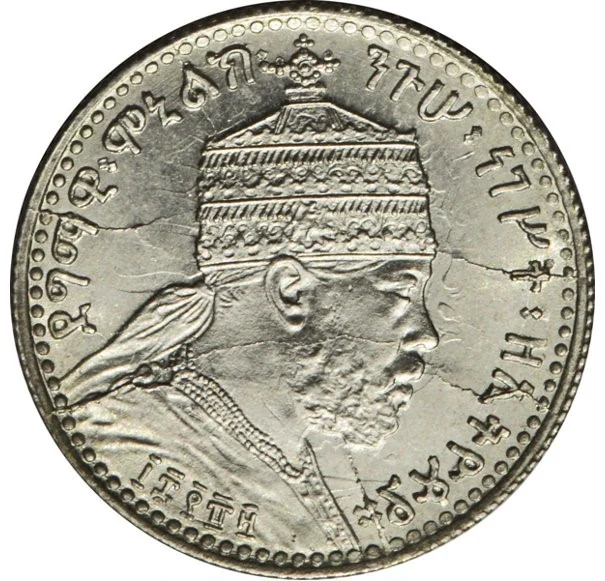
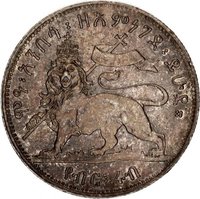
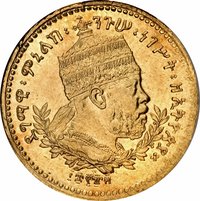
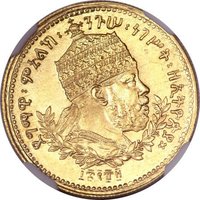
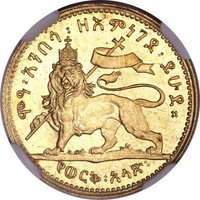
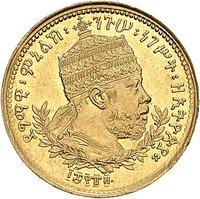
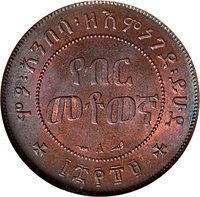
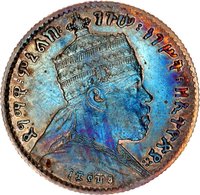
Obverse
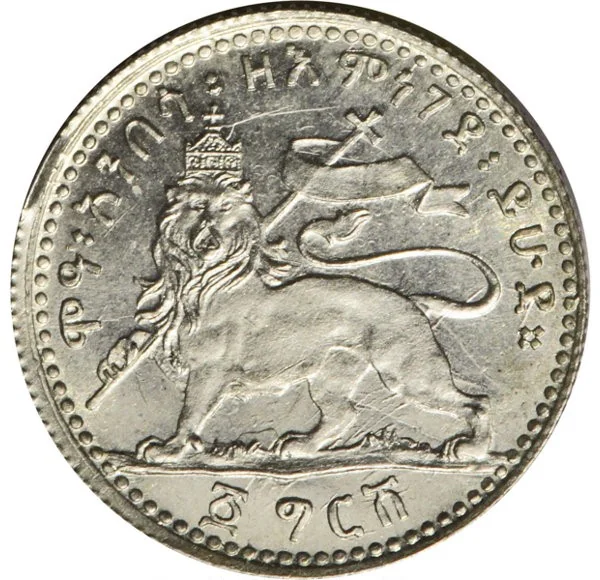
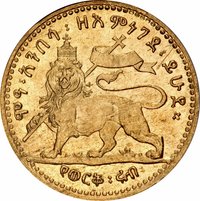
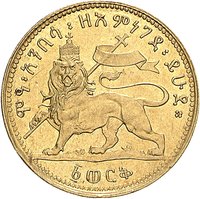
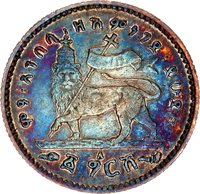
Reverse
Edge
Mints
| Name | Mark |
|---|---|
| Monnaie de Paris | — |
Mintings
| Year | Mint Mark | Mintage | Quality | Collection |
|---|---|---|---|---|
| 1897 | — | — |
Historical background
In 1897, the Ethiopian Empire under Emperor Menelik II was in a period of significant monetary transition and assertion of sovereignty. The traditional currency system was a complex mix of commodity money, primarily the Maria Theresa thaler (MTT), a large silver coin minted in Austria, and salt bars (amole). The MTT, first introduced in the 18th century, had become the dominant medium for large transactions and foreign trade, but its supply was controlled by European powers and its circulation was inconsistent, causing economic instability.
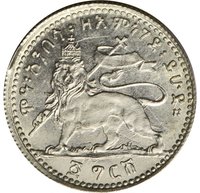
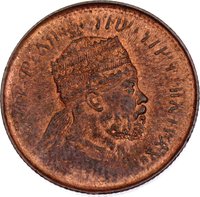
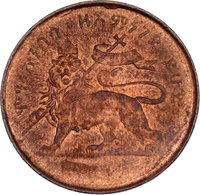
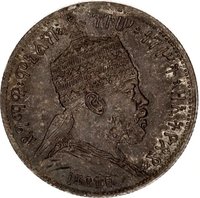
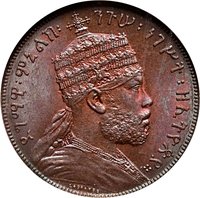
Seeking to modernize the state and reduce external dependence, Menelik II took decisive steps toward establishing a national currency. In 1894, he had obtained minting machinery from Europe, and by 1897, the first Ethiopian coins—silver talari (equivalent to the MTT), gold werk, and copper besa—were being produced at the new mint in Harar. This year was a critical point of implementation, as these new coins, bearing Menelik's likeness and Amharic inscriptions, began to circulate alongside the older MTT, symbolizing a powerful move toward economic self-determination and centralized authority.
However, the transition in 1897 was gradual and faced challenges. Public trust in the familiar MTT remained strong, and the new coinage had not yet fully displaced the old system, especially in remote regions. Furthermore, Ethiopia's engagement in international trade, particularly through the construction of the Addis Ababa-Djibouti railway, required dealing in foreign currencies. Thus, the monetary landscape of 1897 was one of duality, characterized by Emperor Menelik's successful introduction of a sovereign coinage system operating within a still-partially dollarized and traditional economy.
Seeking to modernize the state and reduce external dependence, Menelik II took decisive steps toward establishing a national currency. In 1894, he had obtained minting machinery from Europe, and by 1897, the first Ethiopian coins—silver talari (equivalent to the MTT), gold werk, and copper besa—were being produced at the new mint in Harar. This year was a critical point of implementation, as these new coins, bearing Menelik's likeness and Amharic inscriptions, began to circulate alongside the older MTT, symbolizing a powerful move toward economic self-determination and centralized authority.
However, the transition in 1897 was gradual and faced challenges. Public trust in the familiar MTT remained strong, and the new coinage had not yet fully displaced the old system, especially in remote regions. Furthermore, Ethiopia's engagement in international trade, particularly through the construction of the Addis Ababa-Djibouti railway, required dealing in foreign currencies. Thus, the monetary landscape of 1897 was one of duality, characterized by Emperor Menelik's successful introduction of a sovereign coinage system operating within a still-partially dollarized and traditional economy.
⭐ Rare