

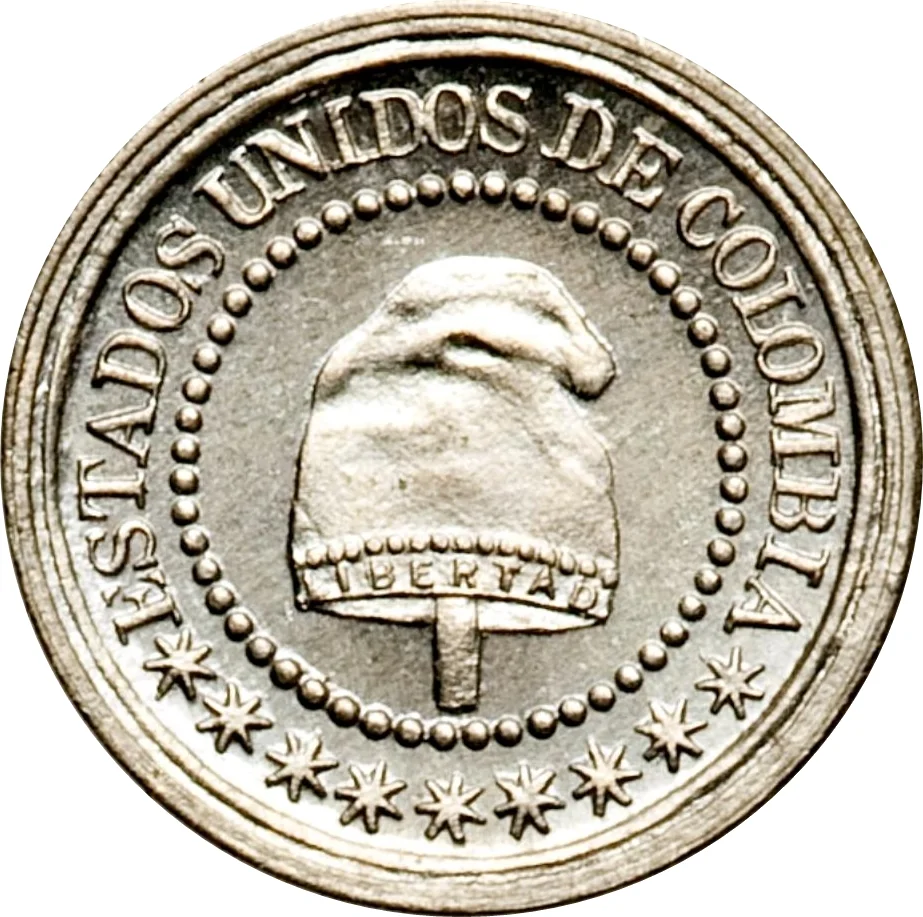
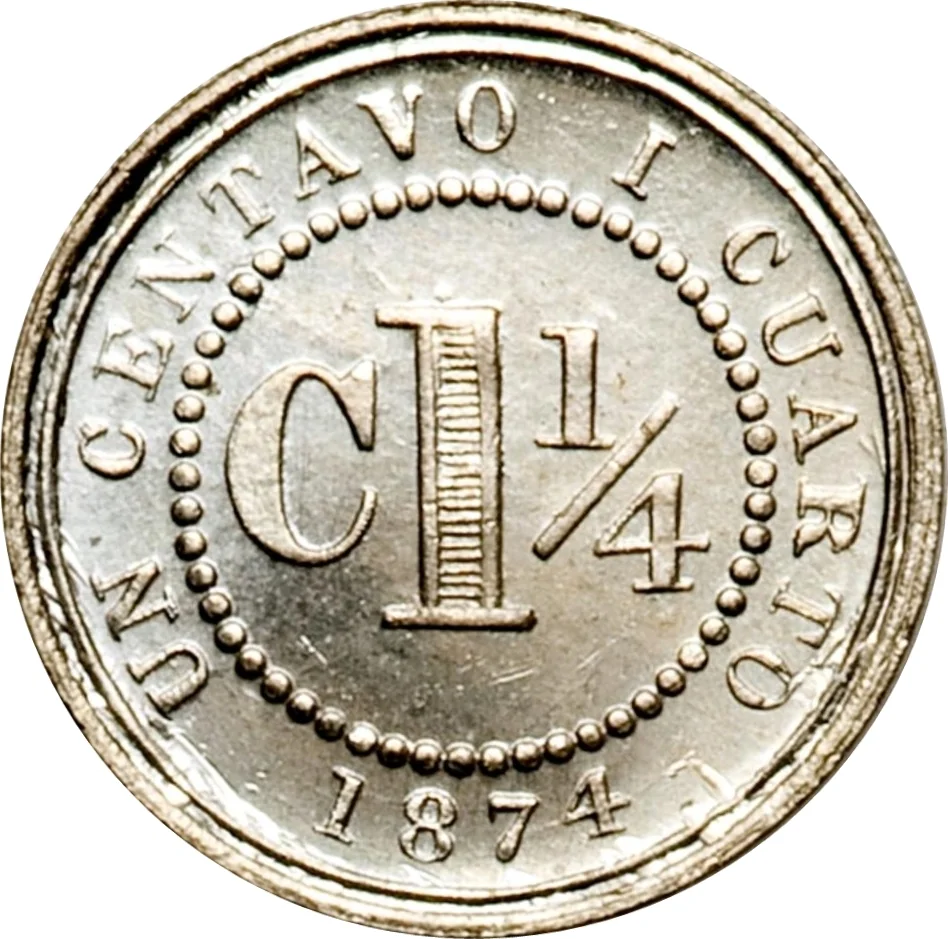
1¼ centavo – Colombia
Add to wishlist
Colombia
Context
Year: 1874
Issuer: Colombia
Period:
(1863—1886)
Currency:
(since 1847)
Demonetized: Yes
Total mintage: 2,400,000
Material
Diameter: 12 mm
Weight: 1.45 g
Thickness: 1.6 mm
Shape: Round
Composition: Copper-nickel
Technique: Milled
Alignment: Coin alignment
flip
References
KM: #
Numista: #27940
Value
Exchange value: 0.0125 COP
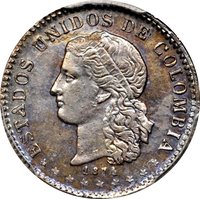
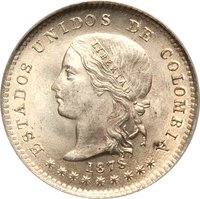
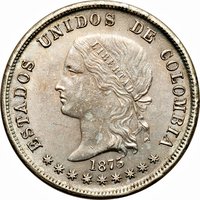
Obverse
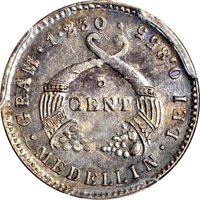
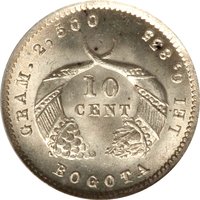
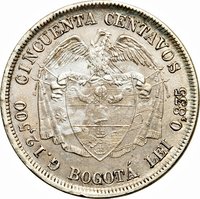
Reverse
Edge
Plain
Categories
| Symbol> Phrygian cap |
Mintings
| Year | Mint Mark | Mintage | Quality | Collection |
|---|---|---|---|---|
| 1874 | — | 2,400,000 | ||
| 1874 | — | — | Proof |
Historical background
In 1874, Colombia, then known as the United States of Colombia under the federalist constitution of 1863, was grappling with a complex and chaotic monetary landscape. The period was characterized by the coexistence of multiple, often depreciated, currencies. The national government issued paper money (billetes), but its value was unstable and not universally trusted. More significantly, the nine sovereign states within the federation exercised their own monetary powers, issuing a plethora of state banknotes, coins, and even private script. This resulted in a bewildering variety of circulating media, with values that fluctuated wildly from region to region, severely hindering national commerce and integration.
The root of this instability lay in the fiscal weakness of the central government and the liberal economic principles of the era, which championed radical decentralization and free banking. Without a strong central bank or uniform monetary policy, control over currency was dispersed, leading to frequent over-issuance to cover state budget deficits. Consequently, much of this paper money traded at a steep discount to its face value, and gold and silver coins, which held intrinsic value, were hoarded, exacerbating the scarcity of sound money. The situation created a climate of uncertainty for merchants and foreign investors, as transactions required constant negotiation over exchange rates between different forms of money.
This fragmented system was widely recognized as a major obstacle to economic progress. By 1874, calls for monetary reform and unification were growing, driven by merchants and intellectuals who argued for a strong, centralized currency to foster a true national market. The debates of this period set the stage for the eventual monetary reforms that would come later in the 1880s, following the Regeneration movement led by Rafael Núñez, which would end the federal era and re-establish a stronger central authority with exclusive power over currency issuance.
The root of this instability lay in the fiscal weakness of the central government and the liberal economic principles of the era, which championed radical decentralization and free banking. Without a strong central bank or uniform monetary policy, control over currency was dispersed, leading to frequent over-issuance to cover state budget deficits. Consequently, much of this paper money traded at a steep discount to its face value, and gold and silver coins, which held intrinsic value, were hoarded, exacerbating the scarcity of sound money. The situation created a climate of uncertainty for merchants and foreign investors, as transactions required constant negotiation over exchange rates between different forms of money.
This fragmented system was widely recognized as a major obstacle to economic progress. By 1874, calls for monetary reform and unification were growing, driven by merchants and intellectuals who argued for a strong, centralized currency to foster a true national market. The debates of this period set the stage for the eventual monetary reforms that would come later in the 1880s, following the Regeneration movement led by Rafael Núñez, which would end the federal era and re-establish a stronger central authority with exclusive power over currency issuance.
Series: 1874 Colombia circulation coins
⭐ Somewhat Rare