

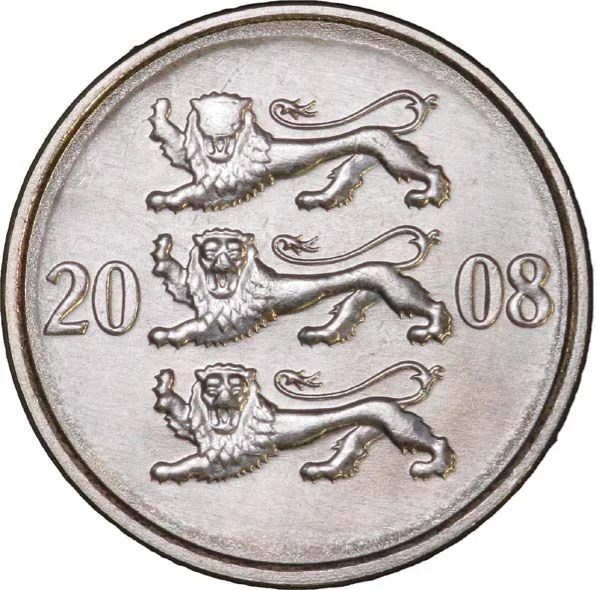
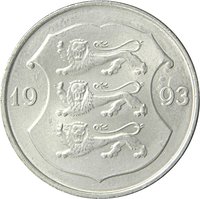
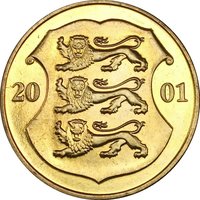
Obverse
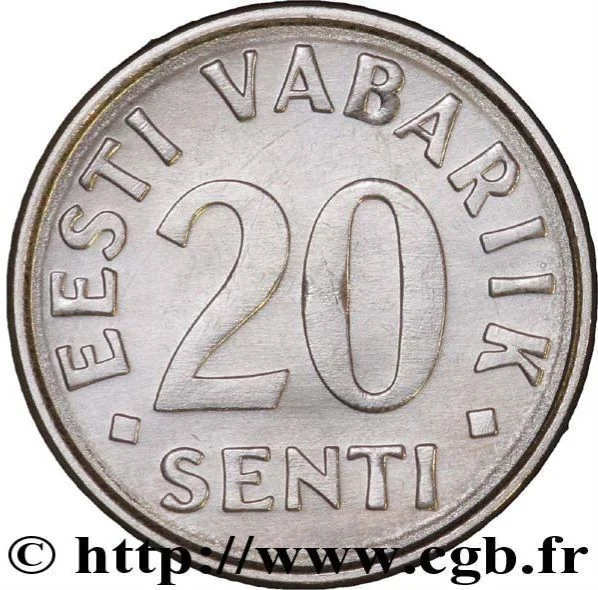
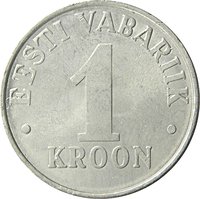
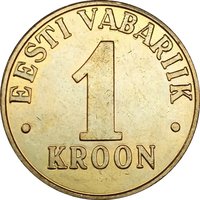
Reverse
Edge
Plain
Mintings
| Year | Mint Mark | Mintage | Quality | Collection |
|---|---|---|---|---|
| 1997 | — | 10,500,000 | ||
| 1999 | — | 20,330,000 | ||
| 2003 | — | — | ||
| 2004 | — | 20,000,000 | ||
| 2006 | — | 2,000,000 | ||
| 2008 | — | 12,000,000 |
Historical background
In 1997, Estonia was in the midst of a period of remarkable economic stability and growth, firmly anchored by its currency board arrangement. The Estonian kroon (EEK) had been introduced in 1992, pegged at a fixed rate of 8 krooni to 1 Deutsche Mark. This strict currency board system mandated that every kroon in circulation be fully backed by foreign reserves, primarily German marks, which eliminated discretionary monetary policy for the central bank but provided immense credibility. This discipline had successfully tamed the hyperinflation of the early transition period and was a cornerstone of Estonia's rapid economic reforms and integration with the West.
The year 1997 saw the benefits of this hard currency regime fully materialize. Inflation had fallen to a single-digit annual rate (around 11%, down from over 1000% earlier in the decade), and the economy was booming with GDP growth exceeding 10%. The fixed peg provided a stable environment for foreign direct investment and trade, crucial for a small, open economy. However, it also meant Estonia imported the monetary policy of the German Bundesbank, and later the European Central Bank, which led to relatively high real interest rates. This contributed to a growing current account deficit, a point of concern for some observers, though it was largely viewed as a symptom of successful convergence and investment-led growth.
The broader context of 1997 was Estonia's determined push toward European integration. The country was actively harmonizing its laws and economy with the European Union, having formally applied for membership in 1995. The kroon's peg to the Deutsche Mark was not just a tool for domestic stability but a strategic anchor aligning Estonia with the core of the future Eurozone. Discussions about ultimately adopting the euro were already part of the long-term policy vision, making the stable performance of the currency board in 1997 a critical step in demonstrating the country's readiness for deeper European economic and monetary union.
The year 1997 saw the benefits of this hard currency regime fully materialize. Inflation had fallen to a single-digit annual rate (around 11%, down from over 1000% earlier in the decade), and the economy was booming with GDP growth exceeding 10%. The fixed peg provided a stable environment for foreign direct investment and trade, crucial for a small, open economy. However, it also meant Estonia imported the monetary policy of the German Bundesbank, and later the European Central Bank, which led to relatively high real interest rates. This contributed to a growing current account deficit, a point of concern for some observers, though it was largely viewed as a symptom of successful convergence and investment-led growth.
The broader context of 1997 was Estonia's determined push toward European integration. The country was actively harmonizing its laws and economy with the European Union, having formally applied for membership in 1995. The kroon's peg to the Deutsche Mark was not just a tool for domestic stability but a strategic anchor aligning Estonia with the core of the future Eurozone. Discussions about ultimately adopting the euro were already part of the long-term policy vision, making the stable performance of the currency board in 1997 a critical step in demonstrating the country's readiness for deeper European economic and monetary union.
🌱 Very Common