

5 krooni (Estonian National Bank) – Estonia
Add to wishlist
Circulating commemorative coins
Commemoration: 75th Anniversary of Estonian National Bank
Estonia
Context
Material
References
KM: #
Numista: #2781
Value
Exchange value: 5 EEK
Inflation-adjusted value: 39.51 EEK
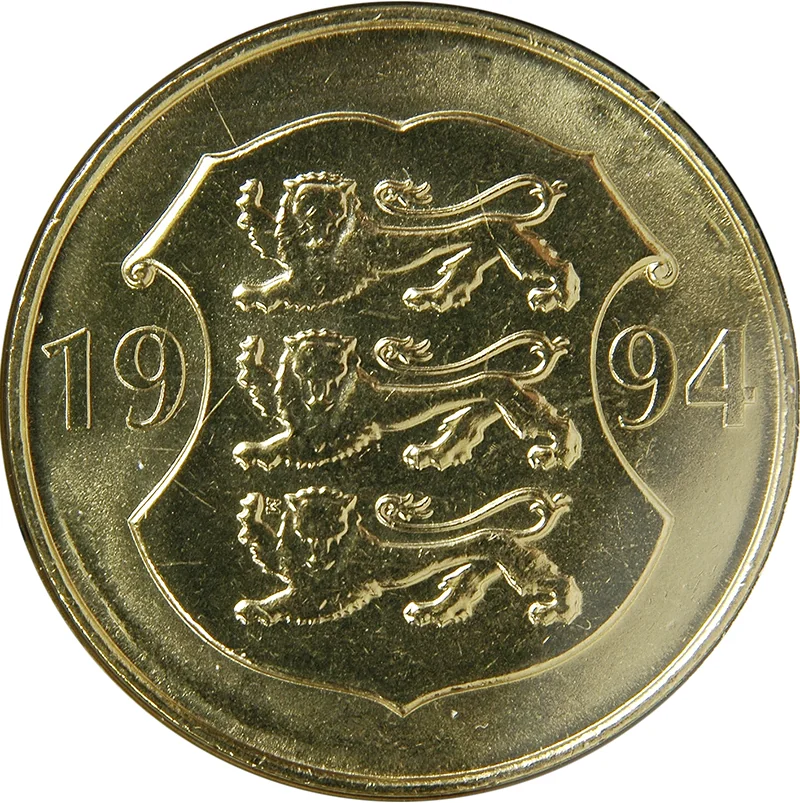
Obverse
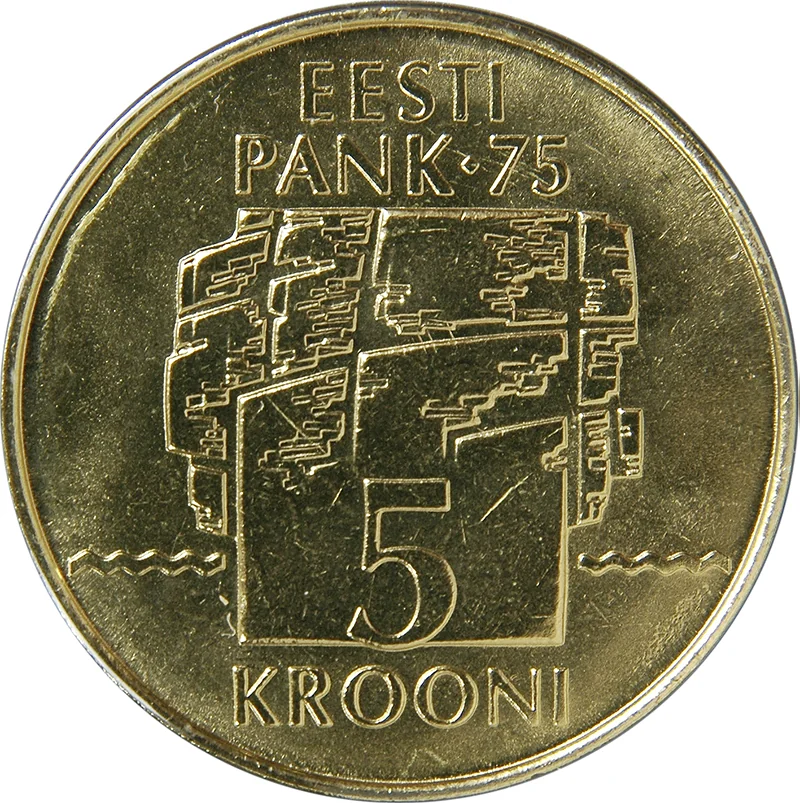
Reverse
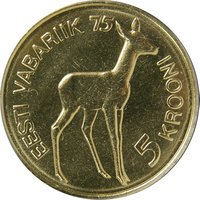
Description:
Denomination design.
Inscription:
EESTI
PANK 75
5
KROONI
PANK 75
5
KROONI
Translation:
Estonian Bank 75
5
Krooni
5
Krooni
Script: Latin
Language: Estonian
Engraver: M. Kadarik
Edge
Plain
Mints
| Name | Mark |
|---|---|
| RE Juveel / OÜ Juveliir / Riigiettevõte Juveel | M |
Mintings
| Year | Mint Mark | Mintage | Quality | Collection |
|---|---|---|---|---|
| 1994 | M | 10,180,000 |
Historical background
In 1994, Estonia was navigating the complex aftermath of the Soviet Union's collapse, having restored its independence in 1991. The country was in the midst of profound economic transformation, moving from a centrally planned system to a market economy. A critical step in this process was the establishment of a stable and credible national currency to replace the temporary Russian ruble, which was suffering from high inflation and instability across the former Soviet space. This was deemed essential for controlling inflation, attracting foreign investment, and facilitating Estonia's integration into the Western economic sphere.
The cornerstone of Estonia's monetary reform was the introduction of the kroon (EEK) on June 20, 1992, which replaced the Russian ruble at a rate of 1 kroon to 10 rubles. Crucially, the new currency was not floating; it was pegged through a currency board arrangement to the Deutsche Mark (DEM) at a fixed rate of 8 krooni to 1 DEM. This rigid peg, which required full foreign exchange reserves to back the monetary base, was a deliberate policy to import the monetary stability and anti-inflation credibility of Germany's Bundesbank. By 1994, this system was firmly in place and had successfully tamed hyperinflation, bringing price stability and creating a predictable environment for economic activity.
Consequently, by 1994, Estonia's currency situation was characterized by remarkable stability and growing confidence. The currency board functioned as intended, eliminating discretionary monetary policy and firmly anchoring the kroon to the strong Deutsche Mark. This stability fostered significant economic reforms and helped attract foreign direct investment, setting the stage for the "Estonian Tiger" economic boom later in the decade. The fixed peg became a symbol of fiscal and monetary discipline, forming the bedrock of Estonia's economic policy as it steadily oriented itself toward eventual European Union and Eurozone membership.
The cornerstone of Estonia's monetary reform was the introduction of the kroon (EEK) on June 20, 1992, which replaced the Russian ruble at a rate of 1 kroon to 10 rubles. Crucially, the new currency was not floating; it was pegged through a currency board arrangement to the Deutsche Mark (DEM) at a fixed rate of 8 krooni to 1 DEM. This rigid peg, which required full foreign exchange reserves to back the monetary base, was a deliberate policy to import the monetary stability and anti-inflation credibility of Germany's Bundesbank. By 1994, this system was firmly in place and had successfully tamed hyperinflation, bringing price stability and creating a predictable environment for economic activity.
Consequently, by 1994, Estonia's currency situation was characterized by remarkable stability and growing confidence. The currency board functioned as intended, eliminating discretionary monetary policy and firmly anchoring the kroon to the strong Deutsche Mark. This stability fostered significant economic reforms and helped attract foreign direct investment, setting the stage for the "Estonian Tiger" economic boom later in the decade. The fixed peg became a symbol of fiscal and monetary discipline, forming the bedrock of Estonia's economic policy as it steadily oriented itself toward eventual European Union and Eurozone membership.
🌱 Very Common