

25 bani – Romania
Add to wishlist
Romania
Context
Year: 1952
Issuer: Romania
Period:
(1947—1965)
Currency:
(1952—2005)
Demonetization: 31 December 1996
Total mintage: 43,600,000
Material
Diameter: 22 mm
Weight: 3.6 g
Thickness: 1.25 mm
Shape: Round
Composition: Copper-nickel
Technique: Milled
Alignment: Coin alignment

flip
References
KM: #
Numista: #133872
Value
Exchange value: 0.25 ROL
Obverse
Description:
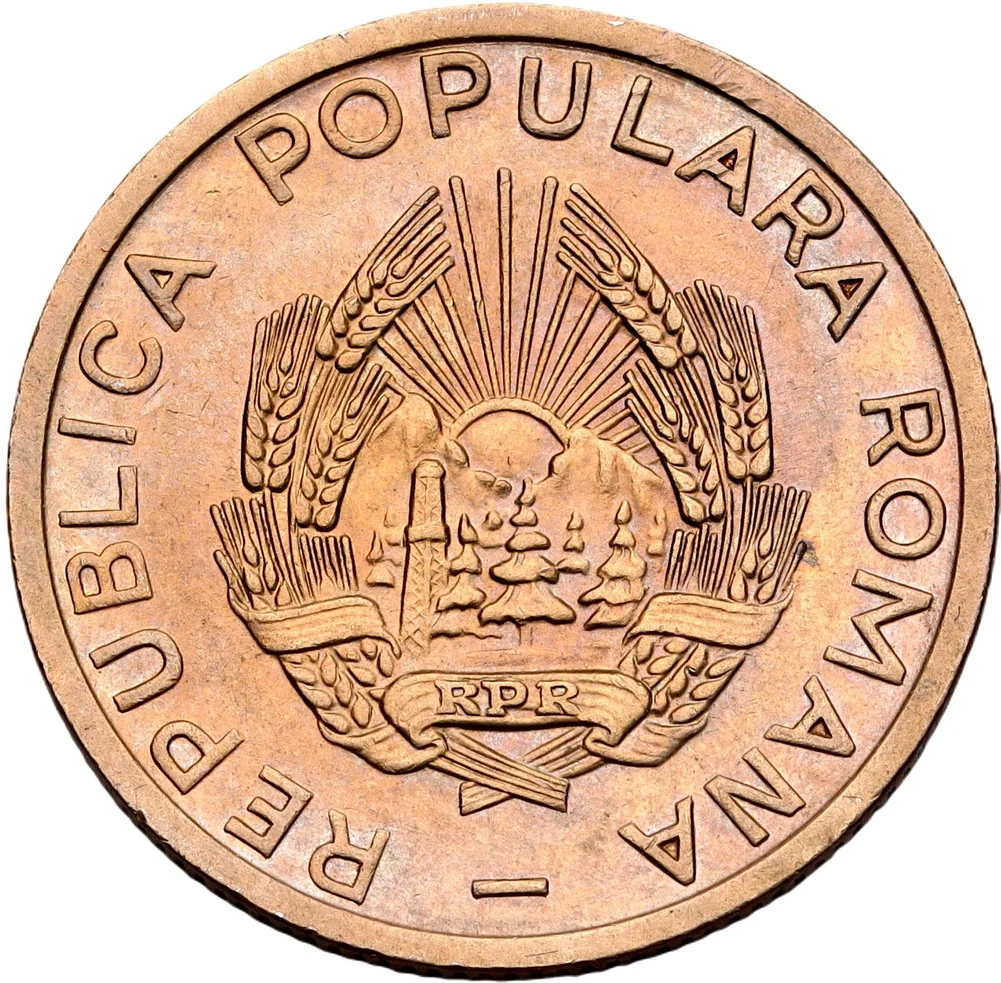
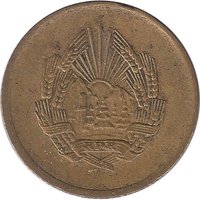
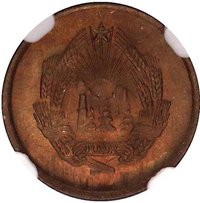
State emblem with star (KM#85.2, KM#85.3) or without (KM#85.1). Country name uses old spelling "ROMANA" (KM#85.1, KM#85.2) or new spelling "ROMÎNIA" (KM#85.3).
Inscription:
REPUBLICA POPULARA ROMINA
RPR
RPR
Translation:
ROMANIAN PEOPLE'S REPUBLIC
RPR
RPR
Script: Latin
Language: Romanian
Engraver: Haralambie Ionescu
Reverse
Description:
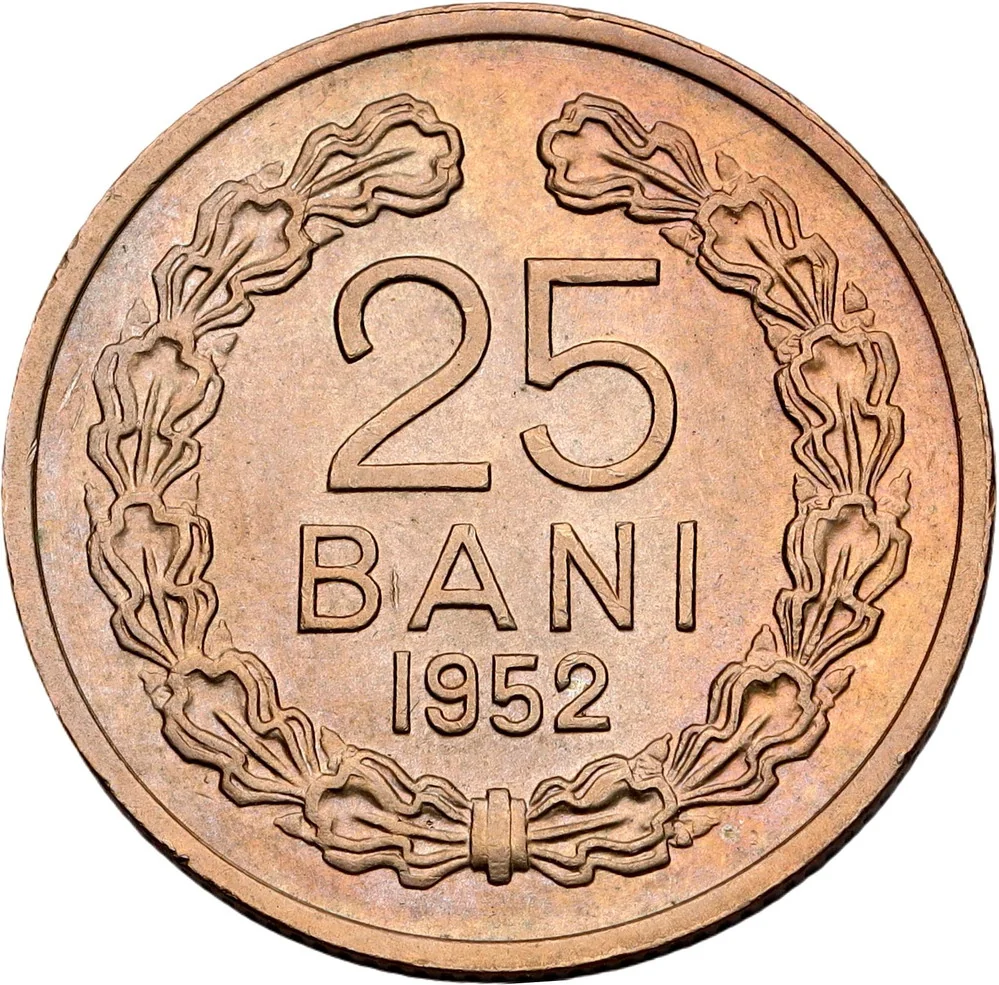
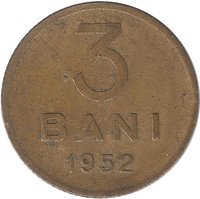
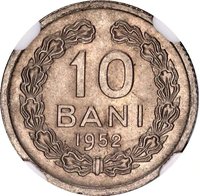
Value and date encircled.
Inscription:
25
BANI
1952
BANI
1952
Script: Latin
Engraver: Haralambie Ionescu
Edge
Reeded
Mints
| Name | Mark |
|---|---|
| State Mint | — |
Mintings
| Year | Mint Mark | Mintage | Quality | Collection |
|---|---|---|---|---|
| 1952 | — | 43,600,000 |
Historical background
In 1952, Romania underwent a drastic and coercive currency reform as part of the Stalinist consolidation of power by the Romanian Workers' Party. The regime, led by Gheorghe Gheorghiu-Dej, sought to solidify its control over the economy, wipe out private savings, and curb the black market that had persisted since the post-war period. The reform, announced suddenly on January 28, 1952, was presented as a measure to stabilize the currency and align it with the Soviet ruble, but its true purpose was deeply political and punitive.
The mechanics of the reform were severe and discriminatory. Old lei were exchanged for new ones at wildly varying rates designed to strip wealth from certain groups. While small sums were converted at a rate of 100 old lei to 1 new leu, larger holdings—deemed the savings of the former bourgeoisie, entrepreneurs, and peasants resisting collectivization—were exchanged at rates of 200:1, 400:1, or even 800:1. In essence, the state confiscated the vast majority of private monetary assets overnight. Simultaneously, wages and prices were redenominated at the more favorable 100:1 rate, causing immense hardship for those with savings while theoretically protecting current state-dictated incomes.
The 1952 reform achieved its political goals, effectively destroying the remaining economic independence of the middle classes and transferring all financial power to the state. It forced the population into complete dependence on the state-controlled economy and marked a final step in the elimination of the market economy. The trauma of this confiscatory measure lingered for decades, eroding public trust in the national currency and in the communist regime's promises, creating a lasting collective memory of financial insecurity.
The mechanics of the reform were severe and discriminatory. Old lei were exchanged for new ones at wildly varying rates designed to strip wealth from certain groups. While small sums were converted at a rate of 100 old lei to 1 new leu, larger holdings—deemed the savings of the former bourgeoisie, entrepreneurs, and peasants resisting collectivization—were exchanged at rates of 200:1, 400:1, or even 800:1. In essence, the state confiscated the vast majority of private monetary assets overnight. Simultaneously, wages and prices were redenominated at the more favorable 100:1 rate, causing immense hardship for those with savings while theoretically protecting current state-dictated incomes.
The 1952 reform achieved its political goals, effectively destroying the remaining economic independence of the middle classes and transferring all financial power to the state. It forced the population into complete dependence on the state-controlled economy and marked a final step in the elimination of the market economy. The trauma of this confiscatory measure lingered for decades, eroding public trust in the national currency and in the communist regime's promises, creating a lasting collective memory of financial insecurity.




🌱 Common