

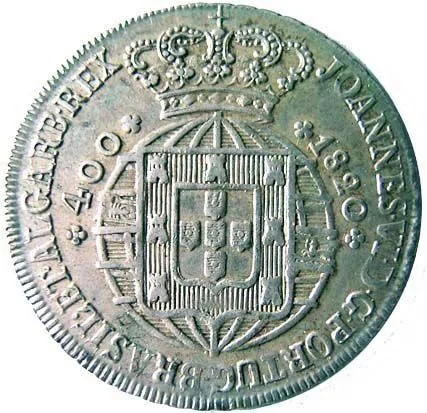
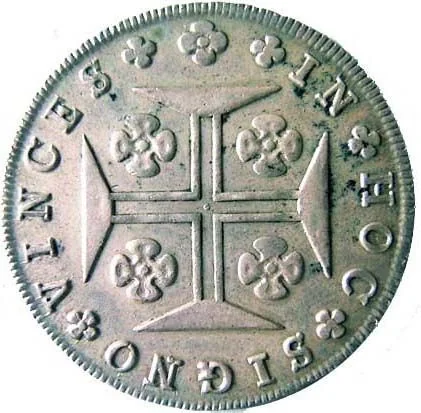
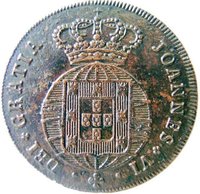
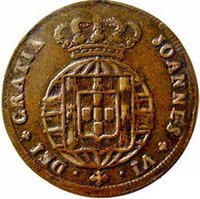
Obverse
Description:
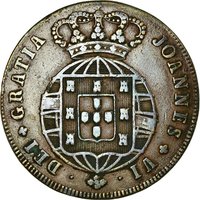
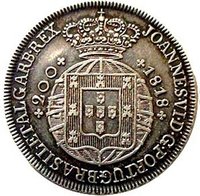
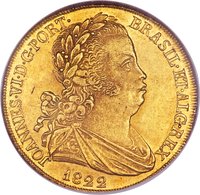
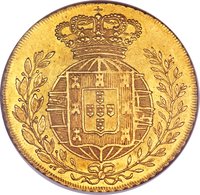
Portuguese coat of arms on a crowned armillary sphere, flanked by value and year, with peripheral Latin legends.
Inscription:
JOANNES VI D G PORTUG BRASIL ET ALGARB REX
*400* / *1822*
*400* / *1822*
Translation:
John VI, by the Grace of God, King of Portugal, Brazil, and the Algarves
*400* / *1822*
*400* / *1822*
Script: Latin
Languages: Latin, Portuguese
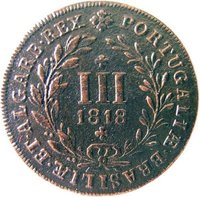
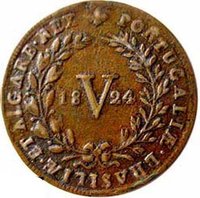
Reverse
Edge
Rope shaped
Mints
| Name | Mark |
|---|---|
| Imprensa Nacional - Casa da Moeda | — |
Mintings
| Year | Mint Mark | Mintage | Quality | Collection |
|---|---|---|---|---|
| 1818 | — | 2,337,338 | ||
| 1819 | — | 1,432,360 | ||
| 1820 | — | 1,844,793 | ||
| 1821 | — | 1,936,864 | ||
| 1822 | — | 566,659 | ||
| 1823 | — | 667,087 | ||
| 1825 | — | 28,471 |
Historical background
In 1818, Portugal’s currency situation was complex and unstable, deeply entangled with the political and economic turmoil of the preceding decades. The country was still recovering from the Peninsular War (1807-1814) and the French occupation, which had devastated the economy and disrupted trade. Furthermore, the royal court’s exile in Brazil from 1807 to 1821 had shifted the empire's financial center to Rio de Janeiro, leading to a drain of metallic currency (gold and silver) from Portugal to its colony. The circulating medium within Portugal itself was a chaotic mix of older Portuguese coins, foreign currency (particularly British), and increasingly depreciated paper money.
The core of the problem lay with the real (plural: réis), the long-standing unit of account, and the severe shortage of physical specie. To finance the war and government operations, the Regency had authorized the issuance of paper notes by the Banco de Lisboa (founded 1821, but plans were underway). However, these notes were not fully convertible and circulated at a significant discount to their face value in metal. This created a dual system where transactions in gold or silver commanded a premium, while most commerce relied on depreciating paper, causing price inflation and public distrust.
This monetary instability reflected a broader fiscal crisis. The state was burdened with enormous debt from the war and faced declining revenues from traditional sources. The situation would not improve until after the liberal revolution of 1820 and the subsequent return of King João VI in 1821, which initiated attempts at financial reform. However, in 1818, Portugal remained in a period of monetary confusion, with its currency system weakened by a lack of specie, reliance on unstable paper, and the overarching political uncertainty of a kingdom divided between Lisbon and Rio de Janeiro.
The core of the problem lay with the real (plural: réis), the long-standing unit of account, and the severe shortage of physical specie. To finance the war and government operations, the Regency had authorized the issuance of paper notes by the Banco de Lisboa (founded 1821, but plans were underway). However, these notes were not fully convertible and circulated at a significant discount to their face value in metal. This created a dual system where transactions in gold or silver commanded a premium, while most commerce relied on depreciating paper, causing price inflation and public distrust.
This monetary instability reflected a broader fiscal crisis. The state was burdened with enormous debt from the war and faced declining revenues from traditional sources. The situation would not improve until after the liberal revolution of 1820 and the subsequent return of King João VI in 1821, which initiated attempts at financial reform. However, in 1818, Portugal remained in a period of monetary confusion, with its currency system weakened by a lack of specie, reliance on unstable paper, and the overarching political uncertainty of a kingdom divided between Lisbon and Rio de Janeiro.
Series: 1818 Portugal circulation coins
⭐ Rare