

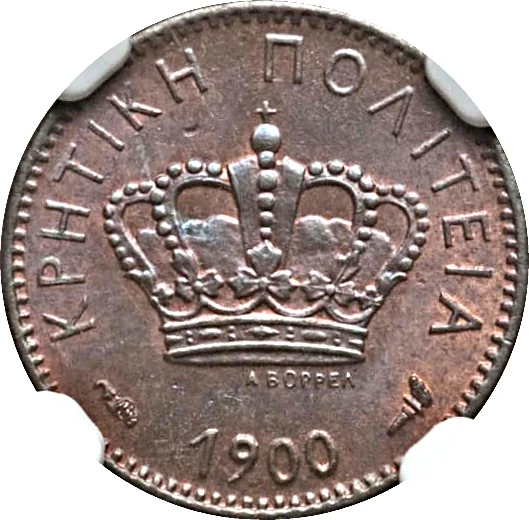
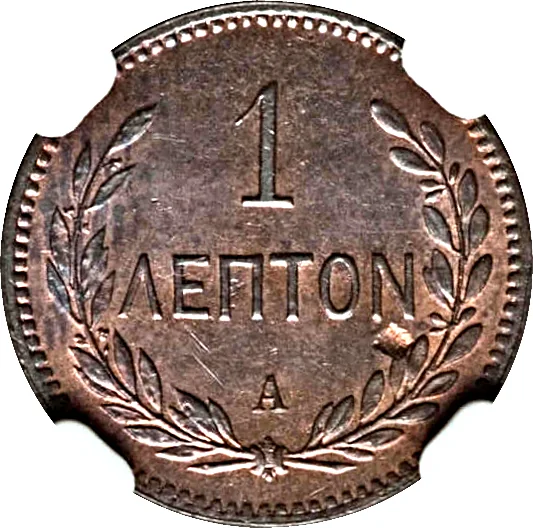
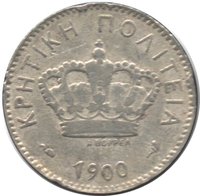
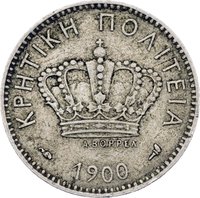
Obverse
Description:
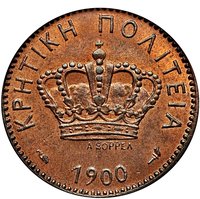
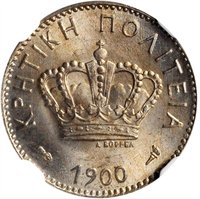
Crown above designer's name in Greek, date and privy mark below.
Inscription:
ΚΡΗΤΙΚΗ ΠΟΛΙΤΕΙΑ
1900
Α ΒΟΡΡΕΛ
1900
Α ΒΟΡΡΕΛ
Translation:
CRETAN STATE
1900
A BORREL
1900
A BORREL
Script: Greek
Language: Greek
Engraver: Henri-Auguste Patey
Designer: Alfred Borrel
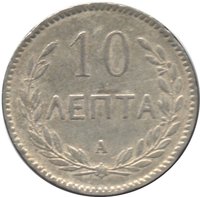
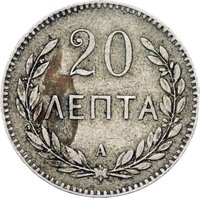
Reverse
Description:
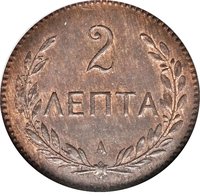
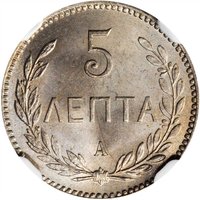
Value mark framed by olive and laurel branches.
Inscription:
1
ΛΕΠΤΟΝ
A
ΛΕΠΤΟΝ
A
Translation:
Lepton
Script: Greek
Language: Greek
Engraver: Henri-Auguste Patey
Designer: Alfred Borrel
Edge
Plain
Mints
| Name | Mark |
|---|---|
| Monnaie de Paris | (A) |
Mintings
| Year | Mint Mark | Mintage | Quality | Collection |
|---|---|---|---|---|
| 1900 | A | 289,283 | ||
| 1901 | A | 1,710,717 |
Historical background
In 1900, Crete existed in a state of complex political and monetary limbo. Following the violent Cretan Revolt of 1897 against Ottoman rule, the Great Powers (Britain, France, Russia, and Italy) had established an autonomous Cretan State under the nominal suzerainty of the Ottoman Sultan. The island was administered by an international commission and governed by High Commissioner Prince George of Greece, creating a de facto protectorate. This unstable autonomy meant Crete was not fully integrated into either the Ottoman monetary system or that of the Kingdom of Greece, leading to a chaotic and multi-currency environment in daily commerce.
Consequently, the currency situation on the island was a fragmented reflection of its political reality. Multiple currencies circulated simultaneously: the Ottoman gold lira and kuruş, the Greek drachma, and various European coins, particularly the French gold 20-franc piece and British sovereigns. This created significant practical difficulties for trade and taxation, as exchange rates fluctuated and the values of coins were often assessed by weight and metal content rather than face value. The lack of a unified, authoritative currency hindered economic development and was a constant reminder of the island's unresolved national status.
This monetary disarray persisted until a pivotal reform in 1900, when the Cretan Assembly, under Prince George, voted to adopt the Greek drachma as the official currency of Crete. This was a profoundly political act, signaling a decisive step toward enosis (union) with Greece. While the transition took time and foreign coins remained in circulation for years, the legal adoption of the drachma standardized the monetary system and served as a powerful symbolic assertion of Cretan Hellenism, aligning the island's economic future with Greece nearly a decade before formal political union was achieved.
Consequently, the currency situation on the island was a fragmented reflection of its political reality. Multiple currencies circulated simultaneously: the Ottoman gold lira and kuruş, the Greek drachma, and various European coins, particularly the French gold 20-franc piece and British sovereigns. This created significant practical difficulties for trade and taxation, as exchange rates fluctuated and the values of coins were often assessed by weight and metal content rather than face value. The lack of a unified, authoritative currency hindered economic development and was a constant reminder of the island's unresolved national status.
This monetary disarray persisted until a pivotal reform in 1900, when the Cretan Assembly, under Prince George, voted to adopt the Greek drachma as the official currency of Crete. This was a profoundly political act, signaling a decisive step toward enosis (union) with Greece. While the transition took time and foreign coins remained in circulation for years, the legal adoption of the drachma standardized the monetary system and served as a powerful symbolic assertion of Cretan Hellenism, aligning the island's economic future with Greece nearly a decade before formal political union was achieved.
Series: 1900 Crete circulation coins
🌟 Limited