

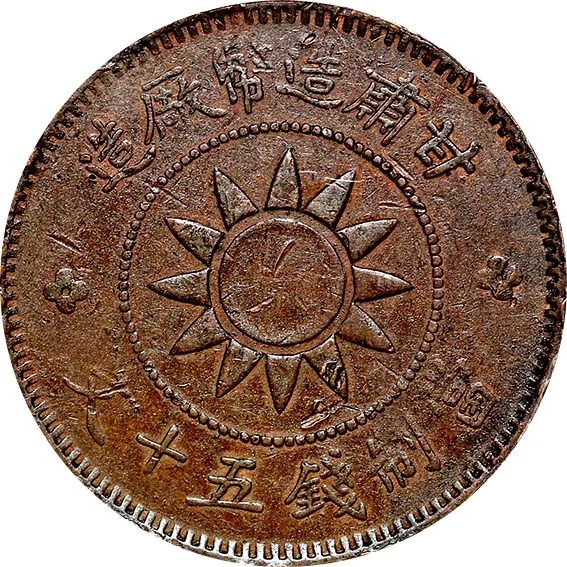
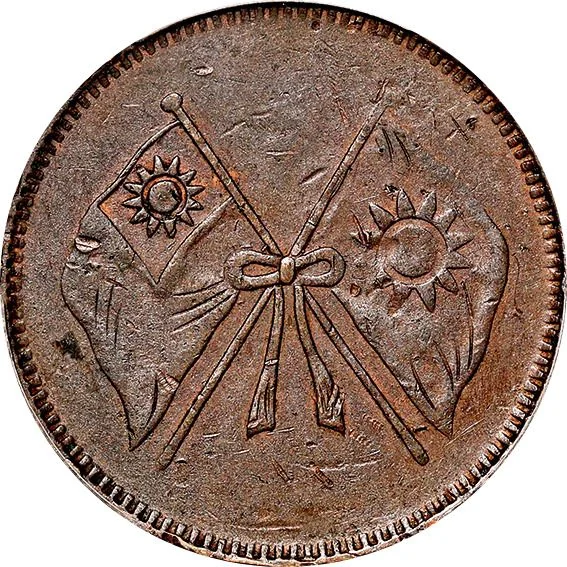
50 Cash – Kansu Province
China
Context
Year: 1927
Country: China 
Issuer: Kansu Province
Period:
(1912—1949)
Currency:
(1920—1949)
Demonetized: Yes
Material
References
Y: #Click to copy to clipboardA408
Numista: #276304
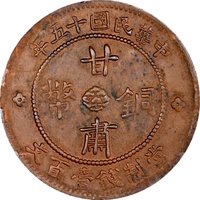
Obverse
Description:
Twelve-rayed star encircled by Chinese characters.
Inscription:
造廠幣造肅甘
文十五銭制當
文十五銭制當
Translation:
Made at the Gansu Mint.
Fifteen Wen, equivalent to one Zhiqian.
Fifteen Wen, equivalent to one Zhiqian.
Language: Chinese
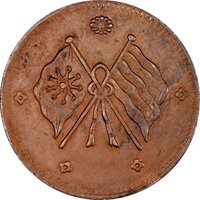
Reverse
Description:
Flags crossed.
Edge
Plain or reeded (which is less common)
Mintings
| Year | Mint Mark | Mintage | Quality | Collection |
|---|---|---|---|---|
| 1927 | — | — |
Historical background
In 1927, Kansu (modern Gansu) Province was mired in a severe and complex monetary crisis, characteristic of China's "warlord era." The national currency system had effectively collapsed, and the province was under the fractious control of regional militarists, primarily the Guominjun (National People's Army) under Feng Yuxiang, though his hold was contested. With a weak agrarian economy and isolated from coastal financial centers, Kansu's monetary environment was defined by extreme fragmentation and hyperinflation. The provincial government and local military authorities, desperate to fund their armies and administrations, resorted to issuing unbacked paper notes with little to no reserves.
The currency landscape was a chaotic mix of depreciating instruments. Alongside limited amounts of old imperial silver dollars and copper coins, the primary circulating media were provincial banknotes, military scrip, and even notes from local merchant associations. The most prominent was the paper currency issued by the Kansu Official Bank (甘肃官银号), which had been established by the provincial government but was relentlessly over-issued to cover deficits. These notes, known as Gansu Guanpiao, flooded the market and rapidly lost value. Soldiers were often paid in such scrip, which they then forced the local populace to accept at face value, leading to widespread devaluation and a collapse in public trust.
The result was economic paralysis and deep hardship. Hyperinflation eroded savings and devastated rural communities, as farmers received worthless paper for their crops. Barter became increasingly common as people rejected official paper, reverting to silver coins for any substantial transaction, which in turn drove silver out of circulation. This monetary anarchy stifled trade, exacerbated famine conditions in poorer areas, and reflected the broader breakdown of central authority. The situation in 1927 Kansu thus stands as a stark example of how warlord finance, through unrestrained currency issuance, directly weaponized the money supply to extract resources from a captive population, plunging the region into destitution.
The currency landscape was a chaotic mix of depreciating instruments. Alongside limited amounts of old imperial silver dollars and copper coins, the primary circulating media were provincial banknotes, military scrip, and even notes from local merchant associations. The most prominent was the paper currency issued by the Kansu Official Bank (甘肃官银号), which had been established by the provincial government but was relentlessly over-issued to cover deficits. These notes, known as Gansu Guanpiao, flooded the market and rapidly lost value. Soldiers were often paid in such scrip, which they then forced the local populace to accept at face value, leading to widespread devaluation and a collapse in public trust.
The result was economic paralysis and deep hardship. Hyperinflation eroded savings and devastated rural communities, as farmers received worthless paper for their crops. Barter became increasingly common as people rejected official paper, reverting to silver coins for any substantial transaction, which in turn drove silver out of circulation. This monetary anarchy stifled trade, exacerbated famine conditions in poorer areas, and reflected the broader breakdown of central authority. The situation in 1927 Kansu thus stands as a stark example of how warlord finance, through unrestrained currency issuance, directly weaponized the money supply to extract resources from a captive population, plunging the region into destitution.
✨ Legendary