

200 Cash – Honan Province
China
Context
Year: 1928
Country: China 
Issuer: Honan Province
Period:
(1912—1949)
Currency:
(1905—1949)
Demonetized: Yes
Material

References
Y: #Click to copy to clipboard396a
Numista: #276079
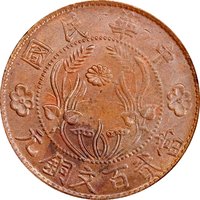
Obverse
Description:
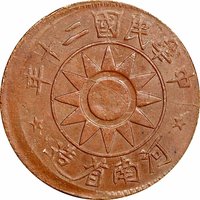
Wreath with central and side flowers, each flanked by Chinese ideograms.
Inscription:
國民華中
元銅文百貳當
元銅文百貳當
Translation:
Republic of China (Central Bank)
One Hundred and Twenty Cash
One Hundred and Twenty Cash
Language: Chinese
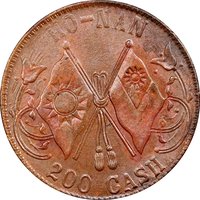
Reverse
Description:
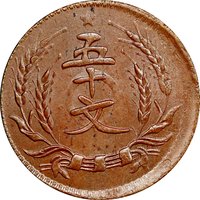
Crossed flags (Republic of China and Wuchang Uprising) flanked by flowers, with English text above and below.
Inscription:
HO-NAN
200 CASH
200 CASH
Edge
Plain
Mintings
| Year | Mint Mark | Mintage | Quality | Collection |
|---|---|---|---|---|
| 1928 | — | — |
Historical background
In 1928, Honan Province was mired in a severe and chaotic currency crisis, a direct consequence of the wider warlord fragmentation following the collapse of the Qing Dynasty. With central authority from Nanjing still nominal, local militarists like Feng Yuxiang, who controlled the region, financed their armies and administrations by recklessly issuing unbacked paper currency. These provincial banknotes, along with a flood of military scrip, rapidly depreciated, causing widespread inflation. The situation was compounded by the simultaneous circulation of silver yuan (both foreign and domestic), copper cash, and notes from neighboring provinces and private banks, creating a bewildering and unstable monetary environment for peasants and merchants alike.
The primary victims were the rural population and local economies. Farmers were forced to sell their harvests for increasingly worthless paper, while taxes were often demanded in stable silver coin, exacerbating hardship. Trade was stifled as merchants struggled to assess the value of various currencies, leading to market distrust and hoarding of precious metal. This monetary anarchy crippled economic recovery and investment, deepening the province's poverty and contributing to social unrest, which was already high due to famine, banditry, and ongoing military conflicts.
This crisis in Honan was a microcosm of the broader struggle for monetary sovereignty in China. The Nationalist government's efforts to unify the currency system under the Central Bank of China and later the fabi in the 1930s were, in part, a direct response to the destabilizing provincial financial autonomy exemplified by Honan. The 1928 situation thus highlighted the fundamental link between political consolidation and economic stability, demonstrating that until a single authority could control both the army and the mint, China's financial landscape would remain fractured and dysfunctional.
The primary victims were the rural population and local economies. Farmers were forced to sell their harvests for increasingly worthless paper, while taxes were often demanded in stable silver coin, exacerbating hardship. Trade was stifled as merchants struggled to assess the value of various currencies, leading to market distrust and hoarding of precious metal. This monetary anarchy crippled economic recovery and investment, deepening the province's poverty and contributing to social unrest, which was already high due to famine, banditry, and ongoing military conflicts.
This crisis in Honan was a microcosm of the broader struggle for monetary sovereignty in China. The Nationalist government's efforts to unify the currency system under the Central Bank of China and later the fabi in the 1930s were, in part, a direct response to the destabilizing provincial financial autonomy exemplified by Honan. The 1928 situation thus highlighted the fundamental link between political consolidation and economic stability, demonstrating that until a single authority could control both the army and the mint, China's financial landscape would remain fractured and dysfunctional.

✨ Legendary