

10 Cash – Anhwei Province
China
Context
Years: 1902–1906
Country: China 
Issuer: Anhwei Province
Ruler: Guangxu
Currency:
(1897—1949)
Demonetized: Yes
Material
References
Y: #Click to copy to clipboard39
Numista: #275621
Obverse
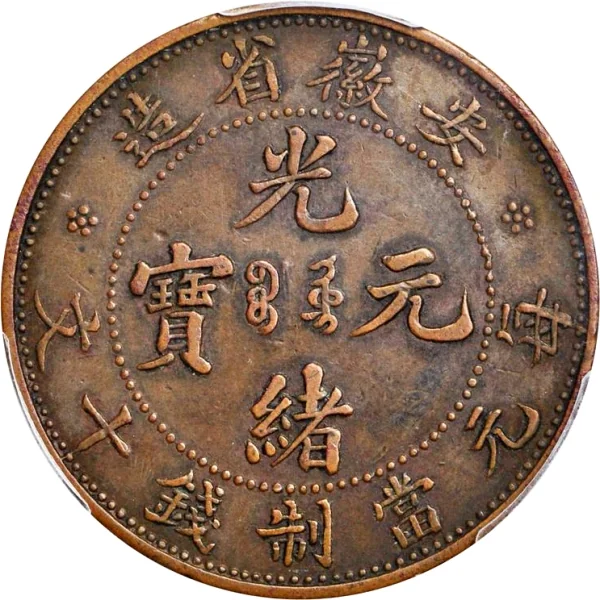
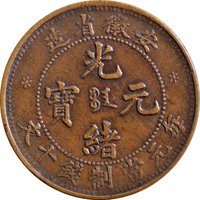
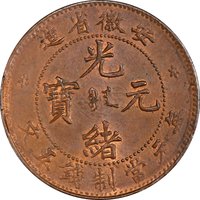
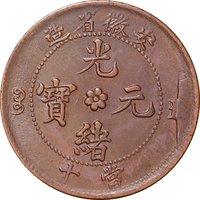
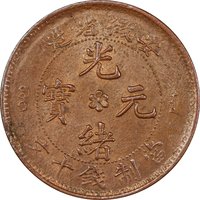
Description:
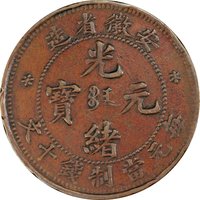
Chinese ideograms top to bottom, right to left, with central Manchu text, all encircled by more Chinese characters.
Inscription:
造省徽安
光
寶 ᠪᠣᠣ ᡥ᠊ᡠᡳ 元
緒
文十錢制當元毎
光
寶 ᠪᠣᠣ ᡥ᠊ᡠᡳ 元
緒
文十錢制當元毎
Translation:
Made by the Board of Revenue for Anhui.
Guangxu
Treasure Coin. Bao Hui (Board of Revenue) Yuan.
10 Cash. Equivalent to 1 Yuan each.
Guangxu
Treasure Coin. Bao Hui (Board of Revenue) Yuan.
10 Cash. Equivalent to 1 Yuan each.
Scripts: Chinese, Mongolian / Manchu
Reverse
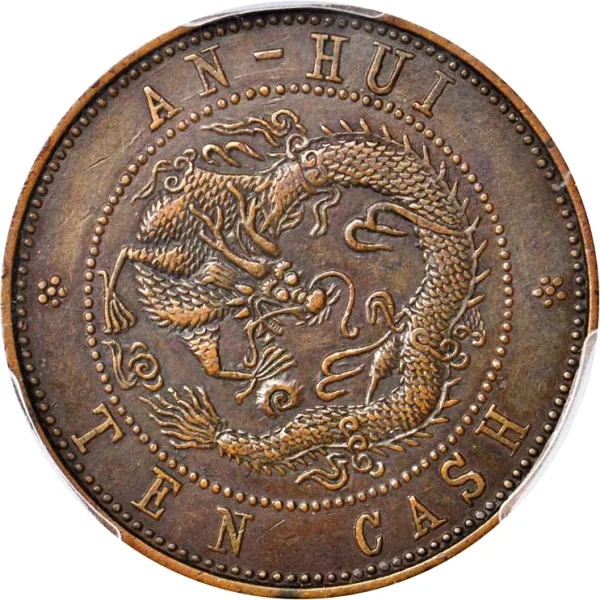
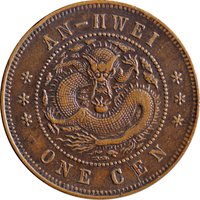
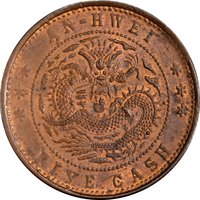
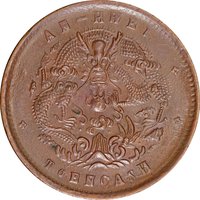
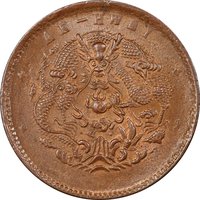
Description:
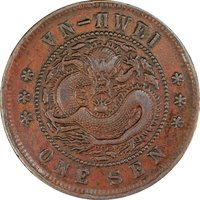
Dragon encircling a pearl, surrounded by English text.
Inscription:
AN-HUI
TEN CASH
TEN CASH
Script: Latin
Edge
Plain
Categories
| Mythology> Fantastic animal |
Mintings
| Year | Mint Mark | Mintage | Quality | Collection |
|---|---|---|---|---|
| — | — | — |
Historical background
In 1902, Anhwei (modern Anhui) Province, like much of late Qing China, operated within a complex and chaotic multi-currency system. The primary medium for large transactions and tax payments remained the silver tael, a unit of weight rather than a coin, leading to inconsistencies as every major city and trade guild had its own standard. The province dealt with a proliferation of silver sycees (shoes or ingots), foreign silver dollars (primarily Mexican and later British trade dollars), and a vast array of copper cash coins for daily retail. This fragmentation created significant friction in commerce, as constant assay and exchange between formats were required, benefiting money-changers and corrupt officials while burdening merchants and peasants.
The period was marked by a severe shortage of standardized small-denomination currency, particularly copper cash. This scarcity was exacerbated by the Boxer Indemnity payments imposed after 1901, which drained silver from the provincial economy, and by the hoarding and melting of copper coins. In response, provincial authorities and even local merchants increasingly issued their own unofficial cash tokens and privately minted copper coins to facilitate local trade, further decentralizing monetary authority. Meanwhile, the imperial government’s attempts at reform, such as promoting the new imperial silver dollar and copper coinage from the Tianjin Mint, had limited and uneven penetration in Anhwei’s inland markets.
Consequently, Anhwei in 1902 exemplified the fiscal weakness of the Qing state. The currency situation was a patchwork of imperial, provincial, private, and foreign monies, leading to exchange rate volatility and widespread counterfeiting. This monetary disarray stifled economic integration within the province, complicated tax collection, and reflected the broader dynastic decline, where central control was eroding in the face of local necessity and foreign economic pressure. It set the stage for the more aggressive provincial minting and banking experiments that would follow in the decade before the 1911 Revolution.
The period was marked by a severe shortage of standardized small-denomination currency, particularly copper cash. This scarcity was exacerbated by the Boxer Indemnity payments imposed after 1901, which drained silver from the provincial economy, and by the hoarding and melting of copper coins. In response, provincial authorities and even local merchants increasingly issued their own unofficial cash tokens and privately minted copper coins to facilitate local trade, further decentralizing monetary authority. Meanwhile, the imperial government’s attempts at reform, such as promoting the new imperial silver dollar and copper coinage from the Tianjin Mint, had limited and uneven penetration in Anhwei’s inland markets.
Consequently, Anhwei in 1902 exemplified the fiscal weakness of the Qing state. The currency situation was a patchwork of imperial, provincial, private, and foreign monies, leading to exchange rate volatility and widespread counterfeiting. This monetary disarray stifled economic integration within the province, complicated tax collection, and reflected the broader dynastic decline, where central control was eroding in the face of local necessity and foreign economic pressure. It set the stage for the more aggressive provincial minting and banking experiments that would follow in the decade before the 1911 Revolution.

✨ Legendary