

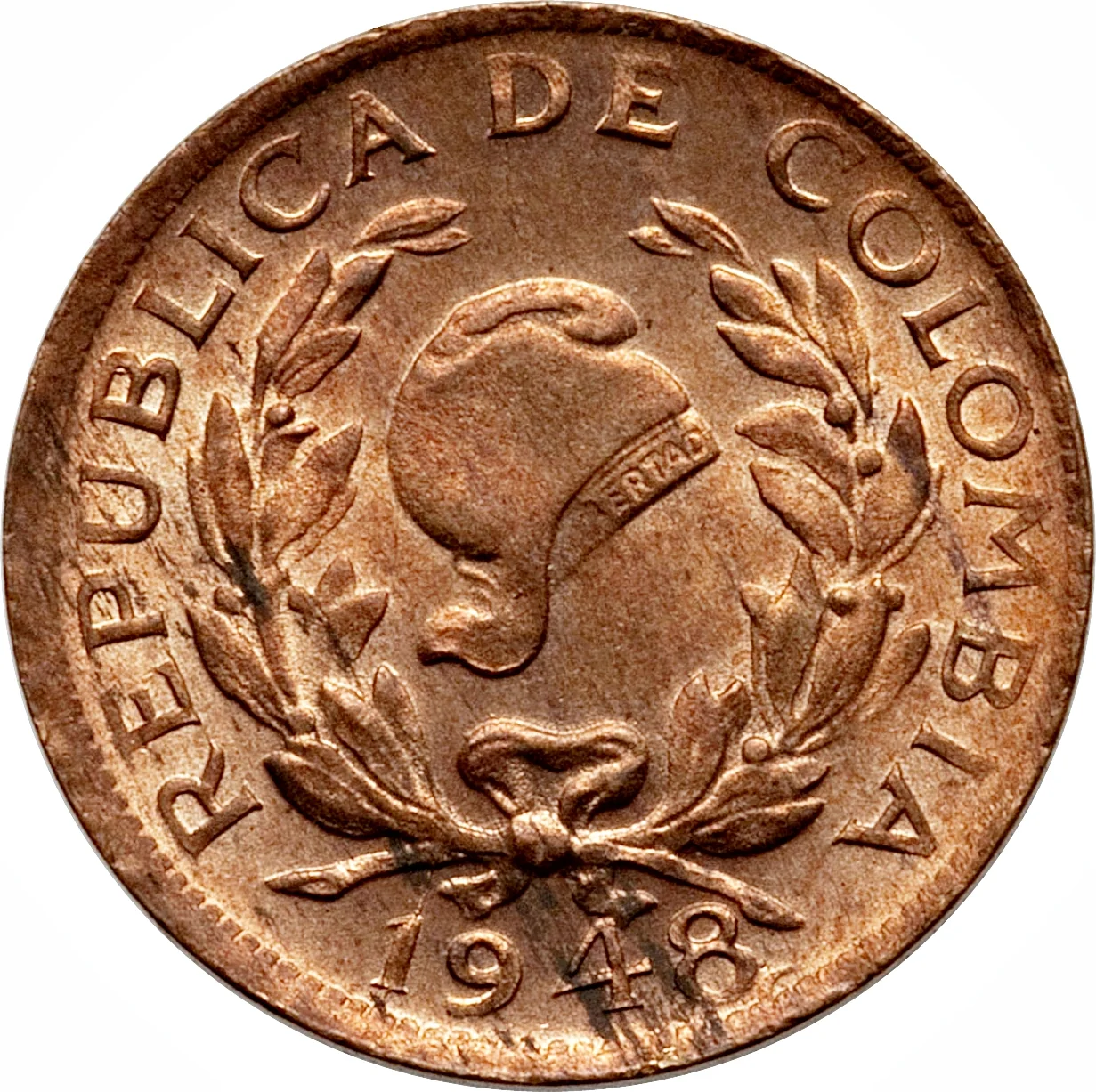
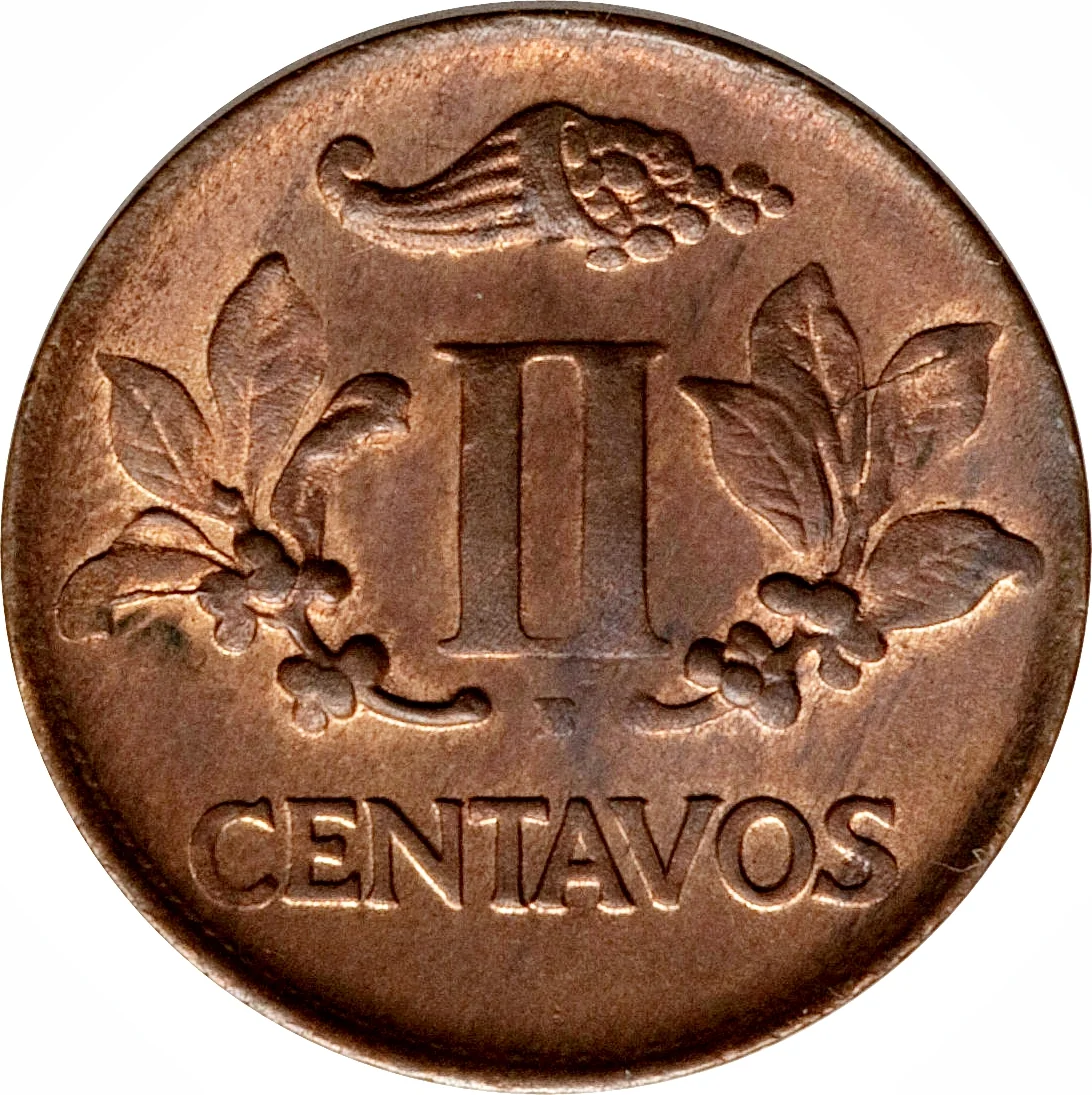
2 centavos – Colombia
Add to wishlist
Colombia
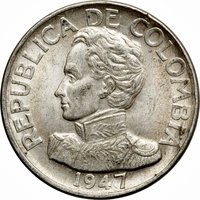
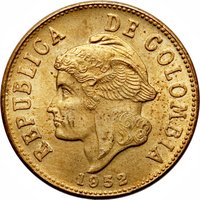
Obverse
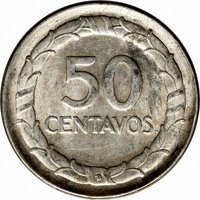
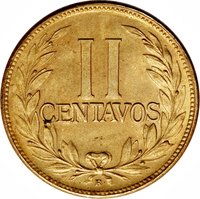
Reverse
Edge
Plain
Categories
| Symbol> Cornucopia |
| Symbol> Phrygian cap |
| Symbol> Wreath |
Mints
| Name | Mark |
|---|---|
| Bogota Mint | B |
Historical background
In 1948, Colombia's currency situation was fundamentally shaped by the global economic order of the Bretton Woods system, to which it adhered. The Colombian peso was pegged to the U.S. dollar at a fixed rate of 1.75 pesos per dollar, a stability managed by the newly established International Monetary Fund (IMF) and the Banco de la República, Colombia's central bank. This peg provided a framework for international trade and investment, but it also meant that Colombia's monetary policy was largely constrained by the need to maintain sufficient dollar reserves to defend the fixed exchange rate, limiting autonomous responses to domestic economic conditions.
The domestic economy, however, was under severe strain, which pressured this stable façade. The period was marked by significant social unrest and political violence, most catastrophically ignited by the assassination of populist leader Jorge Eliécer Gaitán on April 9, 1948—an event that triggered the Bogotazo riots and the decade-long civil conflict known as La Violencia. This instability disrupted agriculture and commerce, creating inflationary pressures and uncertainty. While the official exchange rate remained fixed, the underlying economic productivity and fiscal health were deteriorating, creating a tension between the formal currency policy and the chaotic reality on the ground.
Consequently, 1948 represents a pivotal moment where Colombia's outward monetary stability was increasingly at odds with its internal economic and political disintegration. The fixed peg was maintained, but the strains of financing imports, managing limited reserves, and coping with the economic fallout of widespread violence foreshadowed future challenges. The situation set the stage for the more direct economic interventions and developmentalist policies that would characterize the following decades, as the state sought to modernize and stabilize the economy amidst ongoing turmoil.
The domestic economy, however, was under severe strain, which pressured this stable façade. The period was marked by significant social unrest and political violence, most catastrophically ignited by the assassination of populist leader Jorge Eliécer Gaitán on April 9, 1948—an event that triggered the Bogotazo riots and the decade-long civil conflict known as La Violencia. This instability disrupted agriculture and commerce, creating inflationary pressures and uncertainty. While the official exchange rate remained fixed, the underlying economic productivity and fiscal health were deteriorating, creating a tension between the formal currency policy and the chaotic reality on the ground.
Consequently, 1948 represents a pivotal moment where Colombia's outward monetary stability was increasingly at odds with its internal economic and political disintegration. The fixed peg was maintained, but the strains of financing imports, managing limited reserves, and coping with the economic fallout of widespread violence foreshadowed future challenges. The situation set the stage for the more direct economic interventions and developmentalist policies that would characterize the following decades, as the state sought to modernize and stabilize the economy amidst ongoing turmoil.
🌱 Fairly Common