


Fiji
Context
Years: 1977–1982
Issuer: Fiji 
Ruler: Elizabeth II
Currency:
(since 1969)
Demonetization: 13 October 2008
Total mintage: 17,897,500
Material

References
KM: #Click to copy to clipboard39
Numista: #2747
Value
Exchange value: 0.01 FJD
Obverse
Description:
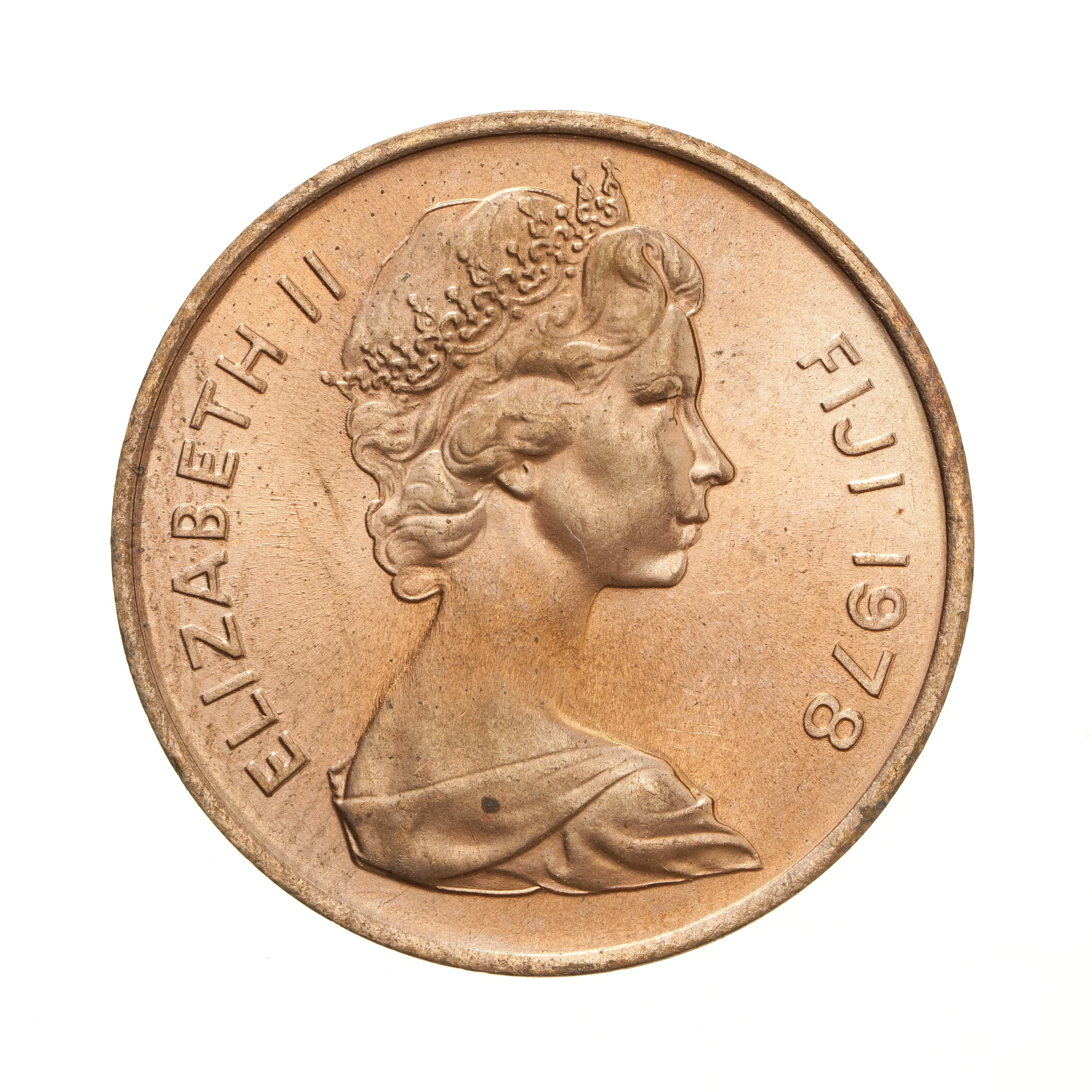
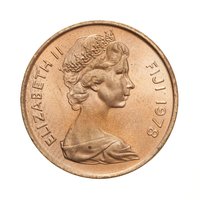
Queen Elizabeth II in the "Girls of Great Britain and Ireland" Tiara.
Inscription:
ELIZABETH II FIJI 1977
Translation:
ELIZABETH II FIJI 1977
Script: Latin
Language: English
Engraver: Arnold Machin
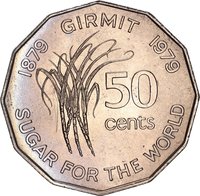
Reverse
Edge
Plain
Categories
| Organization> FAO |
Mints
| Name | Mark |
|---|---|
| Royal Australian Mint | — |
| Royal Mint | — |
Mintings
| Year | Mint Mark | Mintage | Quality | Collection |
|---|---|---|---|---|
| 1977 | — | 3,000,000 | ||
| 1978 | — | 2,000 | Proof | |
| 1978 | — | 3,032,000 | ||
| 1978 | — | 4,000 | BU | |
| 1979 | — | 2,500,000 | ||
| 1980 | — | 314,000 | ||
| 1980 | — | 2,500 | Proof | |
| 1981 | — | 4,040,000 | ||
| 1982 | — | 5,000,000 | ||
| 1982 | — | 3,000 | Proof |
Historical background
In 1977, Fiji found itself at a pivotal moment in its monetary history, navigating the final stages of a transition toward full decimalization and national currency sovereignty. Just six years prior, in 1971, the nation had introduced the Fijian dollar to replace the Fijian pound, a legacy of its colonial past under British administration. However, the new currency remained pegged to sterling and, by extension, the Bretton Woods system, which was itself in a state of collapse in the early 1970s. This period was therefore characterized by Fiji establishing its own central monetary authority and managing its currency in a new and volatile global financial environment.
The year itself was marked by significant political instability, with two general elections resulting in a constitutional crisis and prolonged parliamentary deadlock. This domestic uncertainty inevitably impacted economic confidence and policy direction. Against this backdrop, the Fijian dollar's value was carefully managed by the authorities, who maintained its peg first to sterling and then, following sterling's depreciation, to a basket of currencies. The primary economic focus was on maintaining stability for the crucial sugar and tourism sectors, rather than any dramatic revaluation or devaluation.
Consequently, 1977 was not a year of sudden monetary crisis in Fiji, but rather one of cautious consolidation during a turbulent political period. The government and the nascent Central Monetary Authority (a precursor to the Reserve Bank of Fiji, established in 1983) prioritized exchange rate stability to shield the vulnerable post-colonial economy. The foundational monetary decisions made during this era, including the commitment to a managed peg, set the course for Fiji's currency policy for the decades that followed, ensuring the Fijian dollar's role as a symbol and instrument of national economic sovereignty.
The year itself was marked by significant political instability, with two general elections resulting in a constitutional crisis and prolonged parliamentary deadlock. This domestic uncertainty inevitably impacted economic confidence and policy direction. Against this backdrop, the Fijian dollar's value was carefully managed by the authorities, who maintained its peg first to sterling and then, following sterling's depreciation, to a basket of currencies. The primary economic focus was on maintaining stability for the crucial sugar and tourism sectors, rather than any dramatic revaluation or devaluation.
Consequently, 1977 was not a year of sudden monetary crisis in Fiji, but rather one of cautious consolidation during a turbulent political period. The government and the nascent Central Monetary Authority (a precursor to the Reserve Bank of Fiji, established in 1983) prioritized exchange rate stability to shield the vulnerable post-colonial economy. The foundational monetary decisions made during this era, including the commitment to a managed peg, set the course for Fiji's currency policy for the decades that followed, ensuring the Fijian dollar's role as a symbol and instrument of national economic sovereignty.
🌱 Very Common