

10 Fen – Fukien Province
China
Context
Years: 1896–1903
Country: China 
Issuer: Fukien Province
Ruler: Guangxu
Currency:
(1896—1949)
Demonetized: Yes
Total mintage: 13,425,000
Material
References
Y: #Click to copy to clipboard103.1
Numista: #274603
Value
Bullion value: $6.32
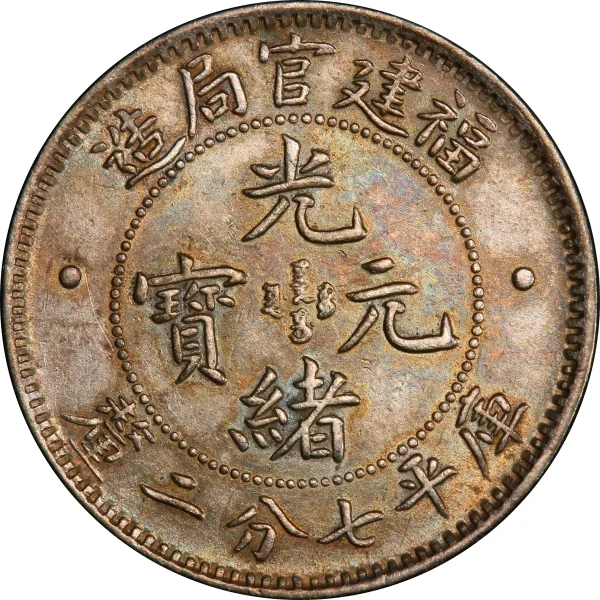
Obverse
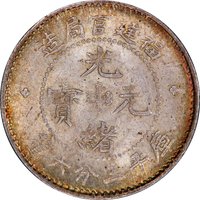
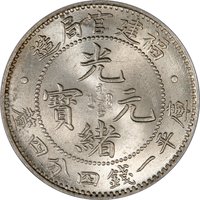
Description:
Chinese ideograms top to bottom, right to left, with central Manchu text, all encircled by more Chinese characters.
Inscription:
造局官建福
光
ᠪᠠᡩᠠᡵᠠᠩᡤᠠ
寶 ᠶᡠᠸᠠᠨ ᠪᠣᠣ 元
ᡩᠣᡵᠣ
緒
釐二分七平庫
光
ᠪᠠᡩᠠᡵᠠᠩᡤᠠ
寶 ᠶᡠᠸᠠᠨ ᠪᠣᠣ 元
ᡩᠣᡵᠣ
緒
釐二分七平庫
Translation:
Official of the Mint, Jianfu
Guang(xu)
Badarangga
Treasure Yuwan Boo
Doro
Xu
2 Fen 7 Li, Pingku (Treasury) Standard
Guang(xu)
Badarangga
Treasure Yuwan Boo
Doro
Xu
2 Fen 7 Li, Pingku (Treasury) Standard
Scripts: Chinese, Mongolian / Manchu
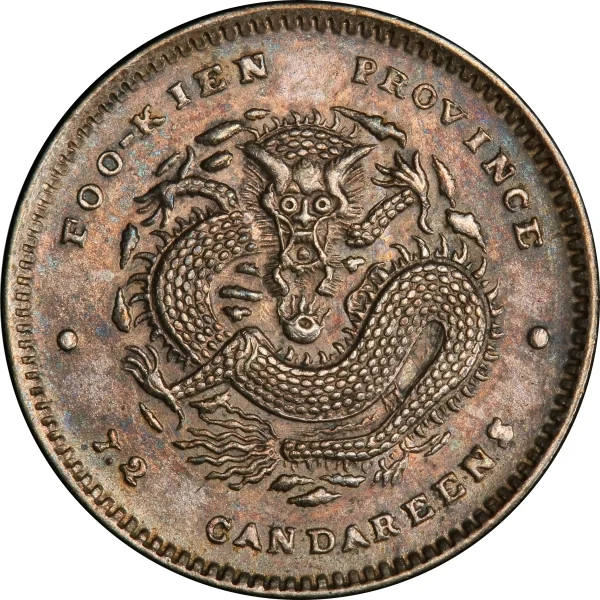
Reverse
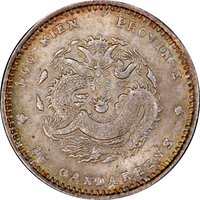
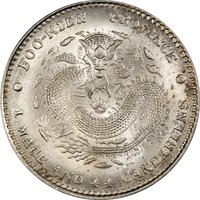
Description:
Dragon encircling a pearl, surrounded by English text.
Inscription:
FOO-KIEN PROVINCE
7.2 CANDAREENS
7.2 CANDAREENS
Script: Latin
Edge
Reeded.
Categories
| Mythology> Fantastic animal |
Mintings
| Year | Mint Mark | Mintage | Quality | Collection |
|---|---|---|---|---|
| — | — | 13,425,000 |
Historical background
In 1896, the currency situation in Fukien (Fujian) Province was a complex and fragmented reflection of China's late Qing Dynasty financial instability. The province operated under a chaotic multi-currency system, where official Qing copper cash coins, silver sycee (measured in taels), and foreign-minted silver dollars all circulated simultaneously. The primary foreign currency was the Mexican Silver Dollar, introduced via Manila Galleon trade and later by British opium traders, which had become the dominant medium for large transactions due to its reliable silver content and standardized weight. This created a dual system where everyday retail used debased copper coins, while taxes and major commerce were priced in silver, subjecting the populace to fluctuating exchange rates between the two metals.
This monetary disorder was exacerbated by severe provincial inflation and the widespread circulation of privately minted, inferior copper cash and "small money" notes issued by local shops and banks. The Qing central government's authority was weak, and provincial mints, including the Fuzhou Arsenal, produced coinage irregularly, often of reduced quality to generate revenue. Furthermore, the Treaty of Shimonoseki (1895), which ended the First Sino-Japanese War, had recently made Fuzhou a treaty port, increasing foreign economic penetration. Japanese yen and British trade dollars began to compete more directly with the Mexican dollar, adding another layer of complexity to an already crowded monetary field.
The situation imposed significant burdens on Fukien's economy, hindering trade and complicating tax collection. Merchants and peasants alike suffered from the uncertainty of exchange, which could erode profits and savings overnight. This financial chaos was a microcosm of the broader Qing monetary crisis, contributing to social unrest and underscoring the dynasty's inability to exert sovereign economic control. It set the stage for the monetary reforms attempted in the following decade, as the province, like much of China, struggled to transition from a traditional, disjointed system to a modern, unified currency.
This monetary disorder was exacerbated by severe provincial inflation and the widespread circulation of privately minted, inferior copper cash and "small money" notes issued by local shops and banks. The Qing central government's authority was weak, and provincial mints, including the Fuzhou Arsenal, produced coinage irregularly, often of reduced quality to generate revenue. Furthermore, the Treaty of Shimonoseki (1895), which ended the First Sino-Japanese War, had recently made Fuzhou a treaty port, increasing foreign economic penetration. Japanese yen and British trade dollars began to compete more directly with the Mexican dollar, adding another layer of complexity to an already crowded monetary field.
The situation imposed significant burdens on Fukien's economy, hindering trade and complicating tax collection. Merchants and peasants alike suffered from the uncertainty of exchange, which could erode profits and savings overnight. This financial chaos was a microcosm of the broader Qing monetary crisis, contributing to social unrest and underscoring the dynasty's inability to exert sovereign economic control. It set the stage for the monetary reforms attempted in the following decade, as the province, like much of China, struggled to transition from a traditional, disjointed system to a modern, unified currency.
💎 Extremely Rare