

1 jiao – Fukien Province
Add to wishlist
China
Context
Years: 1903–1908
Country: China
Issuer: Fukien Province
Ruler: Guangxu
Currency:
(1896—1949)
Demonetized: Yes
Material
References
Y: #
Numista: #274602
Value
Bullion value: $5.66
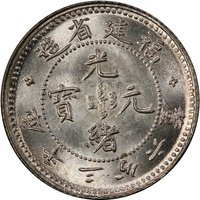
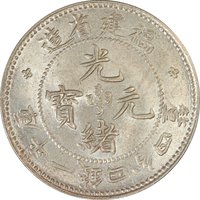
Obverse
Description:
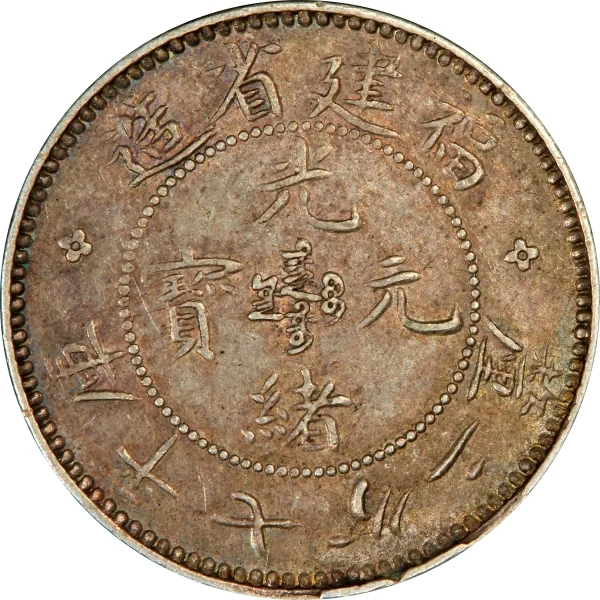
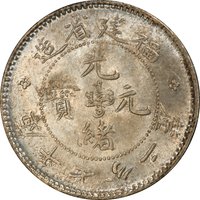
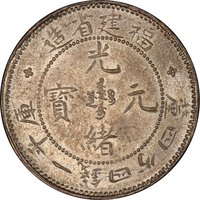
Chinese ideograms top to bottom, right to left, with central Manchu text, all encircled by more Chinese characters.
Inscription:
造省建福
光
ᠪᠠᡩᠠᡵᠠᠩᡤᠠ
寶 ᠶᡠᠸᠠᠨ ᠪᠣᠣ 元
ᡩᠣᡵᠣ
緒
釐二分七平庫
光
ᠪᠠᡩᠠᡵᠠᠩᡤᠠ
寶 ᠶᡠᠸᠠᠨ ᠪᠣᠣ 元
ᡩᠣᡵᠣ
緒
釐二分七平庫
Translation:
Made in the Sheng Province during the Guangxu era.
Badarangga
Treasure, Yuwan Bao
Doro
Reign
7 Fen 2 Li, Treasury Standard
Badarangga
Treasure, Yuwan Bao
Doro
Reign
7 Fen 2 Li, Treasury Standard
Scripts: Chinese, Mongolian / Manchu
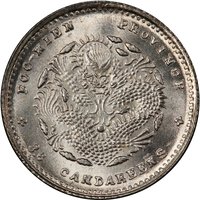
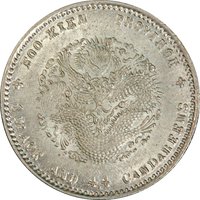
Reverse
Description:
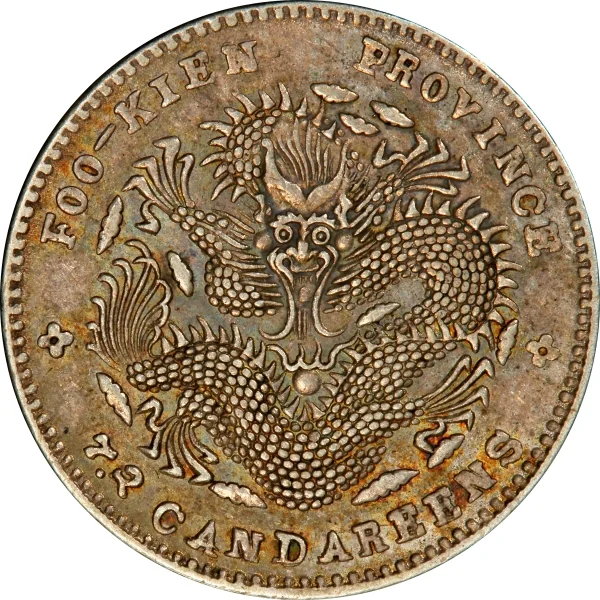
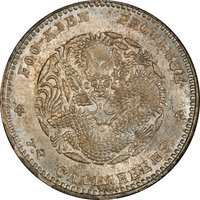
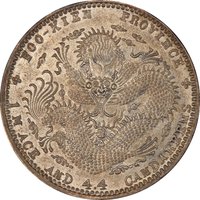
Dragon encircling a pearl, surrounded by English text.
Inscription:
FOO-KIEN PROVINCE
7.2 CANDAREENS
7.2 CANDAREENS
Script: Latin
Edge
Reeded.
Categories
| Mythology> Fantastic animal |
Mintings
| Year | Mint Mark | Mintage | Quality | Collection |
|---|---|---|---|---|
| — | — | — |
Historical background
In 1903, the monetary landscape of Fukien (Fujian) Province was a complex and fragmented system, characteristic of China's late Qing dynasty. The province did not operate under a single, unified currency but was instead a marketplace for a bewildering variety of coins, notes, and bullion. The official currency was the silver tael, a unit of weight rather than a coin, which led to countless local variants like the Fukien tael (or Hoppo tael), each with slightly different purity and weight. Everyday transactions, however, were dominated by a flood of foreign-minted silver dollars, particularly the Mexican "Eagle" dollar and the British trade dollar, which circulated widely due to Fukien's extensive maritime trade.
Alongside silver, a separate system of copper cash coins (with square holes) was used for small, daily purchases by the majority of the population. The exchange rate between silver and copper was volatile and locally determined, often to the detriment of peasants and laborers. Furthermore, the financial strain of the Boxer Indemnity payments led the provincial government and private qianzhuang (native banks) to issue a plethora of paper notes, denominated in both taels and dollars. These notes were of uncertain reliability, their value dependent entirely on the reputation of the issuer, leading to frequent discounts and instability.
This monetary chaos created significant obstacles for commerce and tax collection, as constant conversion and the risk of debasement were inherent in every transaction. The situation in Fukien reflected the Qing central government's weakening authority and its inability to impose monetary standardization. It was a system on the brink, awaiting the reforms that would eventually lead to the establishment of a national yuan system, but in 1903, it remained a tangled, multi-currency environment defined by local custom, foreign influence, and economic pragmatism.
Alongside silver, a separate system of copper cash coins (with square holes) was used for small, daily purchases by the majority of the population. The exchange rate between silver and copper was volatile and locally determined, often to the detriment of peasants and laborers. Furthermore, the financial strain of the Boxer Indemnity payments led the provincial government and private qianzhuang (native banks) to issue a plethora of paper notes, denominated in both taels and dollars. These notes were of uncertain reliability, their value dependent entirely on the reputation of the issuer, leading to frequent discounts and instability.
This monetary chaos created significant obstacles for commerce and tax collection, as constant conversion and the risk of debasement were inherent in every transaction. The situation in Fukien reflected the Qing central government's weakening authority and its inability to impose monetary standardization. It was a system on the brink, awaiting the reforms that would eventually lead to the establishment of a national yuan system, but in 1903, it remained a tangled, multi-currency environment defined by local custom, foreign influence, and economic pragmatism.
✨ Legendary