

2 fillér – Hungary
Add to wishlist
Hungary
Context
Years: 1950–1989
Issuer: Hungary
Period:
(1949—1989)
Currency:
(since 1946)
Demonetization: 30 September 1992
Total mintage: 81,092,000
Material
Diameter: 18 mm
Weight: 0.65 g
Thickness: 1.1 mm
Shape: Round with a round hole
Magnetic: No
Technique: Milled
Alignment: Medal alignment
flip
References
KM: #
Numista: #2746
Value
Exchange value: 0.02 HUF
Obverse
Description:
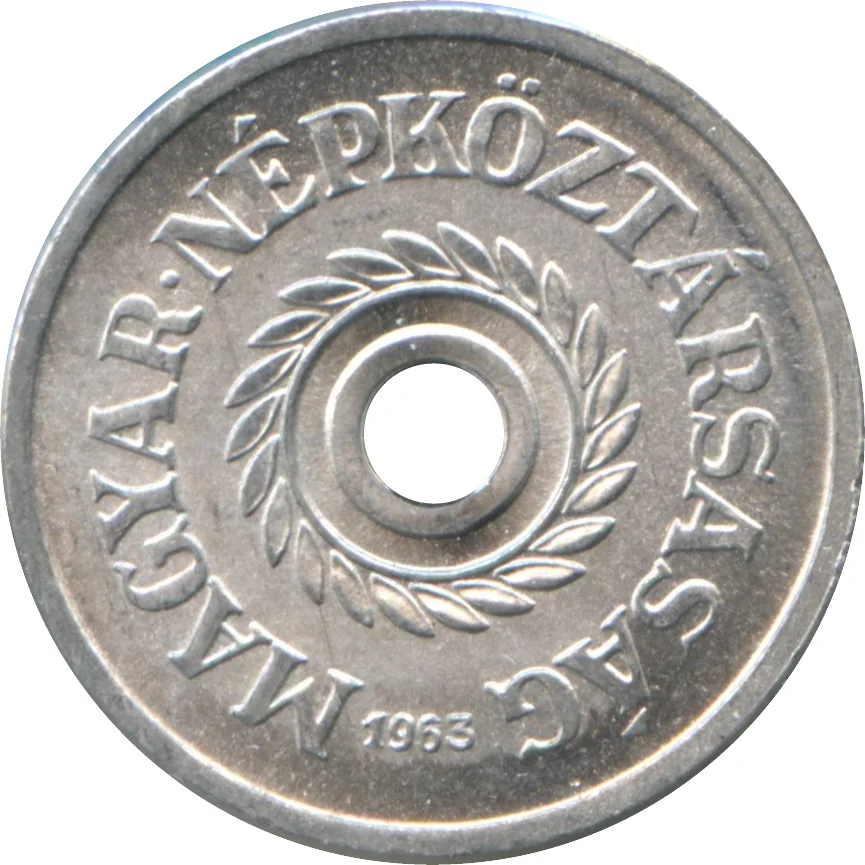
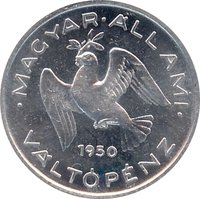
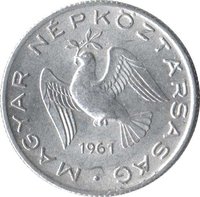
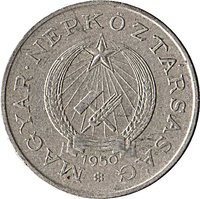
Legend encircles center hole with wreath.
Inscription:
MAGYAR NÉPKÖZTÁRSASÁG
1963
1963
Translation:
HUNGARIAN PEOPLE'S REPUBLIC
1963
1963
Script: Latin
Language: Hungarian
Engraver: Iván István
Reverse
Description:
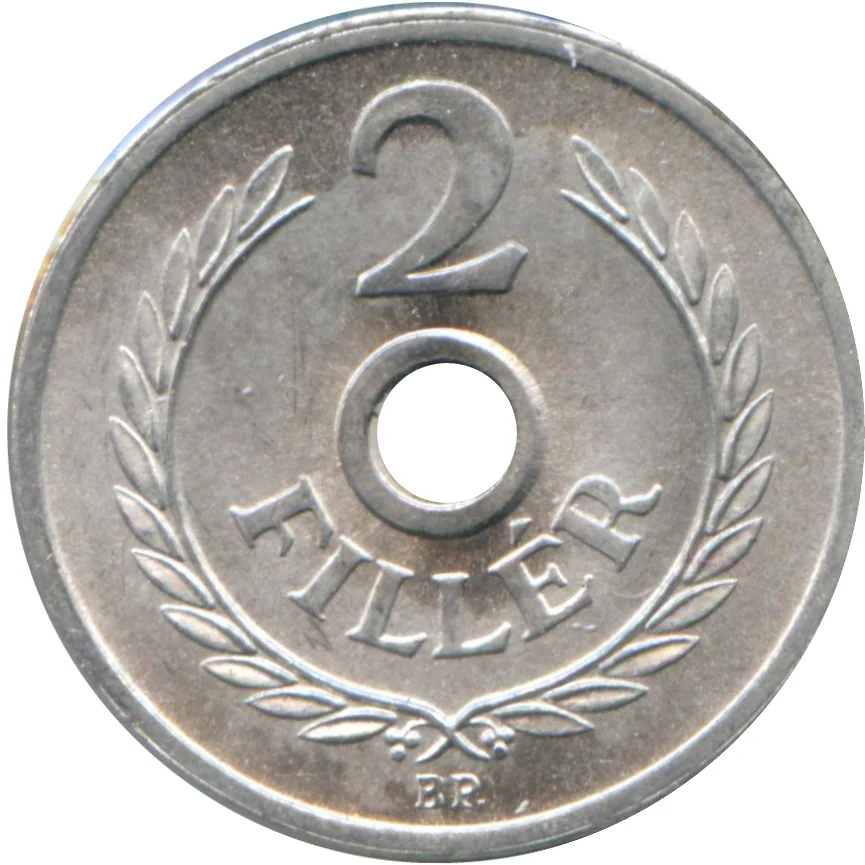
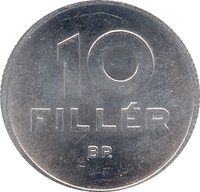
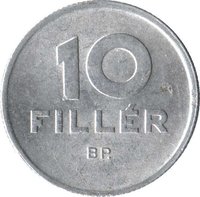
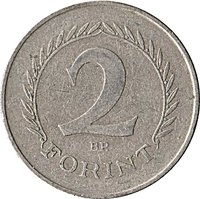
Wreath, mintmark, value.
Inscription:
2
FILLÉR
BP.
FILLÉR
BP.
Translation:
Filler
Budapest Mint.
Budapest Mint.
Script: Latin
Language: Hungarian
Engraver: Iván István
Edge
Plain
Mints
| Name | Mark |
|---|---|
| Hungarian mint | BP. |
Mintings
| Year | Mint Mark | Mintage | Quality | Collection |
|---|---|---|---|---|
| 1950 | BP. | 24,990,000 | ||
| 1952 | BP. | 5,600,000 | ||
| 1953 | BP. | 9,400,000 | ||
| 1954 | BP. | 10,000,000 | ||
| 1955 | BP. | 6,029,000 | ||
| 1956 | BP. | 4,000,000 | ||
| 1957 | BP. | 5,000,000 | ||
| 1960 | BP. | 3,000,000 | ||
| 1961 | BP. | 2,000,000 | ||
| 1962 | BP. | 3,000,000 | ||
| 1963 | BP. | 2,082,000 | ||
| 1965 | BP. | 540,000 | ||
| 1971 | BP. | 1,041,000 | ||
| 1972 | BP. | 1,000,000 | ||
| 1973 | BP. | 2,820,000 | ||
| 1974 | BP. | 50,000 | ||
| 1975 | BP. | 50,000 | ||
| 1976 | BP. | 50,000 | ||
| 1977 | BP. | 60,000 | ||
| 1978 | BP. | 50,000 | ||
| 1979 | BP. | 30,000 | ||
| 1980 | BP. | 30,000 | ||
| 1981 | BP. | 30,000 | ||
| 1982 | BP. | 30,000 | ||
| 1983 | BP. | 30,000 | ||
| 1984 | BP. | 30,000 | ||
| 1985 | BP. | 30,000 | ||
| 1986 | BP. | 30,000 | ||
| 1987 | BP. | 30,000 | ||
| 1988 | BP. | 30,000 | ||
| 1989 | BP. | 30,000 |
Historical background
In 1950, Hungary’s currency situation was a direct product of its integration into the Soviet Bloc and the imposition of a Stalinist command economy. The national currency, the forint (introduced in 1946 to end catastrophic hyperinflation), was now strictly controlled by the state and the Hungarian National Bank, which answered to the ruling Hungarian Working People’s Party. Its value was set artificially by decree, with an official exchange rate pegged to the Soviet ruble rather than market forces, isolating it from the Western financial system. The primary economic focus was on rapid, forced industrialization and the fulfillment of central plans, with monetary policy serving as a passive tool for accounting and resource allocation rather than active economic management.
Domestically, the currency regime was characterized by severe restrictions and a growing disconnect between official prices and reality. While the forint appeared stable on paper, a vast shadow economy and widespread shortages of consumer goods undermined its real purchasing power. The government maintained an artificially strong exchange rate to project an image of strength, but this overvaluation stifled legitimate foreign trade and encouraged black-market currency exchanges. Citizens had limited access to, or use for, foreign currencies, as international travel and imports were tightly restricted to the state apparatus.
This rigid system, however, contained the seeds of future instability. The suppression of market mechanisms and the financing of industrial projects through direct monetary emission created hidden inflationary pressures. By 1950, the structural economic imbalances were becoming entrenched, setting the stage for the chronic shortages and declining living standards that would culminate in the economic grievances fueling the 1956 Hungarian Revolution. The currency, therefore, was not an instrument of a healthy economy but a facade masking the deep distortions of the planned system.
Domestically, the currency regime was characterized by severe restrictions and a growing disconnect between official prices and reality. While the forint appeared stable on paper, a vast shadow economy and widespread shortages of consumer goods undermined its real purchasing power. The government maintained an artificially strong exchange rate to project an image of strength, but this overvaluation stifled legitimate foreign trade and encouraged black-market currency exchanges. Citizens had limited access to, or use for, foreign currencies, as international travel and imports were tightly restricted to the state apparatus.
This rigid system, however, contained the seeds of future instability. The suppression of market mechanisms and the financing of industrial projects through direct monetary emission created hidden inflationary pressures. By 1950, the structural economic imbalances were becoming entrenched, setting the stage for the chronic shortages and declining living standards that would culminate in the economic grievances fueling the 1956 Hungarian Revolution. The currency, therefore, was not an instrument of a healthy economy but a facade masking the deep distortions of the planned system.
Series: 1950 Hungary circulation coins
🌱 Very Common