

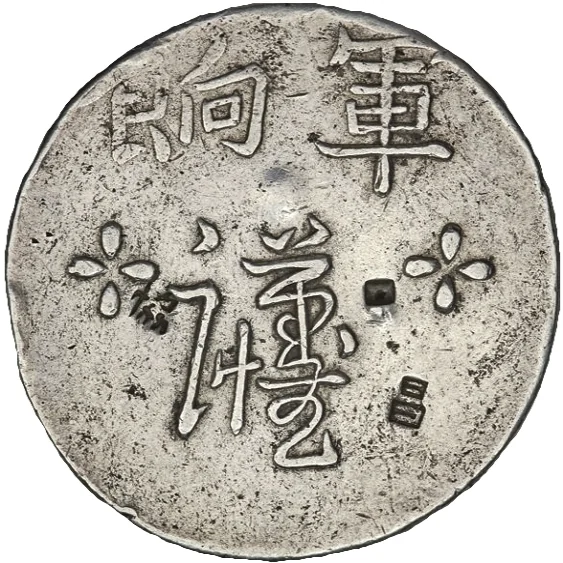

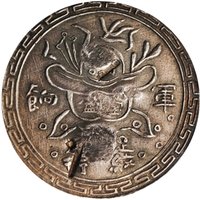
Obverse
Description:
Four Chinese characters above a monogram.
Inscription:
餉軍
Translation:
Pay the army.
Language: Classical Chinese
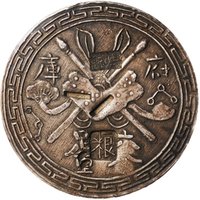
Reverse
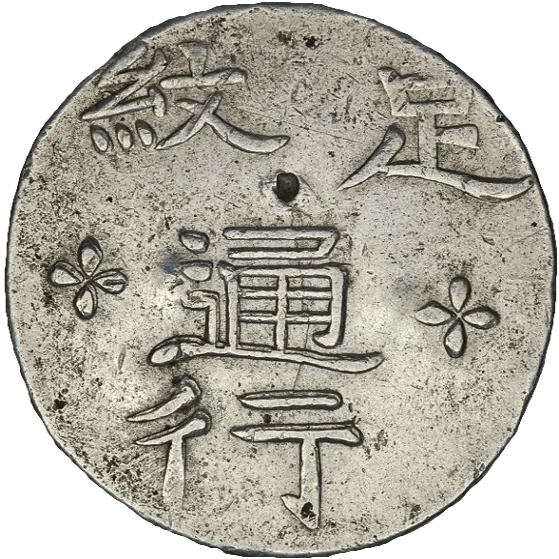
Description:
Two Chinese ideograms above, two below.
Inscription:
纹足
通
行
通
行
Translation:
Circulating Tongbao
Language: Chinese
Edge
Greek design.
Mintings
| Year | Mint Mark | Mintage | Quality | Collection |
|---|---|---|---|---|
| 1844 | — | — |
Historical background
In 1844, Taiwan Province, an integral part of China's Qing Empire, operated within a complex and fragmented monetary system typical of the dynasty's coastal regions. The primary official currency was the silver tael, a unit of weight rather than a coin, used for large transactions and tax payments. For everyday commerce, the most common circulating coins were copper cash (wen), with strings of nominally 1000 coins used for smaller dealings. However, the scarcity of government-minted copper cash in Taiwan led to widespread circulation of privately minted and often debased coins, as well as a variety of foreign silver dollars from Spanish, Mexican, and later British trade. These dollars, particularly the Spanish Carolus dollar, were chopped or stamped by local merchants to verify purity, further complicating exchange.
This multi-currency environment created significant challenges. Exchange rates between silver taels, copper cash strings, and foreign silver coins fluctuated constantly based on metal purity, local supply, and merchant agreements, hindering efficient trade. The monetary fragmentation was exacerbated by Taiwan's geographic position as a hub in regional commerce, where merchants from Fujian, Guangdong, and various foreign trading houses all operated. Furthermore, counterfeiting of copper cash was a persistent problem, undermining trust in the already unstable local currency.
The situation in 1844 must be understood in the broader context of the post-First Opium War period. The Treaty of Nanjing in 1842 opened nearby Fuzhou and Xiamen as treaty ports, increasing Western commercial and monetary influence in the region. While Taiwan itself was not opened as a treaty port until Tainan in 1858, the shifting trade patterns and increased foreign silver flow into the Southeast China coast undoubtedly began to affect Taiwan's economic and monetary landscape by 1844, setting the stage for further monetary integration and complications in the decades that followed. Throughout this period, Taiwan's currency system remained a regional subsystem of the Qing dynasty's fiscal structure.
This multi-currency environment created significant challenges. Exchange rates between silver taels, copper cash strings, and foreign silver coins fluctuated constantly based on metal purity, local supply, and merchant agreements, hindering efficient trade. The monetary fragmentation was exacerbated by Taiwan's geographic position as a hub in regional commerce, where merchants from Fujian, Guangdong, and various foreign trading houses all operated. Furthermore, counterfeiting of copper cash was a persistent problem, undermining trust in the already unstable local currency.
The situation in 1844 must be understood in the broader context of the post-First Opium War period. The Treaty of Nanjing in 1842 opened nearby Fuzhou and Xiamen as treaty ports, increasing Western commercial and monetary influence in the region. While Taiwan itself was not opened as a treaty port until Tainan in 1858, the shifting trade patterns and increased foreign silver flow into the Southeast China coast undoubtedly began to affect Taiwan's economic and monetary landscape by 1844, setting the stage for further monetary integration and complications in the decades that followed. Throughout this period, Taiwan's currency system remained a regional subsystem of the Qing dynasty's fiscal structure.

✨ Legendary