

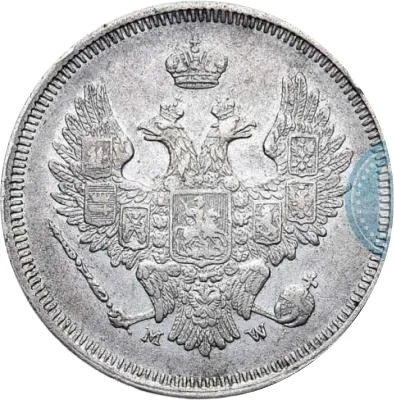
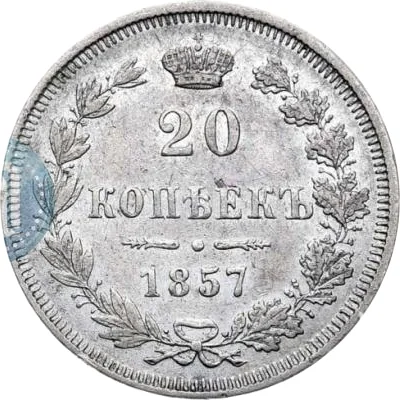
20 Kopecks – Russian Empire
Russia
Context
Year: 1857
Country: Russia 
Issuer: Russian Empire
Ruler: Alexander II
Currency:
(1700—1917)
Demonetized: Yes
Total mintage: 87,460
Material
References
Numista: #274547
Value
Bullion value: $10.39
Obverse
Reverse
Edge
Center slanted reeding
Mints
| Name | Mark |
|---|---|
| Mint of Poland | MW |
Mintings
| Year | Mint Mark | Mintage | Quality | Collection |
|---|---|---|---|---|
| 1857 | MW | 87,460 |
Historical background
In 1857, the Russian Empire’s currency system was in a state of profound strain, caught between the legacy of the past and the costly demands of the present. The foundation was the silver ruble, but its circulation was severely hampered by a chronic shortage of precious metal coinage. Instead, the economy relied heavily on paper money—assignatsii—which had been in use since the late 18th century and were not fully convertible into silver. This created a complex and unstable dual system where the paper ruble traded at a significant discount to the silver ruble, eroding public confidence and complicating both domestic and international trade.
The immediate pressure stemmed from the disastrous Crimean War (1853-1856), which had emptied the state treasury and led to massive emissions of assignatsii to finance the conflict. By 1857, the paper money supply had swollen, exacerbating inflation and deepening the discount. Furthermore, the government was committed to expensive modernization and infrastructure projects, like railway expansion, which required foreign investment and loans. International financiers, however, demanded payments in stable silver or gold, highlighting the weakness of the paper currency and making the state's financial obligations increasingly difficult and expensive to meet.
Consequently, 1857 became a pivotal year for reform discussions within the Ministry of Finance under Alexander II. Officials, recognizing that the archaic monetary system was a barrier to economic recovery and integration into the European financial world, began serious planning for a fundamental overhaul. The key goal was to stabilize the currency and establish gold convertibility, a process that would culminate decades later under Finance Minister Sergei Witte. Thus, the situation in 1857 was one of acute crisis, but also the catalyst for the long and difficult journey toward the modern gold-standard ruble.
The immediate pressure stemmed from the disastrous Crimean War (1853-1856), which had emptied the state treasury and led to massive emissions of assignatsii to finance the conflict. By 1857, the paper money supply had swollen, exacerbating inflation and deepening the discount. Furthermore, the government was committed to expensive modernization and infrastructure projects, like railway expansion, which required foreign investment and loans. International financiers, however, demanded payments in stable silver or gold, highlighting the weakness of the paper currency and making the state's financial obligations increasingly difficult and expensive to meet.
Consequently, 1857 became a pivotal year for reform discussions within the Ministry of Finance under Alexander II. Officials, recognizing that the archaic monetary system was a barrier to economic recovery and integration into the European financial world, began serious planning for a fundamental overhaul. The key goal was to stabilize the currency and establish gold convertibility, a process that would culminate decades later under Finance Minister Sergei Witte. Thus, the situation in 1857 was one of acute crisis, but also the catalyst for the long and difficult journey toward the modern gold-standard ruble.
✨ Legendary