

20 Fen – Chekiang Province
China
Context
Years: 1898–1899
Country: China 
Issuer: Chekiang Province
Ruler: Guangxu
Currency:
(1896—1940)
Demonetized: Yes
Material
References
Y: #Click to copy to clipboard53.7
Numista: #274535
Value
Bullion value: $12.46
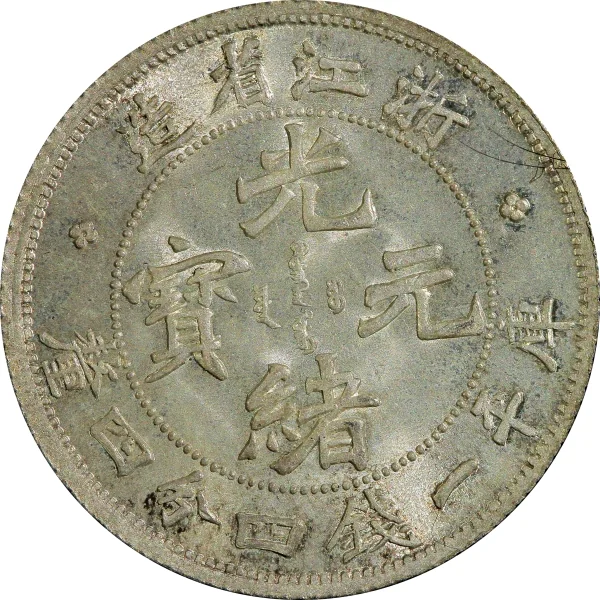
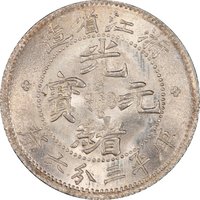
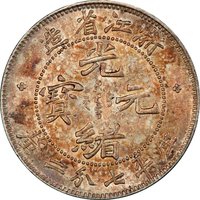
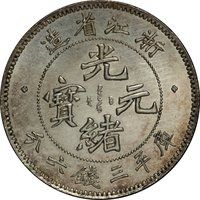
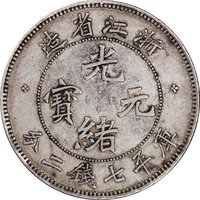
Obverse
Description:
Chinese ideograms top to bottom, right to left, with central Manchu text, all encircled by more Chinese characters.
Inscription:
造省江浙
光
ᠪᠠᡩᠠᡵᠠᠩᡤᠠ
寶 ᠶᡠᠸᠠᠨ ᠪᠣᠣ 元
ᡩᠣᡵᠣ
緒
釐四分四錢一平庫
光
ᠪᠠᡩᠠᡵᠠᠩᡤᠠ
寶 ᠶᡠᠸᠠᠨ ᠪᠣᠣ 元
ᡩᠣᡵᠣ
緒
釐四分四錢一平庫
Translation:
Made in Jiangsu and Zhejiang Provinces
Guangxu
Badarangga
Treasure Yuan
Doro
One Pingku Coin, Four Fen, Four Qian
Guangxu
Badarangga
Treasure Yuan
Doro
One Pingku Coin, Four Fen, Four Qian
Scripts: Chinese, Mongolian / Manchu
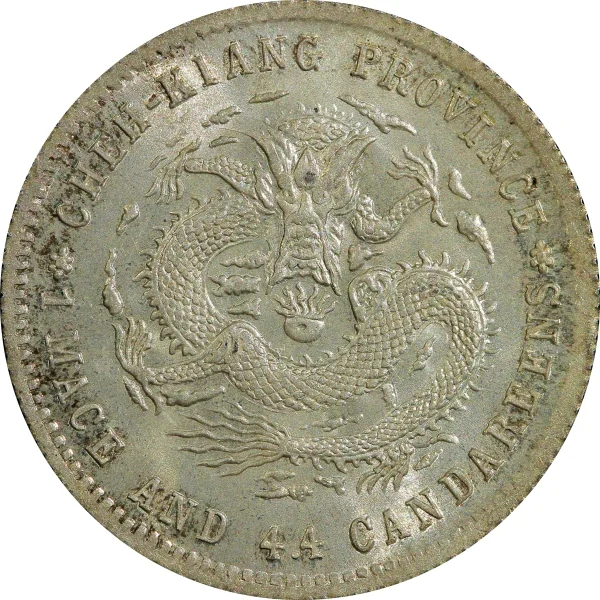
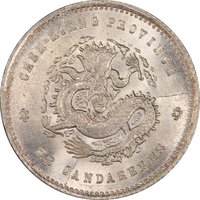
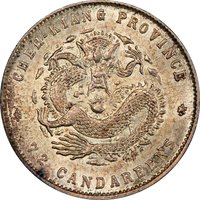
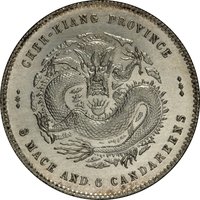
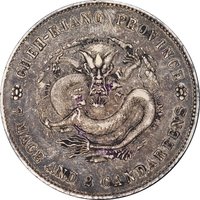
Reverse
Description:
Dragon encircling a pearl, surrounded by English text.
Inscription:
CHEH-KIANG PROVINCE
1 MACE AND 4.4 CANDAREENS
1 MACE AND 4.4 CANDAREENS
Script: Latin
Edge
Reeded.
Categories
| Mythology> Fantastic animal |
Mintings
| Year | Mint Mark | Mintage | Quality | Collection |
|---|---|---|---|---|
| — | — | — |
Historical background
In 1898, Chekiang (Zhejiang) Province, like much of late Qing China, operated within a complex and fragmented monetary system. The official currency was the silver tael, a unit of weight rather than a coined denomination, leading to countless local variants like the Hangchow tael. Concurrently, strings of bronze cash coins served as the everyday currency for the populace. However, the province was profoundly impacted by the influx of foreign silver dollars, particularly the Mexican "Eagle" dollar, which circulated widely in treaty ports like Ningpo due to its standardized weight and reliability, undermining the official Qing currency.
This period was marked by severe monetary instability. A nationwide scarcity of copper, exacerbated by Japan's withdrawal from the Chinese cash coin trade after the First Sino-Japanese War (1894-95), led to a drastic depreciation of bronze cash against silver. This cash-silver exchange crisis caused severe hardship for peasants and laborers who were paid in cash but often paid taxes reckoned in silver, effectively increasing their burdens. Furthermore, the circulation of debased and privately minted "bad cash" and the increasing presence of Japanese and other foreign silver yen added to the chaotic mix, confusing trade and facilitating fraud.
The Qing government's attempts at reform were piecemeal and largely ineffective in Chekiang at this precise moment. While the imperial mints in Hangchow and Ningpo produced copper cash, they could not alleviate the shortage. Broader proposals for a unified national silver coinage, which would culminate in the Imperial Chinese Coinage reforms of the early 1900s, were still in discussion. Thus, in 1898, Chekiang's economy navigated a turbulent transitional period, caught between traditional systems, foreign economic pressure, and inadequate state response, which strained local commerce and exacerbated social tensions.
This period was marked by severe monetary instability. A nationwide scarcity of copper, exacerbated by Japan's withdrawal from the Chinese cash coin trade after the First Sino-Japanese War (1894-95), led to a drastic depreciation of bronze cash against silver. This cash-silver exchange crisis caused severe hardship for peasants and laborers who were paid in cash but often paid taxes reckoned in silver, effectively increasing their burdens. Furthermore, the circulation of debased and privately minted "bad cash" and the increasing presence of Japanese and other foreign silver yen added to the chaotic mix, confusing trade and facilitating fraud.
The Qing government's attempts at reform were piecemeal and largely ineffective in Chekiang at this precise moment. While the imperial mints in Hangchow and Ningpo produced copper cash, they could not alleviate the shortage. Broader proposals for a unified national silver coinage, which would culminate in the Imperial Chinese Coinage reforms of the early 1900s, were still in discussion. Thus, in 1898, Chekiang's economy navigated a turbulent transitional period, caught between traditional systems, foreign economic pressure, and inadequate state response, which strained local commerce and exacerbated social tensions.
✨ Legendary