



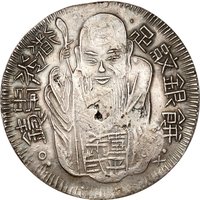
Obverse
Description:
Longevity God holding staff, chest and sides adorned with Chinese characters.
Inscription:
鑄年光道 - 足紋銀餅
柒庫
弍平
柒庫
弍平
Translation:
Cast in the Year Guangdao - Full Weight Silver Cake
Seven Treasury
Two Ping
Seven Treasury
Two Ping
Language: Chinese
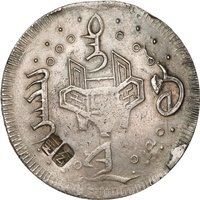
Reverse
Edge
Meandering Greek design.
Mintings
| Year | Mint Mark | Mintage | Quality | Collection |
|---|---|---|---|---|
| — | — | — |
Historical background
In 1837, Taiwan Province was under the administrative control of the Qing Dynasty, and its currency situation reflected the broader monetary complexities of late imperial China. The primary official currency was silver, measured in weight-based units like taels (liang) and mace (qian), which was used for large transactions, tax payments, and interregional trade. However, a severe shortage of standardized silver coinage was a chronic problem, leading to reliance on irregularly shaped silver sycee ingots, whose value depended on purity and weight, requiring assay by local money-changers.
Alongside silver, a vast quantity of copper-alloy cash coins (wen) with a square hole, strung together in strings, served as the everyday currency for the common people. These coins were officially minted, but the supply was often insufficient, leading to widespread circulation of privately minted and older coins, including those from previous dynasties. Furthermore, the value of copper cash relative to silver was highly unstable and subject to local fluctuations, with exchange rates (yinjia) varying significantly between regions like Tainan, Taipei, and the hinterlands, creating a fragmented monetary environment.
This period also saw the increasing infiltration of foreign silver dollars, particularly Spanish Carolus pesos and later Mexican dollars, brought by European and American traders involved in the tea and camphor exports from ports like Tamsui and Anping. These coins, valued for their consistent silver content, began to circulate alongside Qing sycee, adding another layer to the monetary system. The overall currency situation in 1837 was therefore characterized by a tri-metallic struggle involving unstable silver, insufficient official coinage, and growing foreign currency influence, which complicated commerce and taxation on the island.
Alongside silver, a vast quantity of copper-alloy cash coins (wen) with a square hole, strung together in strings, served as the everyday currency for the common people. These coins were officially minted, but the supply was often insufficient, leading to widespread circulation of privately minted and older coins, including those from previous dynasties. Furthermore, the value of copper cash relative to silver was highly unstable and subject to local fluctuations, with exchange rates (yinjia) varying significantly between regions like Tainan, Taipei, and the hinterlands, creating a fragmented monetary environment.
This period also saw the increasing infiltration of foreign silver dollars, particularly Spanish Carolus pesos and later Mexican dollars, brought by European and American traders involved in the tea and camphor exports from ports like Tamsui and Anping. These coins, valued for their consistent silver content, began to circulate alongside Qing sycee, adding another layer to the monetary system. The overall currency situation in 1837 was therefore characterized by a tri-metallic struggle involving unstable silver, insufficient official coinage, and growing foreign currency influence, which complicated commerce and taxation on the island.

✨ Legendary