

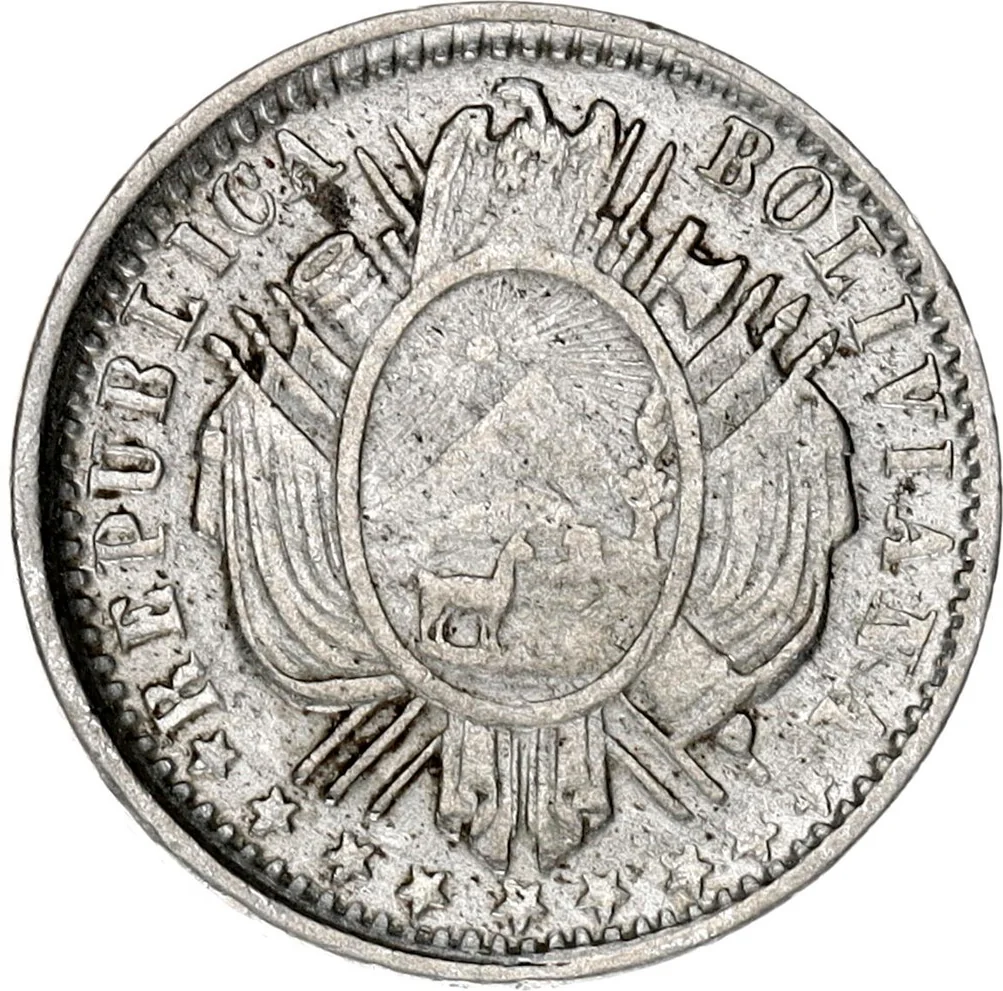
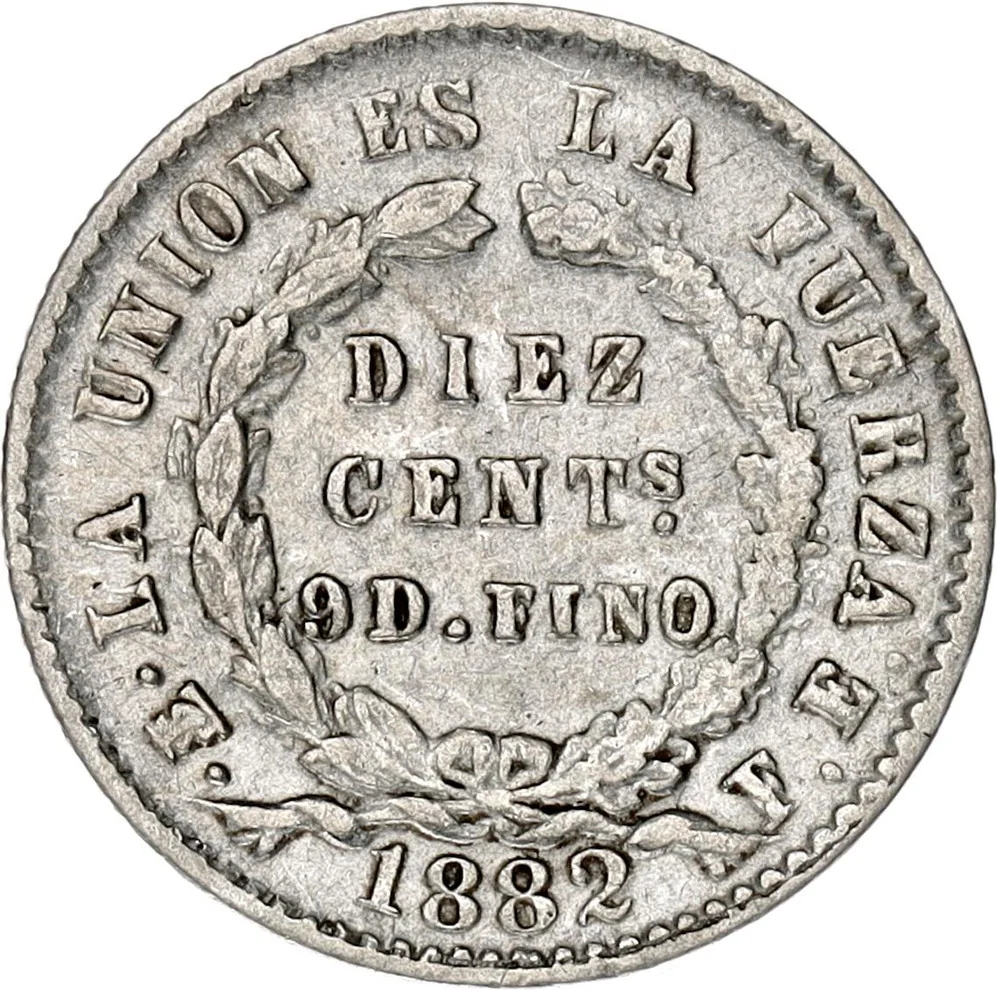
10 centavos – Bolivia
Add to wishlist
Bolivia
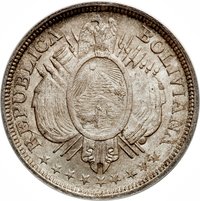
Obverse
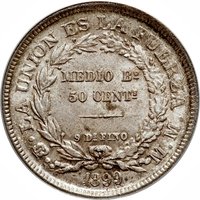
Reverse
Edge
Mints
| Name | Mark |
|---|---|
| Potosi | PTS |
Mintings
| Year | Mint Mark | Mintage | Quality | Collection |
|---|---|---|---|---|
| 1875 | FE | — | ||
| 1876 | FE | — | ||
| 1877 | FE | — | ||
| 1878 | FE | — | ||
| 1879 | FE | — | ||
| 1880 | FE | — | ||
| 1881 | FE | — | ||
| 1882 | FE | — | ||
| 1883 | F/EE | — | ||
| 1883 | FE | — | ||
| 1884 | FE | — | Proof |
Historical background
In 1875, Bolivia's currency situation was characterized by profound instability and fragmentation, a legacy of economic exhaustion following the Pacific War (1879-1884) that had not yet begun, but rooted in earlier fiscal crises. The national treasury was chronically depleted due to decades of political turbulence, costly military ventures, and a reliance on declining silver mining, which was the traditional backbone of the economy. The government of President Tomás Frías (1874-1876) operated under severe financial constraints, struggling to maintain a unified monetary standard while various forms of coinage, both domestic and foreign, circulated with fluctuating values.
The monetary system was officially bimetallic, based on both silver and gold, but in practice, it was dominated by silver. The primary unit was the Boliviano, a silver coin, but its value and acceptance were uneven. Crucially, the country suffered from a severe shortage of minted currency, leading to widespread circulation of foreign coins, particularly Peruvian and Chilean pesos, and even debased or counterfeit "feble" coins. This created a chaotic environment where exchange rates between different coin types varied by region and merchant, undermining commerce and state revenue collection.
Efforts to reform the system were ongoing but largely ineffective. The government had established the Banco Nacional de Bolivia in 1872 to help regulate currency and act as a treasury agent, but it lacked sufficient capital and public trust. Proposals to introduce paper money were met with deep skepticism from a populace that remembered the hyperinflation of earlier fiat experiments. Consequently, in 1875, Bolivia remained trapped in a cycle of fiscal weakness and monetary disorder, a prelude to the far greater economic catastrophe that would follow the loss of its nitrate-rich coastal territory in the war just a few years later.
The monetary system was officially bimetallic, based on both silver and gold, but in practice, it was dominated by silver. The primary unit was the Boliviano, a silver coin, but its value and acceptance were uneven. Crucially, the country suffered from a severe shortage of minted currency, leading to widespread circulation of foreign coins, particularly Peruvian and Chilean pesos, and even debased or counterfeit "feble" coins. This created a chaotic environment where exchange rates between different coin types varied by region and merchant, undermining commerce and state revenue collection.
Efforts to reform the system were ongoing but largely ineffective. The government had established the Banco Nacional de Bolivia in 1872 to help regulate currency and act as a treasury agent, but it lacked sufficient capital and public trust. Proposals to introduce paper money were met with deep skepticism from a populace that remembered the hyperinflation of earlier fiat experiments. Consequently, in 1875, Bolivia remained trapped in a cycle of fiscal weakness and monetary disorder, a prelude to the far greater economic catastrophe that would follow the loss of its nitrate-rich coastal territory in the war just a few years later.
🌟 Limited