

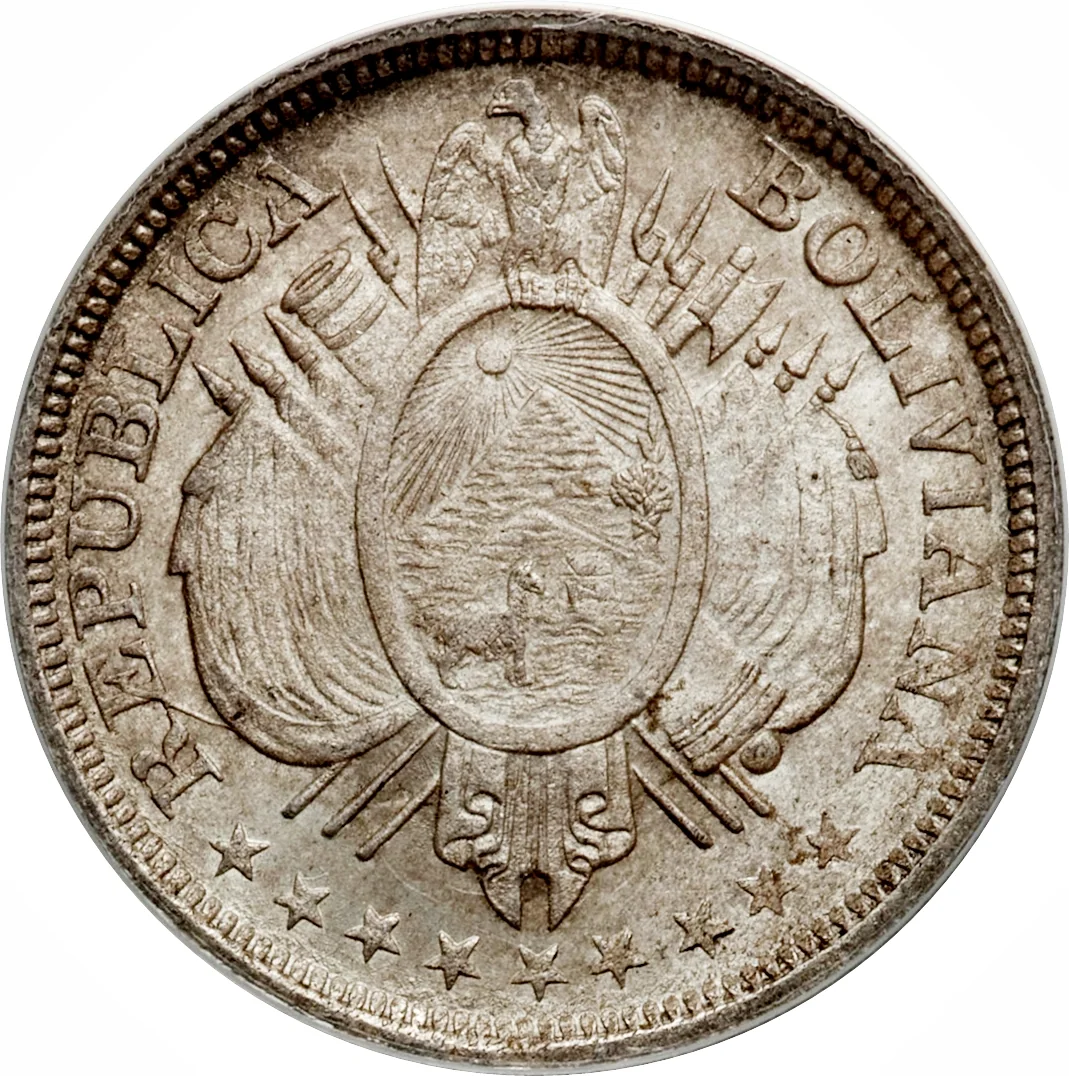
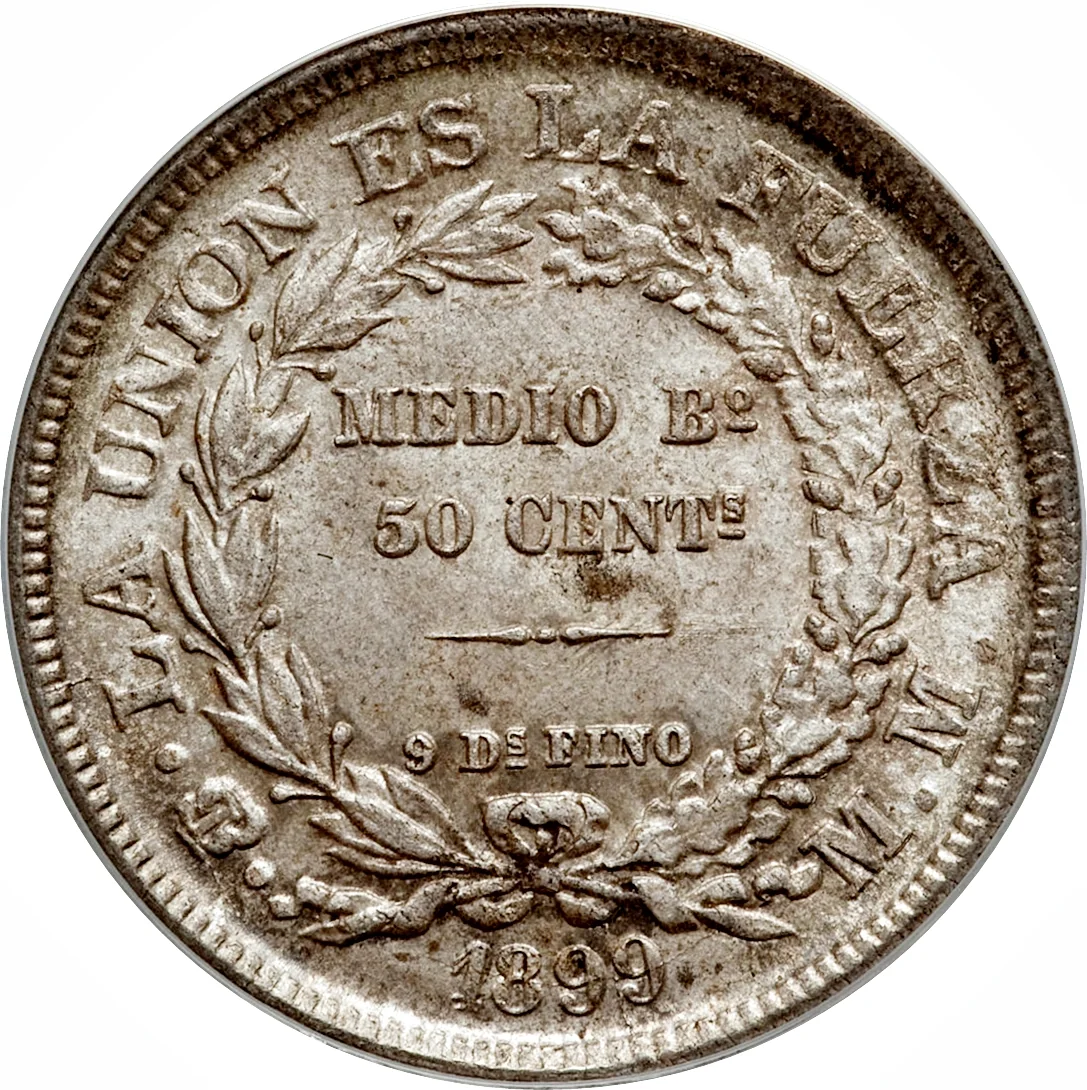
50 centavos – Bolivia
Add to wishlist
Bolivia
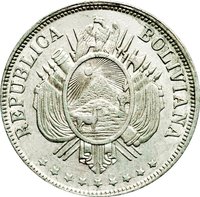
Obverse
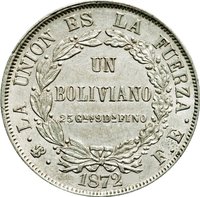
Reverse
Edge
Milled
Mints
| Name | Mark |
|---|---|
| Potosi | PTS |
Mintings
Historical background
In 1873, Bolivia's currency situation was characterized by a fragmented and unstable monetary system, a direct legacy of its colonial past and the economic turmoil following independence in 1825. The country operated on a bimetallic standard in theory, but in practice, a chaotic mix of Peruvian, Bolivian, and even older Spanish colonial coins circulated alongside rudimentary banknotes. The most significant unit was the Boliviano, introduced in 1864 to replace the old Scudo, but its adoption was incomplete. Crucially, the government lacked the institutional strength and bullion reserves to enforce a uniform national currency, leading to widespread confusion in trade and valuation.
This monetary disarray was exacerbated by a severe shortage of small-denomination coinage for everyday transactions, a problem known as falta de sencillo. To fill this void, private entities such as mining companies, merchants, and even local shops issued their own paper vouchers and tokens as makeshift currency. While this practice alleviated some immediate market pressures, it further undermined the state's monetary authority and created a patchwork of credit instruments of questionable and varying reliability. The public's trust in paper money remained low, with a strong preference for silver coin, particularly the Peruvian Sol, which was often more trusted than domestic issues.
The underlying weakness of the system reflected Bolivia's broader economic reality: a dependence on silver exports, primarily from the mines of Huanchaca, within a largely informal economy. Government finances were perpetually strained, limiting its ability to reform the currency or back it with substantial reserves. Therefore, in 1873, Bolivia's currency was not a tool of national economic integration but a symptom of its fragility—a non-uniform, specie-scarce system that hindered internal commerce and would remain vulnerable until more profound political stability and economic diversification could be achieved.
This monetary disarray was exacerbated by a severe shortage of small-denomination coinage for everyday transactions, a problem known as falta de sencillo. To fill this void, private entities such as mining companies, merchants, and even local shops issued their own paper vouchers and tokens as makeshift currency. While this practice alleviated some immediate market pressures, it further undermined the state's monetary authority and created a patchwork of credit instruments of questionable and varying reliability. The public's trust in paper money remained low, with a strong preference for silver coin, particularly the Peruvian Sol, which was often more trusted than domestic issues.
The underlying weakness of the system reflected Bolivia's broader economic reality: a dependence on silver exports, primarily from the mines of Huanchaca, within a largely informal economy. Government finances were perpetually strained, limiting its ability to reform the currency or back it with substantial reserves. Therefore, in 1873, Bolivia's currency was not a tool of national economic integration but a symptom of its fragility—a non-uniform, specie-scarce system that hindered internal commerce and would remain vulnerable until more profound political stability and economic diversification could be achieved.
🌱 Common