

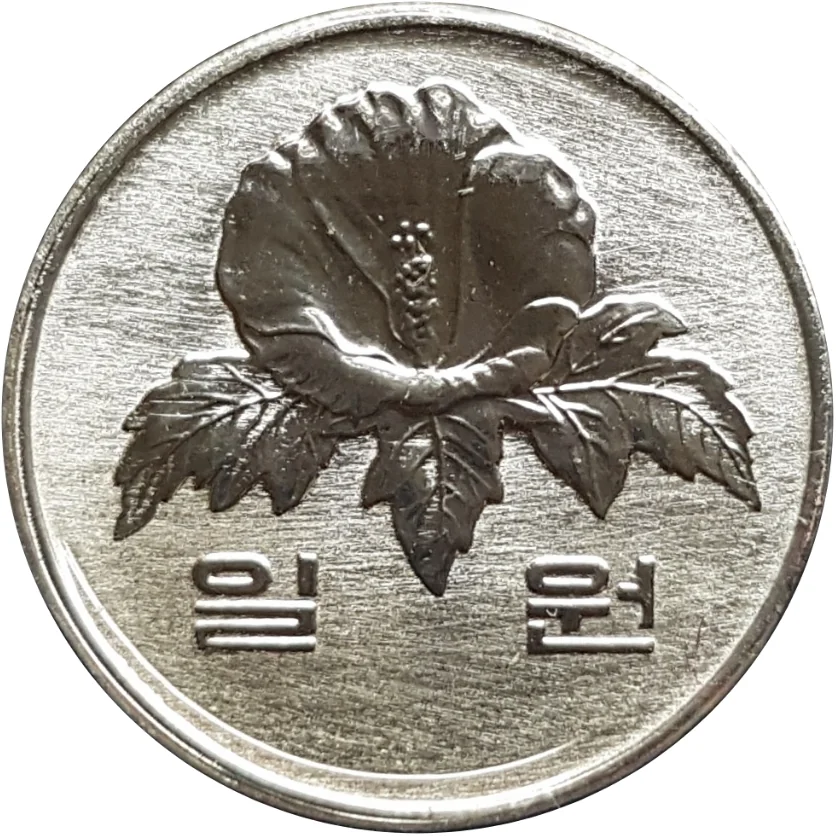
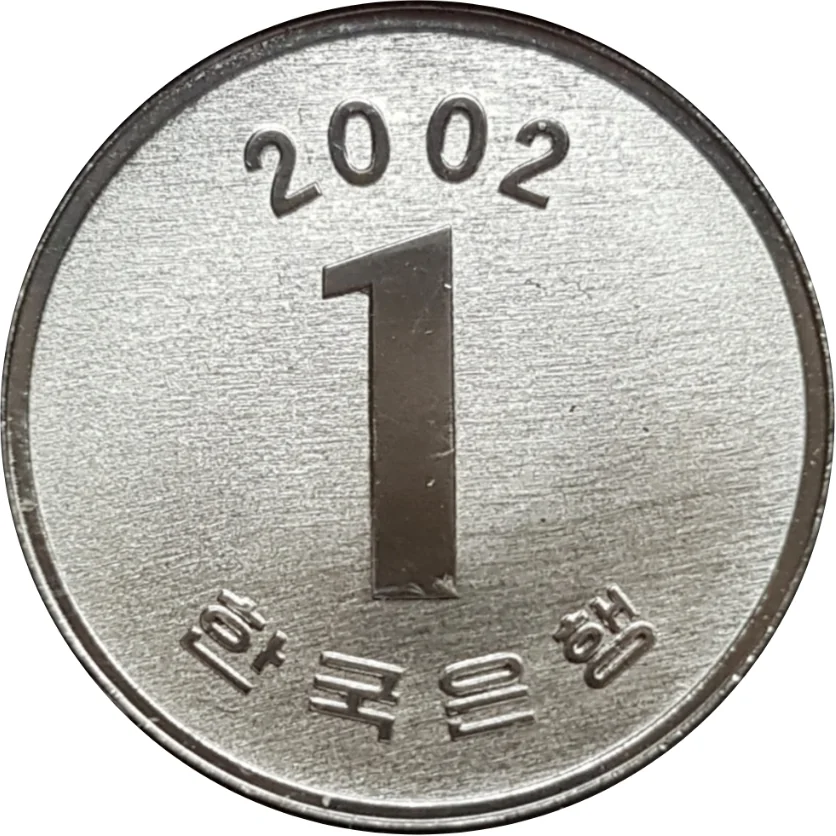
1 won – South Korea
Add to wishlist
South Korea
Context
Years: 1983–2025
Issuer: South Korea
Issuing organization: Bank of Korea
Period:
(since 1948)
Currency:
(since 1962)
Total mintage: 109,794,540
Material
References
KM: #
Numista: #2732
Value
Exchange value: 1 KRW
Inflation-adjusted value: 4.25 KRW
Obverse
Reverse
Edge
Plain
Mints
| Name | Mark |
|---|---|
| Korea Minting and Security Printing Corporation | — |
Mintings
| Year | Mint Mark | Mintage | Quality | Collection |
|---|---|---|---|---|
| 1983 | — | 40,000,000 | ||
| 1984 | — | 20,000,000 | ||
| 1985 | — | 10,000,000 | ||
| 1987 | — | 10,000,000 | ||
| 1988 | — | 6,500,000 | ||
| 1989 | — | 10,000,000 | ||
| 1990 | — | 6,000,000 | ||
| 1991 | — | 5,000,000 | ||
| 1995 | — | 15,000 | ||
| 1996 | — | 15,000 | ||
| 1997 | — | 15,000 | ||
| 2000 | — | 30,000 | ||
| 2001 | — | 130,000 | ||
| 2002 | — | 122,000 | ||
| 2003 | — | 20,000 | ||
| 2004 | — | 25,500 | ||
| 2005 | — | 38,000 | ||
| 2006 | — | 53,000 | ||
| 2007 | — | 53,000 | ||
| 2008 | — | 53,000 | ||
| 2009 | — | 53,000 | ||
| 2010 | — | 53,000 | ||
| 2011 | — | 53,000 | ||
| 2012 | — | 53,000 | ||
| 2013 | — | 54,000 | ||
| 2014 | — | 54,000 | ||
| 2015 | — | 64,000 | ||
| 2016 | — | 64,000 | ||
| 2017 | — | 74,000 | ||
| 2018 | — | 104,000 | ||
| 2019 | — | 152,000 | ||
| 2020 | — | 207,000 | ||
| 2020 | — | 70,000 | Proof | |
| 2021 | — | 100,000 | ||
| 2022 | — | 90,000 | ||
| 2023 | — | 210,020 | ||
| 2024 | — | 160,000 | ||
| 2025 | — | 110,020 |
Historical background
In 1983, South Korea's currency situation was characterized by a tightly controlled and undervalued won, operating under a fixed exchange rate system managed by the authoritarian government of President Chun Doo-hwan. The won was pegged to a basket of currencies, heavily weighted toward the U.S. dollar, at an official rate of approximately 748 won per dollar. This fixed rate was a key instrument of the state-led, export-oriented industrialization drive, as it kept Korean goods cheap and competitive on the global market. The government, through the Bank of Korea and strict capital controls, maintained absolute authority over foreign exchange transactions, with access to foreign currency severely restricted for both businesses and citizens to prioritize the needs of major export conglomerates, the chaebol.
This rigid system existed alongside a growing and volatile black market for foreign exchange, where the dollar traded at a significant premium. The disparity highlighted the mounting pressures on the won as Korea's rapid economic expansion, dubbed the "Miracle on the Han River," led to rising imports and a growing current account deficit. Furthermore, significant U.S. pressure was mounting for Korea to liberalize its financial markets and allow its currency to appreciate, partly to reduce America's own trade deficit. Internally, the system created distortions, shielding inefficient industries and contributing to high domestic inflation, which averaged around 7% that year.
Thus, 1983 represented a pivotal moment of mounting strain within a controlled regime. The currency policy was increasingly seen as unsustainable, caught between the successes of the export model it helped create and the new demands of a maturing economy and international trading partners. The tensions of this period would set the stage for a series of cautious liberalization measures later in the decade, beginning with a shift to a managed float in 1980, which was still being cautiously implemented, and culminating in the more significant financial reforms of the early 1990s.
This rigid system existed alongside a growing and volatile black market for foreign exchange, where the dollar traded at a significant premium. The disparity highlighted the mounting pressures on the won as Korea's rapid economic expansion, dubbed the "Miracle on the Han River," led to rising imports and a growing current account deficit. Furthermore, significant U.S. pressure was mounting for Korea to liberalize its financial markets and allow its currency to appreciate, partly to reduce America's own trade deficit. Internally, the system created distortions, shielding inefficient industries and contributing to high domestic inflation, which averaged around 7% that year.
Thus, 1983 represented a pivotal moment of mounting strain within a controlled regime. The currency policy was increasingly seen as unsustainable, caught between the successes of the export model it helped create and the new demands of a maturing economy and international trading partners. The tensions of this period would set the stage for a series of cautious liberalization measures later in the decade, beginning with a shift to a managed float in 1980, which was still being cautiously implemented, and culminating in the more significant financial reforms of the early 1990s.
🌱 Very Common