

1 dinar – Serbia
Add to wishlist
Serbia
Context
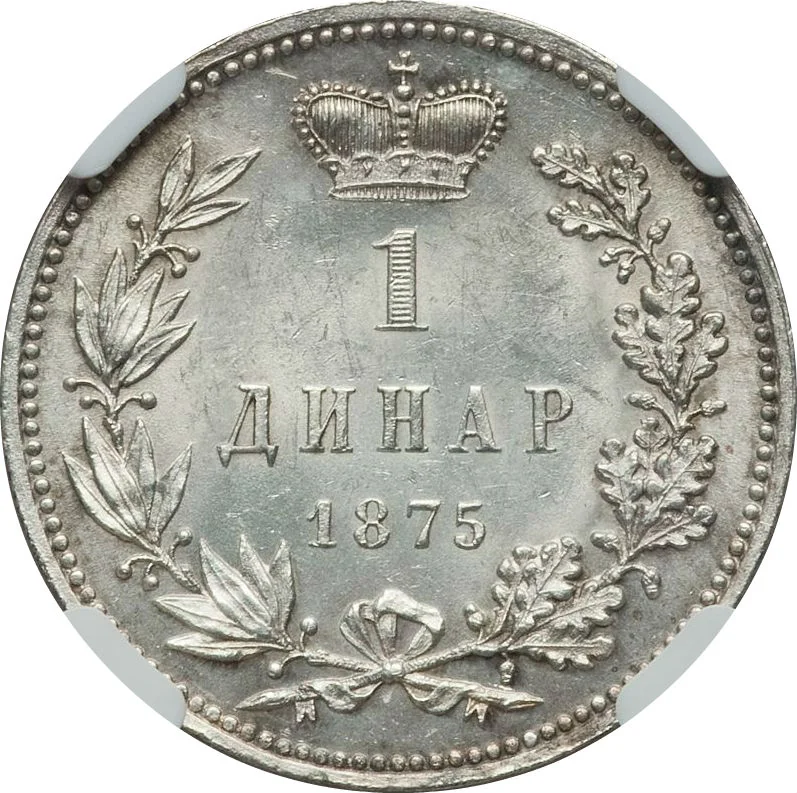
Year: 1875
Issuer: Serbia
Ruler: Milan Obrenović IV
Currency:
(1868—1918)
Demonetized: Yes
Total mintage: 3,000,000
Material
References
KM: #
Numista: #27311
Value
Bullion value: $10.48
Obverse
Description:
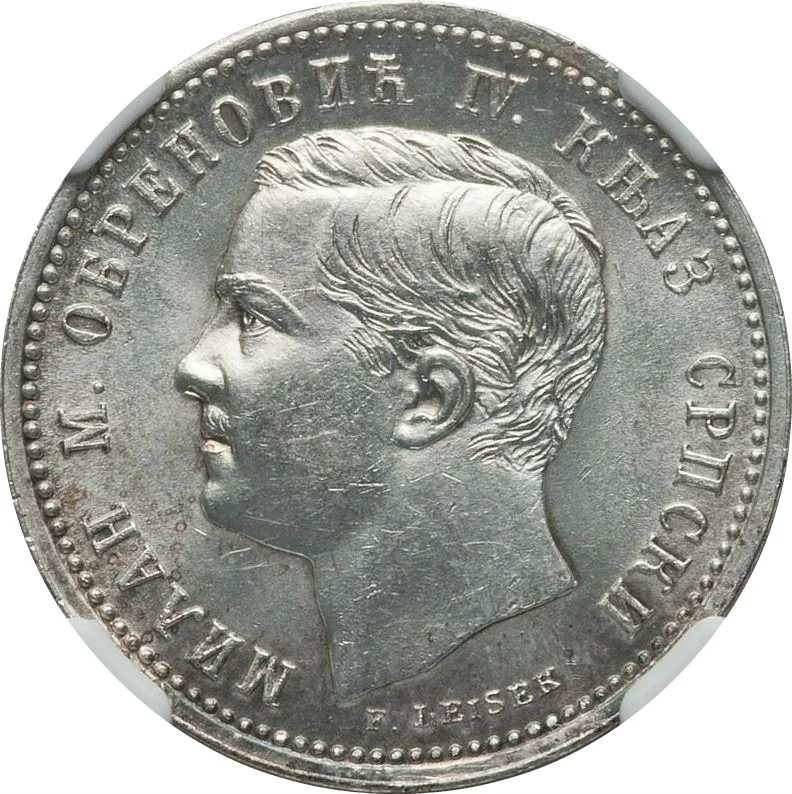
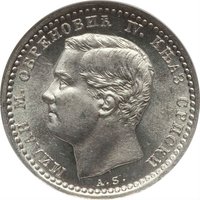
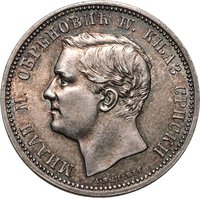
Milan Obrenović IV, left profile.
Inscription:
МИЛАН М. ОБРЕНОВИЋ IV.
КЊАЗ СРПСКИ
F. LEISEK
КЊАЗ СРПСКИ
F. LEISEK
Translation:
Milan M. Obrenović IV.
Prince of Serbia
F. Leisek
Prince of Serbia
F. Leisek
Script: Cyrillic
Engraver: Joseph F. Leisek
Reverse
Edge
Plain
Mintings
| Year | Mint Mark | Mintage | Quality | Collection |
|---|---|---|---|---|
| 1875 | — | 3,000,000 | ||
| 1875 | — | — | Proof |
Historical background
In 1875, Serbia operated under a complex and fragmented monetary system, a legacy of centuries of Ottoman rule and growing economic independence. The official currency was the Serbian dinar, introduced in 1868 to replace the Ottoman kuruş (piaster), but its circulation was limited and it struggled to gain public trust. In practice, the economy relied on a bewildering array of foreign coins, primarily the Austrian florin (guilder), Ottoman lira and kuruş, and Russian rubles. This monetary pluralism created chronic instability, as exchange rates fluctuated and hindered domestic trade and state financial planning.
The situation was exacerbated by Serbia's lack of a modern banking system and limited precious metal reserves to back its own currency. The National Bank of Serbia, a crucial institution for issuing stable banknotes, would not be founded until 1884. Consequently, the state treasury was often strained, relying heavily on foreign loans and customs revenue. The concurrent economic downturn in the Ottoman Empire, of which Serbia was still a nominal vassal, further disrupted regional trade and financial flows.
This unstable currency backdrop was a significant factor in the political tensions that culminated in the Herzegovina Uprising of 1875 and the subsequent Serbo-Turkish Wars (1876-1878). A weak and fragmented monetary system limited the Principality's ability to finance military modernization and state-building projects, underscoring its economic vulnerability as it moved toward full independence from the Porte. Thus, the currency chaos of 1875 was not merely a financial issue but a reflection of Serbia's transitional and precarious position on the path to sovereign nationhood.
The situation was exacerbated by Serbia's lack of a modern banking system and limited precious metal reserves to back its own currency. The National Bank of Serbia, a crucial institution for issuing stable banknotes, would not be founded until 1884. Consequently, the state treasury was often strained, relying heavily on foreign loans and customs revenue. The concurrent economic downturn in the Ottoman Empire, of which Serbia was still a nominal vassal, further disrupted regional trade and financial flows.
This unstable currency backdrop was a significant factor in the political tensions that culminated in the Herzegovina Uprising of 1875 and the subsequent Serbo-Turkish Wars (1876-1878). A weak and fragmented monetary system limited the Principality's ability to finance military modernization and state-building projects, underscoring its economic vulnerability as it moved toward full independence from the Porte. Thus, the currency chaos of 1875 was not merely a financial issue but a reflection of Serbia's transitional and precarious position on the path to sovereign nationhood.
🌟 Limited