

2 dollars – ERR New ZealandandUnited Kingdom
Add to wishlist
Context
Material
Diameter: 26.5 mm
Weight: 10 g
Shape: Round
Composition: Aluminium bronze
Magnetic: No
Technique: Milled
Alignment: Medal alignment
flip
References
Numista: #272622
Value
Exchange value: 2 NZD
Obverse
Description:
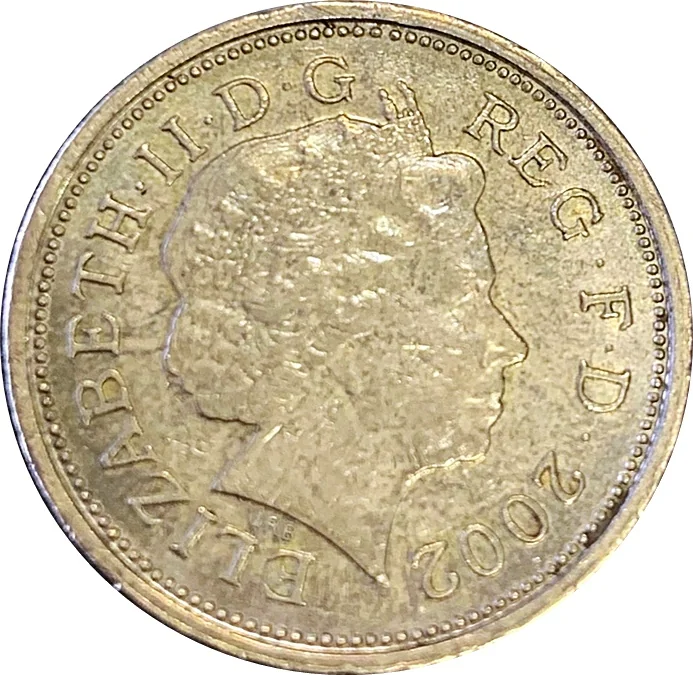
Queen Elizabeth IV facing right, wearing the Girls of Great Britain and Ireland tiara.
Inscription:
ELIZABETH·II·D·G REG·F·D·2002
IRB
IRB
Translation:
Elizabeth the Second, by the Grace of God, Queen, Defender of the Faith, 2002
Script: Latin
Designer: Ian Rank-Broadley
Reverse
Description:
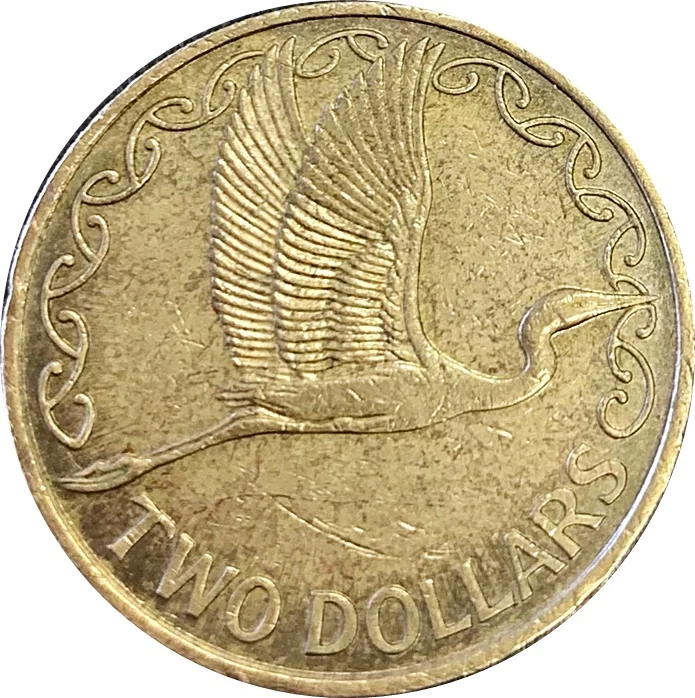
Kotuku (white heron) within a Maori motif, denomination below.
Inscription:
TWO DOLLARS
Script: Latin
Designer: Robert Maurice Conly
Edge
Security
Mints
| Name | Mark |
|---|---|
| Royal Mint | — |
Mintings
| Year | Mint Mark | Mintage | Quality | Collection |
|---|---|---|---|---|
| 2002 | — | — |
Historical background
In 2002, both New Zealand and the United Kingdom operated with distinct monetary policy frameworks, but shared a common focus on managing inflation. In New Zealand, the Reserve Bank of New Zealand (RBNZ) was a pioneer, having adopted an inflation targeting regime in 1990. By 2002, this policy was well-established, with the Official Cash Rate (OCR) set at 5.75% for much of the year to keep Consumer Price Index (CPI) inflation within the target band of 0-3%. The New Zealand dollar (NZD), having floated since 1985, was experiencing a period of relative strength, which helped contain import prices but also posed challenges for exporters.
Across the globe, the United Kingdom in 2002 was in its fifth year of operational independence for the Bank of England (BoE). The Monetary Policy Committee (MPC) was tasked with meeting a government-set inflation target of 2.5% for the Retail Price Index (RPIX). Interest rates were held at a historically low 4% for the entire year, a response to subdued global economic growth and muted domestic inflationary pressures following the dot-com bubble burst. The pound sterling (GBP) was strong, trading significantly above its late 1990s lows, partly due to the UK's relative economic stability compared to the Eurozone.
A key divergence between the two nations was their relationship with larger currency unions. The UK, having opted out of the Euro, was in a period of assessment following the 1997 "five economic tests" criteria for possible adoption; a decision was pending for 2003. New Zealand, meanwhile, had ongoing discussions about potential "dollarisation" with the Australian dollar, but these remained theoretical, with a firm commitment to maintaining its independent currency and monetary policy. Both economies were navigating post-2001 global uncertainty, using their independent monetary levers to balance growth and price stability in a world of floating exchange rates.
Across the globe, the United Kingdom in 2002 was in its fifth year of operational independence for the Bank of England (BoE). The Monetary Policy Committee (MPC) was tasked with meeting a government-set inflation target of 2.5% for the Retail Price Index (RPIX). Interest rates were held at a historically low 4% for the entire year, a response to subdued global economic growth and muted domestic inflationary pressures following the dot-com bubble burst. The pound sterling (GBP) was strong, trading significantly above its late 1990s lows, partly due to the UK's relative economic stability compared to the Eurozone.
A key divergence between the two nations was their relationship with larger currency unions. The UK, having opted out of the Euro, was in a period of assessment following the 1997 "five economic tests" criteria for possible adoption; a decision was pending for 2003. New Zealand, meanwhile, had ongoing discussions about potential "dollarisation" with the Australian dollar, but these remained theoretical, with a firm commitment to maintaining its independent currency and monetary policy. Both economies were navigating post-2001 global uncertainty, using their independent monetary levers to balance growth and price stability in a world of floating exchange rates.
✨ Legendary