

1 cash – Turkestan Khanate
Add to wishlist
China
Context
Years: 1864–1867
Country: China
Issuer: Turkestan Khanate
Ruler: Rashidin Khan Khoja
Currency:
(1864—1867)
Demonetized: Yes
Material
Diameter: 25 mm
Weight: 3.45 g
Shape: Round with a square hole
Composition: Copper
Magnetic: No
Technique: Cast
Alignment: Medal alignment
flip
References
Numista: #272300
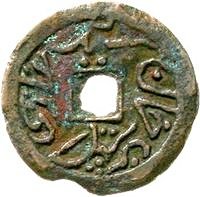
Obverse
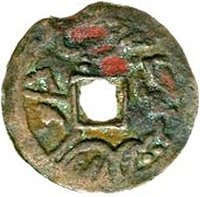
Reverse
Edge
Plain
Mints
| Name | Mark |
|---|---|
| Aksu Mint | — |
Mintings
| Year | Mint Mark | Mintage | Quality | Collection |
|---|---|---|---|---|
| — | — | — |
Historical background
In 1864, the Turkestan Khanate, more commonly referred to as the Khanate of Kokand, was in a state of severe monetary and political crisis. Its currency system, based on a silver tanga and copper pul, was fundamentally destabilized. Years of costly warfare against the expanding Russian Empire and rival khanates, combined with rampant internal corruption and the extravagant spending of the court, had drained the state treasury. To finance these deficits, the Khudayar Khan, who had recently been reinstated with Russian support, resorted to the debasement of coinage, reducing the silver content in tangas and issuing excessive amounts of copper pul, leading to sharp inflation and a loss of public confidence in the currency.
This monetary instability mirrored and exacerbated the broader collapse of the khanate's authority. The debased currency crippled trade, angered merchants and the population, and made it difficult to pay soldiers and officials reliably. Simultaneously, Khudayar Khan’s oppressive taxation and perceived subservience to Russian interests fueled widespread rebellion. Key religious and tribal leaders, including the powerful Kyrgyz chief Alimqul, led insurrections that by mid-1864 had stripped Khudayar of control over most of his realm beyond the capital, effectively fracturing the state’s economic and political unity.
Therefore, the currency situation in 1864 was not merely a financial issue but a critical symptom of the khanate's death throes. The collapse of its monetary system reflected a complete failure of central governance and fiscal policy. Within months, this internal chaos would be decisively exploited by the Russian Empire, whose forces were already advancing into the region, leading to the fall of Tashkent in 1865 and the eventual annexation of the khanate's territories, ending its independent existence.
This monetary instability mirrored and exacerbated the broader collapse of the khanate's authority. The debased currency crippled trade, angered merchants and the population, and made it difficult to pay soldiers and officials reliably. Simultaneously, Khudayar Khan’s oppressive taxation and perceived subservience to Russian interests fueled widespread rebellion. Key religious and tribal leaders, including the powerful Kyrgyz chief Alimqul, led insurrections that by mid-1864 had stripped Khudayar of control over most of his realm beyond the capital, effectively fracturing the state’s economic and political unity.
Therefore, the currency situation in 1864 was not merely a financial issue but a critical symptom of the khanate's death throes. The collapse of its monetary system reflected a complete failure of central governance and fiscal policy. Within months, this internal chaos would be decisively exploited by the Russian Empire, whose forces were already advancing into the region, leading to the fall of Tashkent in 1865 and the eventual annexation of the khanate's territories, ending its independent existence.
✨ Legendary