

1 Cash – Turkestan Khanate
China
Context
Years: 1865–1867
Country: China 
Issuer: Turkestan Khanate
Ruler: Rashidin Khan Khoja
Currency:
(1864—1867)
Demonetized: Yes
Material
Diameter: 25 mm
Weight: 3.47 g
Shape: Round with a square hole
Composition: Copper
Magnetic: No
Technique: Cast
Alignment: Medal alignment
flip
References
Numista: #272299
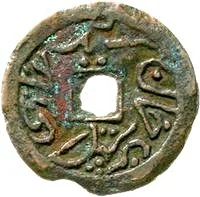
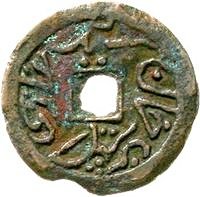
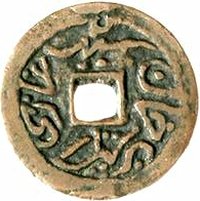
Obverse
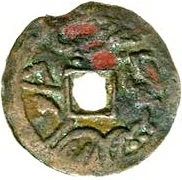
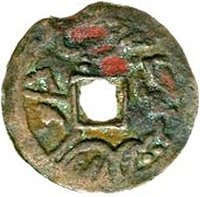
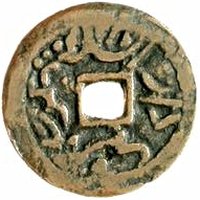
Reverse
Description:
Arabic script encircles the opening.
Inscription:
زرب دار السلطانات كوجا
Translation:
Struck in the Abode of the Sultans, Koca
Script: Arabic
Language: Ottoman Turkish
Edge
Plain
Mintings
| Year | Mint Mark | Mintage | Quality | Collection |
|---|---|---|---|---|
| — | ٢ | — |
Historical background
In 1865, the Turkestan Khanate, more commonly referred to as the Khanate of Kokand, was in a state of severe political and economic crisis, which was directly reflected in its currency. The khanate, centered in the Fergana Valley, was under immense pressure from the advancing Russian Empire, which had already captured the major city of Tashkent that same year. This military collapse destabilized the central authority of Khan Khudayar, leading to widespread rebellion and fiscal chaos. The state treasury was depleted from constant warfare, and the traditional silver tanga coinage, the backbone of the monetary system, suffered from severe debasement as the government scrambled to finance its armies and administration.
The currency in circulation was a heterogeneous mix, reflecting the khanate’s history and its precarious position on the Silk Road. Alongside the debased Kokandi tangas, older Bukharan and even Russian coins circulated, alongside Chinese puls (copper coins) in the east, and barter remained significant in rural areas. The most acute problem was the drastic shortage of full-weight silver coins, leading to a disconnect between the official and market value of money. This instability crippled long-distance trade and caused price inflation, further eroding public confidence in the Khan's government and exacerbating the social unrest that was tearing the state apart.
Ultimately, the monetary disorder of 1865 was a symptom of the khanate’s impending dissolution. With Russian forces at the gates and internal revolt spreading, the authority needed to enforce a uniform and stable currency had evaporated. The economic fragmentation mirrored the political fragmentation, as regional warlords and rebel leaders likely issued their own tokens or reverted to local payment systems. Within a decade, the Khanate of Kokand would be fully annexed by the Russian Empire, which subsequently imposed its own ruble-based monetary system, bringing a definitive end to the chaotic and declining currency regime of the independent khanate.
The currency in circulation was a heterogeneous mix, reflecting the khanate’s history and its precarious position on the Silk Road. Alongside the debased Kokandi tangas, older Bukharan and even Russian coins circulated, alongside Chinese puls (copper coins) in the east, and barter remained significant in rural areas. The most acute problem was the drastic shortage of full-weight silver coins, leading to a disconnect between the official and market value of money. This instability crippled long-distance trade and caused price inflation, further eroding public confidence in the Khan's government and exacerbating the social unrest that was tearing the state apart.
Ultimately, the monetary disorder of 1865 was a symptom of the khanate’s impending dissolution. With Russian forces at the gates and internal revolt spreading, the authority needed to enforce a uniform and stable currency had evaporated. The economic fragmentation mirrored the political fragmentation, as regional warlords and rebel leaders likely issued their own tokens or reverted to local payment systems. Within a decade, the Khanate of Kokand would be fully annexed by the Russian Empire, which subsequently imposed its own ruble-based monetary system, bringing a definitive end to the chaotic and declining currency regime of the independent khanate.

✨ Legendary