

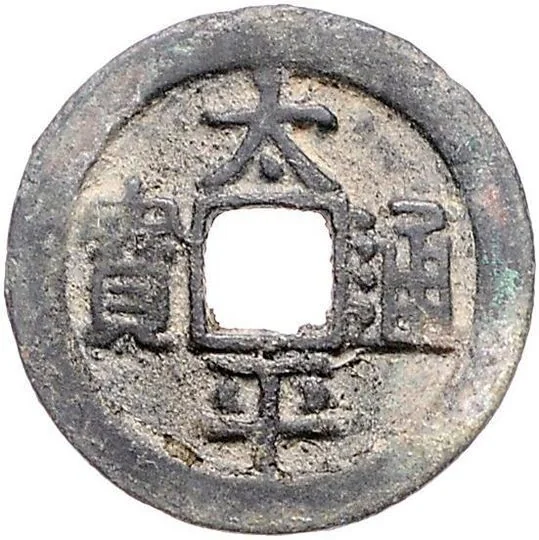
1 Cash – Small Sword Society
China
Context

Material
Diameter: 25 mm
Weight: 3.78 g
Shape: Round with a square hole
Composition: Brass
Magnetic: No
Technique: Cast
Alignment: Medal alignment
flip
References
Numista: #271975
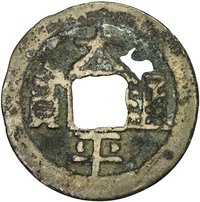
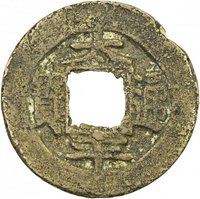
Obverse
Description:
Four Chinese characters read vertically, right to left.
Inscription:
太
寶 通
平
寶 通
平
Translation:
Taiping Treasure Coin.
Scripts: Chinese (traditional, regular script)
Language: Classical Chinese
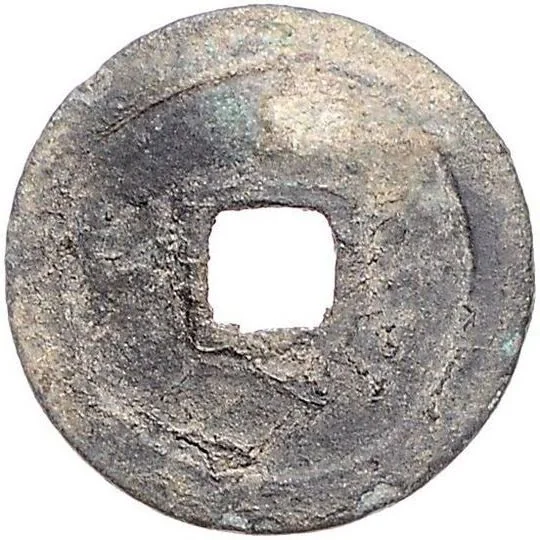
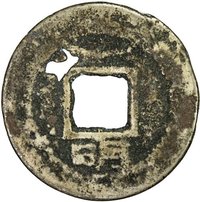
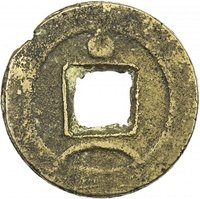
Reverse
Description:
Blank (uniface).
Edge
Plain
Mintings
| Year | Mint Mark | Mintage | Quality | Collection |
|---|---|---|---|---|
| — | — | — |
Historical background
The Small Sword Society uprising in Shanghai (1853-1855) created a complex and chaotic currency situation by 1854, reflecting its precarious position as a rebel enclave within a collapsing economic system. Having seized the Chinese-administered parts of Shanghai, the society operated in a major international port while being besieged by Qing imperial forces. This isolation disrupted normal tax revenue and trade, forcing the rebels to finance their administration and military through ad-hoc measures, including confiscations, levies on trade, and donations from sympathetic merchants. The regular Qing monetary system, based on silver taels and copper cash, became severely strained as the rebellion disrupted supply chains and eroded public confidence.
Within the society's controlled territory, a multi-layered currency ecosystem emerged. Crucially, foreign silver coins, especially Spanish Carolus and Mexican dollars, continued to circulate due to the undisturbed foreign concessions and their role in international trade. The Small Sword Society itself attempted to assert sovereignty and generate funds by minting its own coinage. They produced both silver and copper coins, often stamped with the name of the reigning Ming dynasty heir they supported ("Taiping Tongbao") or their own slogans. However, these issues were limited in quantity and scope, failing to establish a unified, trusted currency. Meanwhile, the Qing authorities continued to circulate their own money, and private merchants issued promissory notes and scrip, leading to a competitive and confusing monetary environment.
The currency chaos of 1854 ultimately mirrored the society's political and military fragility. The proliferation of different monies, coupled with inflationary pressures from scarcity and siege, created economic hardship for the populace. The inability to establish a stable, authoritative currency undermined the society's claim to legitimate governance and complicated daily commerce. This financial instability, combined with the relentless Qing blockade, eroded the rebellion's internal cohesion and economic foundation, contributing significantly to its eventual defeat and suppression in early 1855.
Within the society's controlled territory, a multi-layered currency ecosystem emerged. Crucially, foreign silver coins, especially Spanish Carolus and Mexican dollars, continued to circulate due to the undisturbed foreign concessions and their role in international trade. The Small Sword Society itself attempted to assert sovereignty and generate funds by minting its own coinage. They produced both silver and copper coins, often stamped with the name of the reigning Ming dynasty heir they supported ("Taiping Tongbao") or their own slogans. However, these issues were limited in quantity and scope, failing to establish a unified, trusted currency. Meanwhile, the Qing authorities continued to circulate their own money, and private merchants issued promissory notes and scrip, leading to a competitive and confusing monetary environment.
The currency chaos of 1854 ultimately mirrored the society's political and military fragility. The proliferation of different monies, coupled with inflationary pressures from scarcity and siege, created economic hardship for the populace. The inability to establish a stable, authoritative currency undermined the society's claim to legitimate governance and complicated daily commerce. This financial instability, combined with the relentless Qing blockade, eroded the rebellion's internal cohesion and economic foundation, contributing significantly to its eventual defeat and suppression in early 1855.

✨ Legendary