

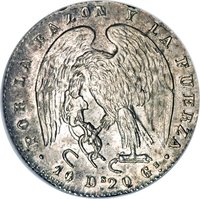
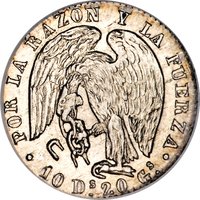
Obverse
Description:
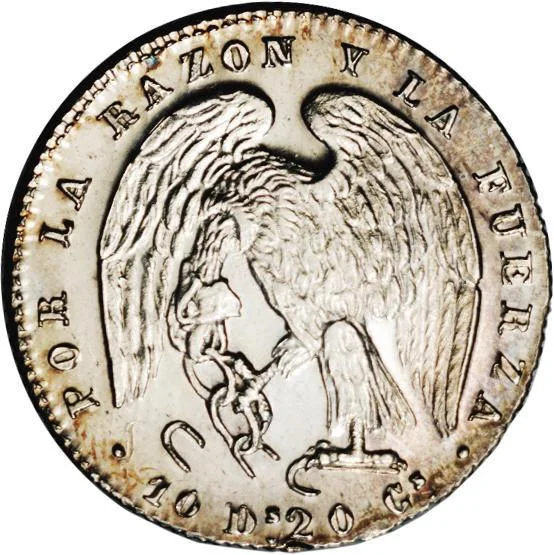
Condor shatters chains.
Inscription:
POR LA RAZON Y LA FUERZA
· 10 Ds. 20 Gs. ·
· 10 Ds. 20 Gs. ·
Script: Latin
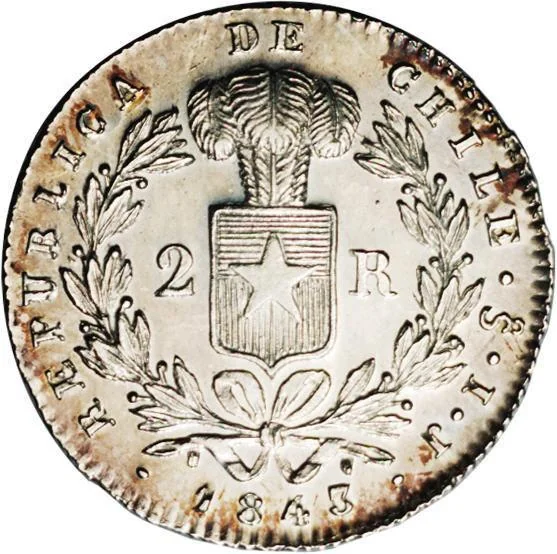
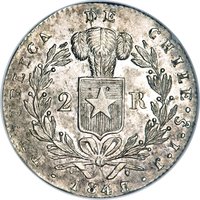
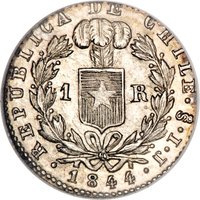
Reverse
Edge
Reeded
Mintings
| Year | Mint Mark | Mintage | Quality | Collection |
|---|---|---|---|---|
| 1843 | So | — | ||
| 1844 | So | — | ||
| 1845 | So | — | ||
| 1846 | So | — | ||
| 1847 | So | — | ||
| 1848 | So | — | ||
| 1849 | So | — | ||
| 1850 | So | — | ||
| 1851 | So | — | ||
| 1852 | So | — |
Historical background
In 1843, Chile's currency situation was characterized by a chaotic and fragmented system, a direct legacy of the colonial era and the early decades of independence. The official unit of account was the peso, but the physical money in circulation was a confusing mix of foreign and domestic coins. Spanish colonial coins, such as the gold escudo and silver real, circulated alongside coins from other Latin American nations like Peru and Bolivia, as well as European currencies. Crucially, the value of these coins was not fixed by their face value but by their intrinsic metallic content (gold or silver weight), leading to constant valuation disputes and complexity in commerce.
The Chilean state attempted to impose order by minting its own coins at the Casa de Moneda in Santiago. The most significant domestic coin was the silver peso of 8 reales, but its production was insufficient to drive out foreign currencies. Furthermore, a severe shortage of small-denomination coinage (moneda menuda) for everyday transactions plagued the economy. This scarcity led to the widespread and problematic use of fichas (private tokens) issued by haciendas, mines, and merchants, which created a semi-feudal currency system where workers were often paid in tokens only redeemable at company-owned stores (pulperías).
This monetary anarchy was recognized as a major obstacle to national economic integration, administration, and growth. Consequently, the year 1843 fell within a period of active reform. Just three years prior, in 1840, a law had been passed to decimalize the currency, and in 1844, a major step would be taken with the issuance of the first regulated Chilean copper coins. Therefore, the 1843 landscape represents the tail end of the colonial monetary disorder, poised on the cusp of the state-led consolidation that would eventually lead to the creation of a unified, national currency system under the Condor and Peso in the 1850s.
The Chilean state attempted to impose order by minting its own coins at the Casa de Moneda in Santiago. The most significant domestic coin was the silver peso of 8 reales, but its production was insufficient to drive out foreign currencies. Furthermore, a severe shortage of small-denomination coinage (moneda menuda) for everyday transactions plagued the economy. This scarcity led to the widespread and problematic use of fichas (private tokens) issued by haciendas, mines, and merchants, which created a semi-feudal currency system where workers were often paid in tokens only redeemable at company-owned stores (pulperías).
This monetary anarchy was recognized as a major obstacle to national economic integration, administration, and growth. Consequently, the year 1843 fell within a period of active reform. Just three years prior, in 1840, a law had been passed to decimalize the currency, and in 1844, a major step would be taken with the issuance of the first regulated Chilean copper coins. Therefore, the 1843 landscape represents the tail end of the colonial monetary disorder, poised on the cusp of the state-led consolidation that would eventually lead to the creation of a unified, national currency system under the Condor and Peso in the 1850s.
⭐ Somewhat Rare