

1 Riyal – British Mandate of Mesopotamia
Iraq
Context
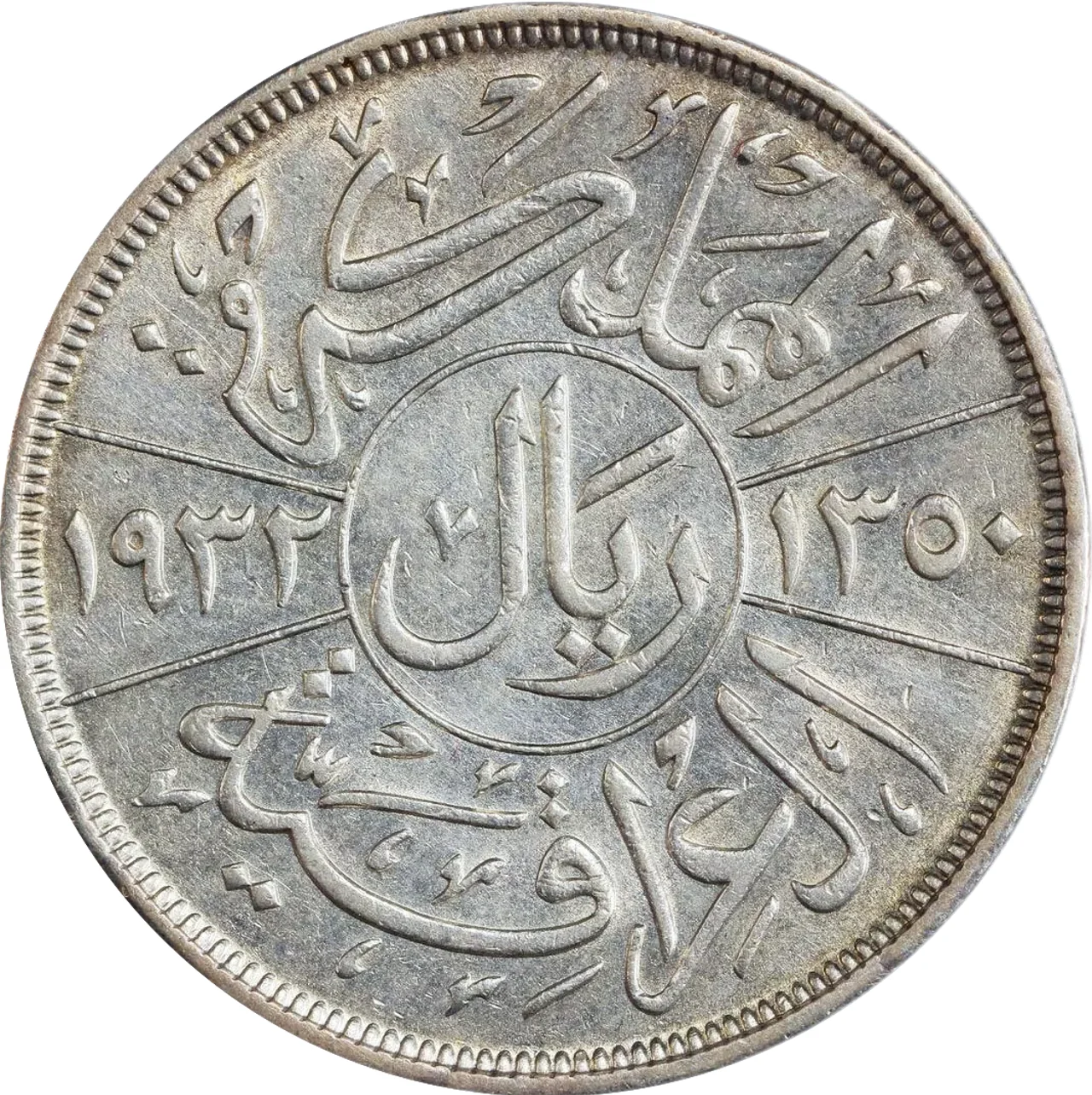
Year: 1932
Islamic (Hijri) Year: 1350
Country: Iraq 
Issuer: British Mandate of Mesopotamia
Ruler: Faisal I
Currency:
(since 1931)
Demonetization: 6 January 1961
Total mintage: 500,020
Material
References
KM: #Click to copy to clipboard101
Numista: #27139
Value
Exchange value: ⅕ IQD
Bullion value: $28.89
Obverse
Description:
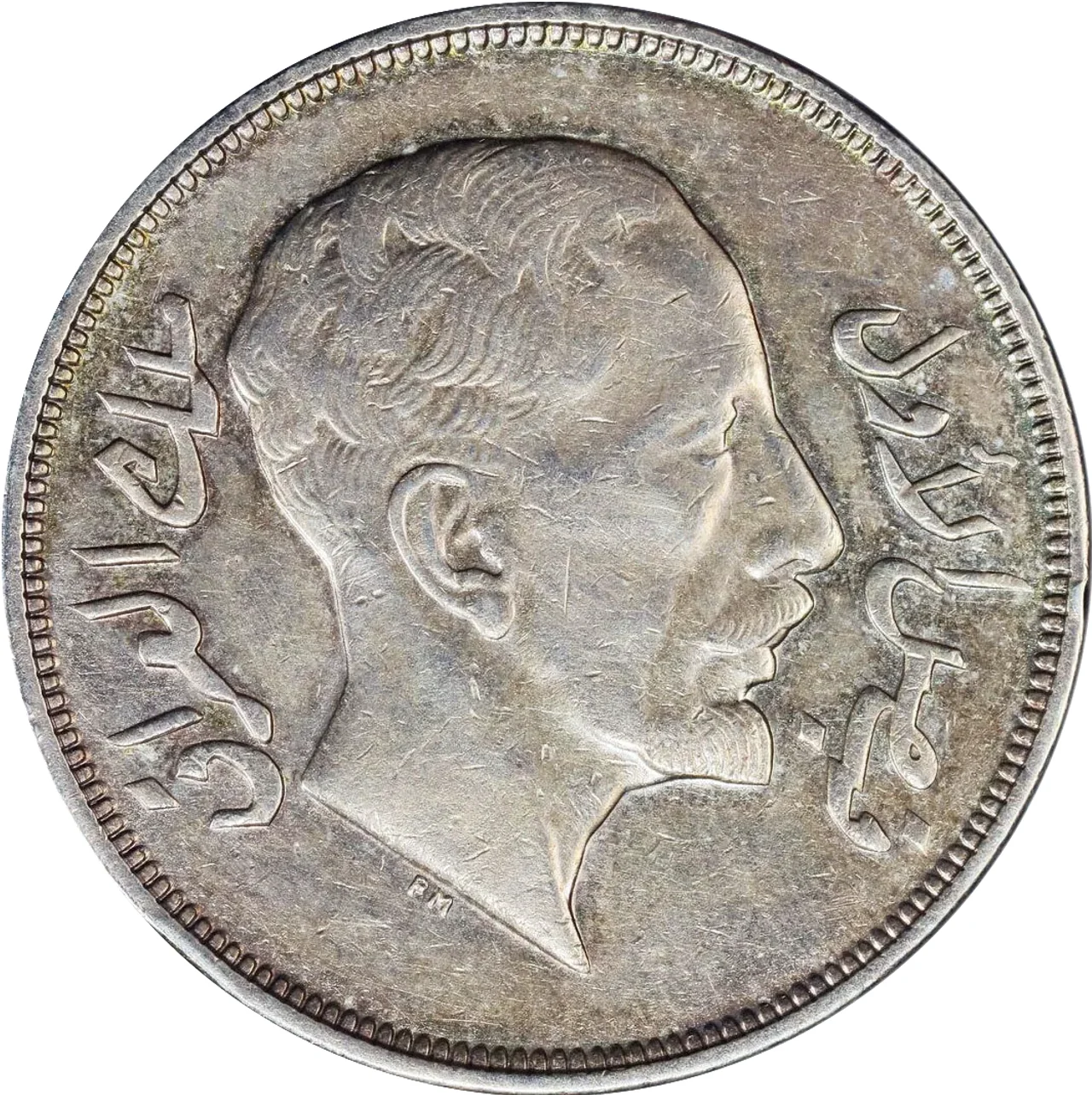
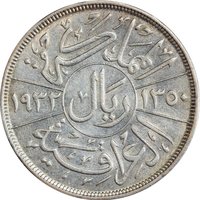
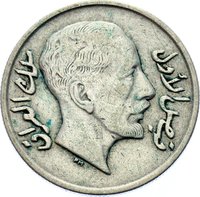
King Faisal (1921-1933) in right profile with flanking text.
Inscription:
فيصل الأول
ملك العراق
ملك العراق
Translation:
Faisal the First
King of Iraq
King of Iraq
Script: Arabic
Language: Arabic
Engraver: Percy Metcalfe
Reverse
Edge
Mints
| Name | Mark |
|---|---|
| Royal Mint (Tower Hill) | — |
Mintings
| Year | Mint Mark | Mintage | Quality | Collection |
|---|---|---|---|---|
| 1932 | — | 500,000 | ||
| 1932 | — | 20 | Proof |
Historical background
By 1932, the currency situation in the British Mandate of Mesopotamia (soon to become the independent Kingdom of Iraq) was characterized by a transitional and hybrid system, heavily influenced by British imperial finance. The official currency was the Iraqi dinar, introduced in 1931 to replace the Indian rupee, which had been the circulating currency since the British occupation during World War I. The dinar was pegged to the British pound sterling at a fixed rate of 1 dinar = 1 pound, firmly anchoring Iraq's economy to the sterling bloc and ensuring monetary stability as it approached independence.
This new currency was issued by the Iraqi Currency Board, headquartered in London. The board held all of Iraq's sterling reserves, guaranteeing full convertibility. While the dinar was the unit of account for government transactions and larger commerce, in practice, a multitude of coins and notes from the preceding period remained in widespread circulation, particularly in rural areas. This included Indian rupees, Ottoman coins, and even Maria Theresa thalers, creating a somewhat fragmented everyday monetary environment.
The 1932 currency arrangement was a deliberate political and economic construct. It provided the nascent Iraqi state with a stable and credible currency to underpin its sovereignty, but it also maintained British financial control. The London-based Currency Board meant Iraq's monetary policy was effectively outsourced, ensuring its economic alignment with British interests even after the Mandate officially ended in October 1932. Thus, the system represented a careful balance between Iraqi nation-building and enduring imperial influence.
This new currency was issued by the Iraqi Currency Board, headquartered in London. The board held all of Iraq's sterling reserves, guaranteeing full convertibility. While the dinar was the unit of account for government transactions and larger commerce, in practice, a multitude of coins and notes from the preceding period remained in widespread circulation, particularly in rural areas. This included Indian rupees, Ottoman coins, and even Maria Theresa thalers, creating a somewhat fragmented everyday monetary environment.
The 1932 currency arrangement was a deliberate political and economic construct. It provided the nascent Iraqi state with a stable and credible currency to underpin its sovereignty, but it also maintained British financial control. The London-based Currency Board meant Iraq's monetary policy was effectively outsourced, ensuring its economic alignment with British interests even after the Mandate officially ended in October 1932. Thus, the system represented a careful balance between Iraqi nation-building and enduring imperial influence.
🌱 Fairly Common