

5 köpejek – Tannu Tuva
Add to wishlist
Russia
Context
Year: 1934
Country: Russia
Issuer: Tannu Tuva
Period:
(1921—1941)
Currency:
(1933—1944)
Demonetization: 1 January 1945
Material
Diameter: 25 mm
Weight: 5 g
Shape: Round
Composition: Aluminium bronze
Magnetic: No
Technique: Milled
Alignment: Medal alignment
flip
References
KM: #
Numista: #27103
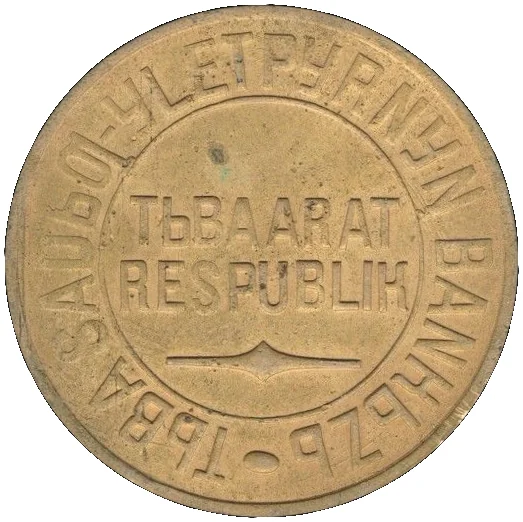
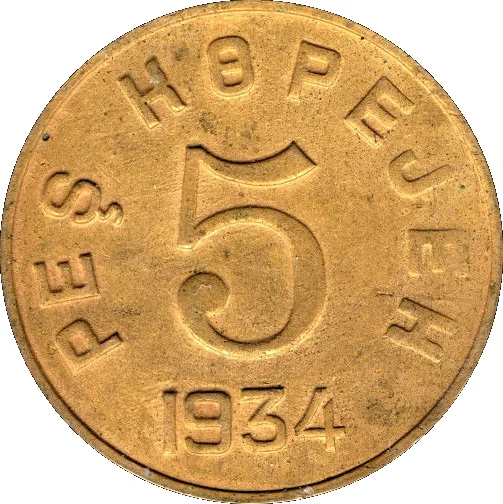
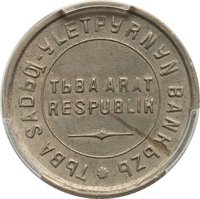
Obverse
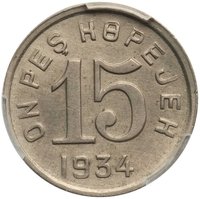
Reverse
Description:
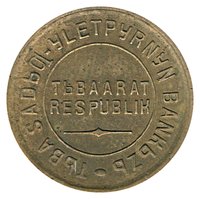
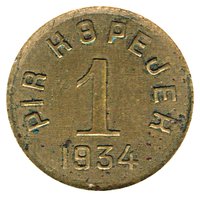
Denomination and date below.
Inscription:
PEŞ KƟPEJEK
5
1934
5
1934
Translation:
Five Kopeks
1934
1934
Script: Latin
Language: Crimean Tatar
Edge
Reeded
Mints
| Name | Mark |
|---|---|
| Saint Petersburg | — |
Mintings
| Year | Mint Mark | Mintage | Quality | Collection |
|---|---|---|---|---|
| 1934 | — | — |
Historical background
In 1934, the currency situation in the Tuvan People's Republic reflected its unique political and economic position as a nominally independent state under de facto Soviet control. Having broken from Chinese rule in 1911 and become a Russian protectorate, Tuvan currency had already transitioned from the Chinese tael and lan to the Russian Tsarist ruble, and then to the Soviet ruble. However, by the early 1930s, as Moscow intensified its integration of Tuva into its economic sphere, the exclusive use of Soviet rubles became problematic. It limited the Tuvan government's monetary sovereignty and made its economy directly vulnerable to Soviet monetary policy shifts.
Consequently, 1934 marked a pivotal year with the introduction of a distinct national currency, the Tuvan Aksha. This move, directed by the ruling Tuvan People's Revolutionary Party (TPRP) with clear Soviet guidance, was part of a broader state-building and collectivization drive. The Aksha, denominated in kopecks and rubles mirroring the Soviet system, was pegged 1:1 to the Soviet ruble. Its issuance was managed by the newly established Tuvan Trade and Industrial Bank (Tuvbank), which was effectively a subsidiary of the Soviet State Bank, ensuring Moscow retained ultimate financial control.
The primary purposes of this currency reform were to formalize Tuvan sovereignty in appearance while tightening Soviet economic management in practice. It allowed the Tuvan government to conduct its internal budget and wage payments in a separate currency, creating a facade of financial independence. In reality, the 1:1 peg and Soviet oversight meant the Aksha was merely a local surrogate for the ruble, facilitating the extraction of Tuvan resources, primarily livestock and minerals, into the Soviet economic system and further binding Tuva's destiny to that of the USSR, which would fully annex it in 1944.
Consequently, 1934 marked a pivotal year with the introduction of a distinct national currency, the Tuvan Aksha. This move, directed by the ruling Tuvan People's Revolutionary Party (TPRP) with clear Soviet guidance, was part of a broader state-building and collectivization drive. The Aksha, denominated in kopecks and rubles mirroring the Soviet system, was pegged 1:1 to the Soviet ruble. Its issuance was managed by the newly established Tuvan Trade and Industrial Bank (Tuvbank), which was effectively a subsidiary of the Soviet State Bank, ensuring Moscow retained ultimate financial control.
The primary purposes of this currency reform were to formalize Tuvan sovereignty in appearance while tightening Soviet economic management in practice. It allowed the Tuvan government to conduct its internal budget and wage payments in a separate currency, creating a facade of financial independence. In reality, the 1:1 peg and Soviet oversight meant the Aksha was merely a local surrogate for the ruble, facilitating the extraction of Tuvan resources, primarily livestock and minerals, into the Soviet economic system and further binding Tuva's destiny to that of the USSR, which would fully annex it in 1944.
⭐ Rare