

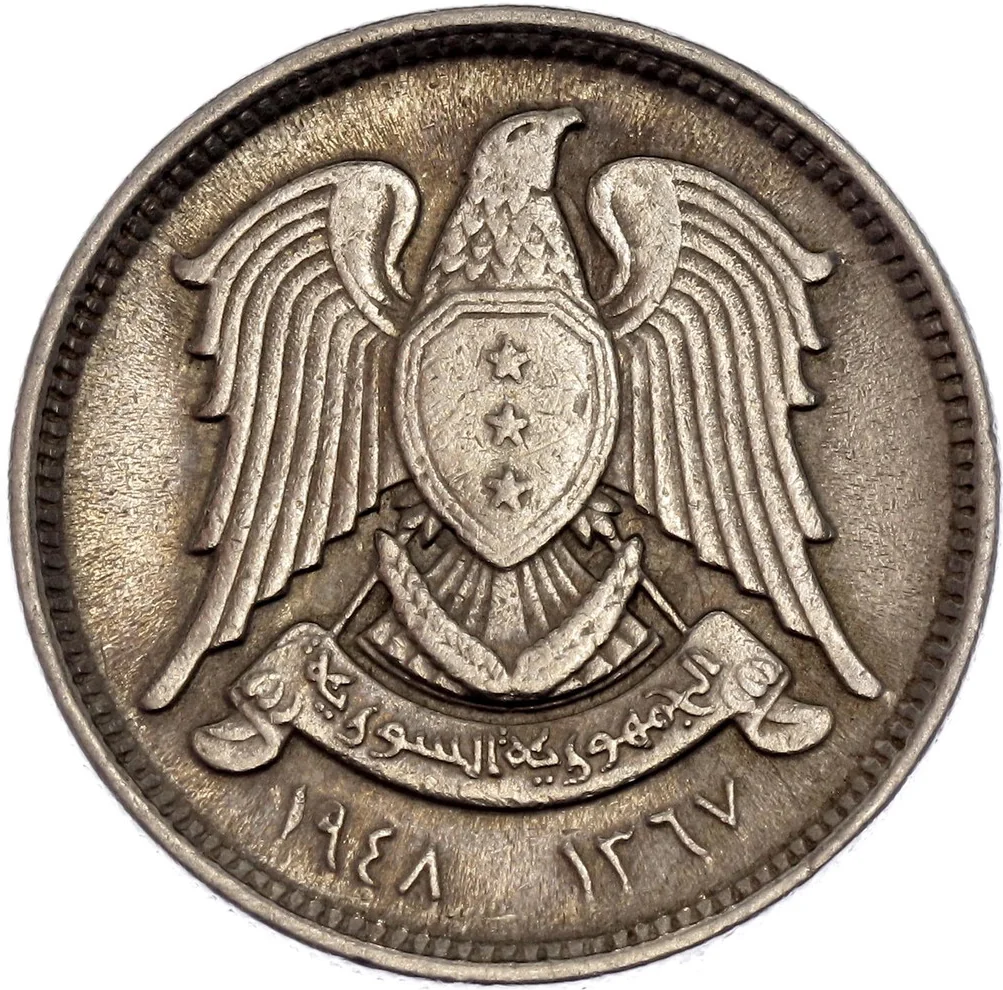
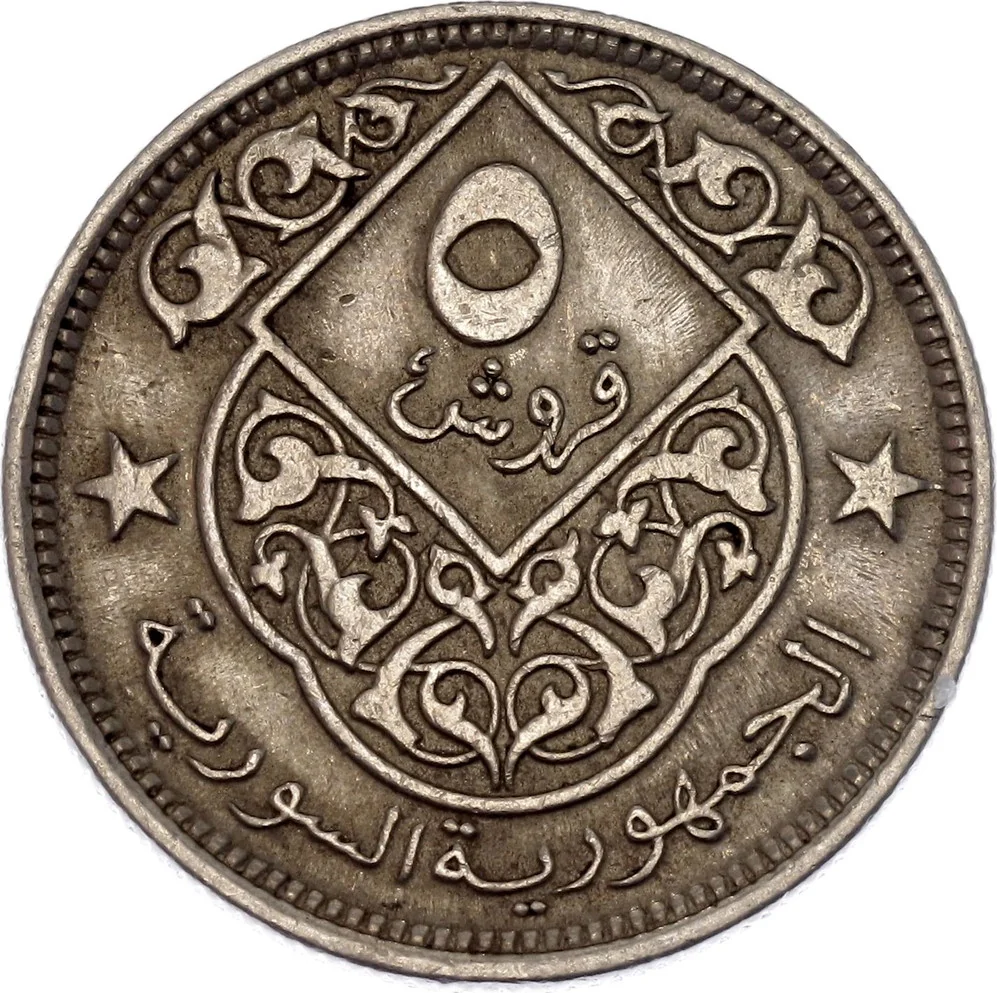
5 piastres – Syria
Add to wishlist
Syria
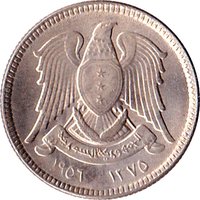
Obverse
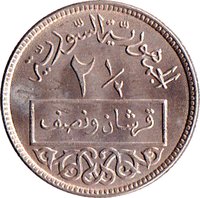
Reverse
Edge
Reeded
Categories
| Animal> Bird |
| Symbols> Coat of Arms |
Mintings
| Year | Mint Mark | Mintage | Quality | Collection |
|---|---|---|---|---|
| 1948 | — | 8,000,000 | ||
| 1955 | — | 4,000,000 |
Historical background
In 1948, Syria's currency situation was intrinsically linked to its colonial past and regional dynamics. Following the dissolution of the Ottoman Empire, Syria and Lebanon fell under a French Mandate, during which the French-established Banque de Syrie et du Liban (BSL) issued a shared currency, the Syrian-Lebanese pound (or livre), pegged to the French franc. This arrangement persisted even after Syria gained independence in 1946, meaning the country did not yet possess a fully sovereign national currency. The BSL, with its significant French private shareholding, continued to control monetary policy, a point of growing contention for the newly independent Syrian state seeking economic autonomy.
The pivotal year of 1948 brought two major shocks that severely strained this system. First, the devaluation of the French franc by 44% in January automatically devalued the Syrian-Lebanese pound tied to it, triggering inflation and public discontent. Second, the 1948 Arab-Israeli War (the Nakba) erupted in May, imposing heavy military expenditures on the Syrian treasury. These twin pressures—a weakened currency and sudden fiscal burden—exposed the vulnerabilities of the colonial-era monetary arrangement and fueled nationalist demands for financial independence.
Consequently, 1948 became the catalyst for decisive monetary reform. The Syrian government, led by President Shukri al-Quwatli, accelerated plans to establish a truly national central bank and currency. This culminated in the Monetary Law of 1949, which created the Central Bank of Syria and introduced the fully sovereign Syrian pound. Thus, the currency crisis of 1948, born from colonial legacy and regional conflict, directly spurred the creation of an independent Syrian monetary institution the following year.
The pivotal year of 1948 brought two major shocks that severely strained this system. First, the devaluation of the French franc by 44% in January automatically devalued the Syrian-Lebanese pound tied to it, triggering inflation and public discontent. Second, the 1948 Arab-Israeli War (the Nakba) erupted in May, imposing heavy military expenditures on the Syrian treasury. These twin pressures—a weakened currency and sudden fiscal burden—exposed the vulnerabilities of the colonial-era monetary arrangement and fueled nationalist demands for financial independence.
Consequently, 1948 became the catalyst for decisive monetary reform. The Syrian government, led by President Shukri al-Quwatli, accelerated plans to establish a truly national central bank and currency. This culminated in the Monetary Law of 1949, which created the Central Bank of Syria and introduced the fully sovereign Syrian pound. Thus, the currency crisis of 1948, born from colonial legacy and regional conflict, directly spurred the creation of an independent Syrian monetary institution the following year.
Series: 1948 Syria circulation coins
🌱 Common