

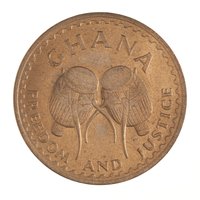
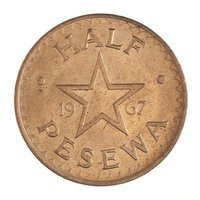
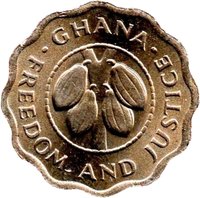
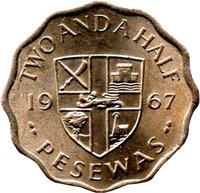
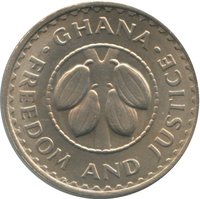
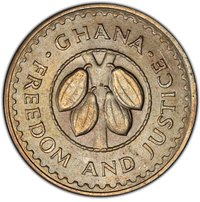
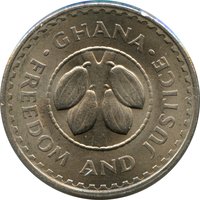
Obverse
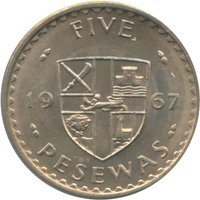
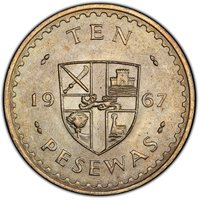
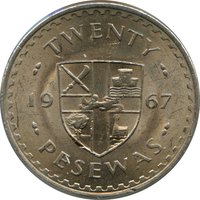
Reverse
Edge
Plain
Mints
| Name | Mark |
|---|---|
| Heaton and Sons / The Mint Birmingham | — |
| Royal Mint (Tower Hill) | — |
Mintings
| Year | Mint Mark | Mintage | Quality | Collection |
|---|---|---|---|---|
| 1967 | — | 62,500,000 | ||
| 1967 | — | 2,000 | Proof | |
| 1975 | — | 50,250,000 | ||
| 1979 | — | 5,000,000 |
Historical background
In 1967, Ghana was navigating a turbulent economic landscape under the National Liberation Council (NLC) military government, which had overthrown Kwame Nkrumah the previous year. The country faced severe economic strain, characterized by a large external debt, declining foreign reserves, and a substantial budget deficit. These issues were exacerbated by falling global prices for cocoa, Ghana's primary export, and the costly legacy of Nkrumah's state-led industrialization projects. This precarious financial position created intense pressure on the national currency, the Ghanaian pound.
Consequently, on July 8, 1967, the government enacted a major currency reform. The old Ghanaian pound (£G) was replaced with a new decimal currency, the cedi (¢), at a rate of 1 new cedi to 1.2 old pounds, effectively a devaluation. The reform also introduced the pesewa as one-hundredth of a cedi. While officially presented as a simplification and a break from the colonial monetary system, the primary objective was a disguised devaluation of 30% to make exports more competitive and to stabilize the nation's finances. Citizens were given a limited time to exchange their old notes, a process designed to also identify hoarded cash.
The immediate aftermath of the 1967 currency change was challenging for the public, eroding savings and purchasing power, and contributing to rising inflation. While it provided a short-term fiscal adjustment, the underlying structural problems of the economy remained unaddressed. The reform thus proved to be a temporary measure rather than a lasting solution, setting a precedent for further devaluations and currency struggles in the decades that followed, as Ghana continued to grapple with balance of payments crises.
Consequently, on July 8, 1967, the government enacted a major currency reform. The old Ghanaian pound (£G) was replaced with a new decimal currency, the cedi (¢), at a rate of 1 new cedi to 1.2 old pounds, effectively a devaluation. The reform also introduced the pesewa as one-hundredth of a cedi. While officially presented as a simplification and a break from the colonial monetary system, the primary objective was a disguised devaluation of 30% to make exports more competitive and to stabilize the nation's finances. Citizens were given a limited time to exchange their old notes, a process designed to also identify hoarded cash.
The immediate aftermath of the 1967 currency change was challenging for the public, eroding savings and purchasing power, and contributing to rising inflation. While it provided a short-term fiscal adjustment, the underlying structural problems of the economy remained unaddressed. The reform thus proved to be a temporary measure rather than a lasting solution, setting a precedent for further devaluations and currency struggles in the decades that followed, as Ghana continued to grapple with balance of payments crises.
Series: 1967 Ghana circulation coins

🌱 Very Common