

5 Kobo – Nigeria
Nigeria
Context
Years: 1973–1986
Issuer: Nigeria 
Period:
(since 1963)
Currency:
(since 1973)
Demonetization: 1991
Total mintage: 106,730,000
Material
References
KM: #Click to copy to clipboard9.1
Numista: #2697
Value
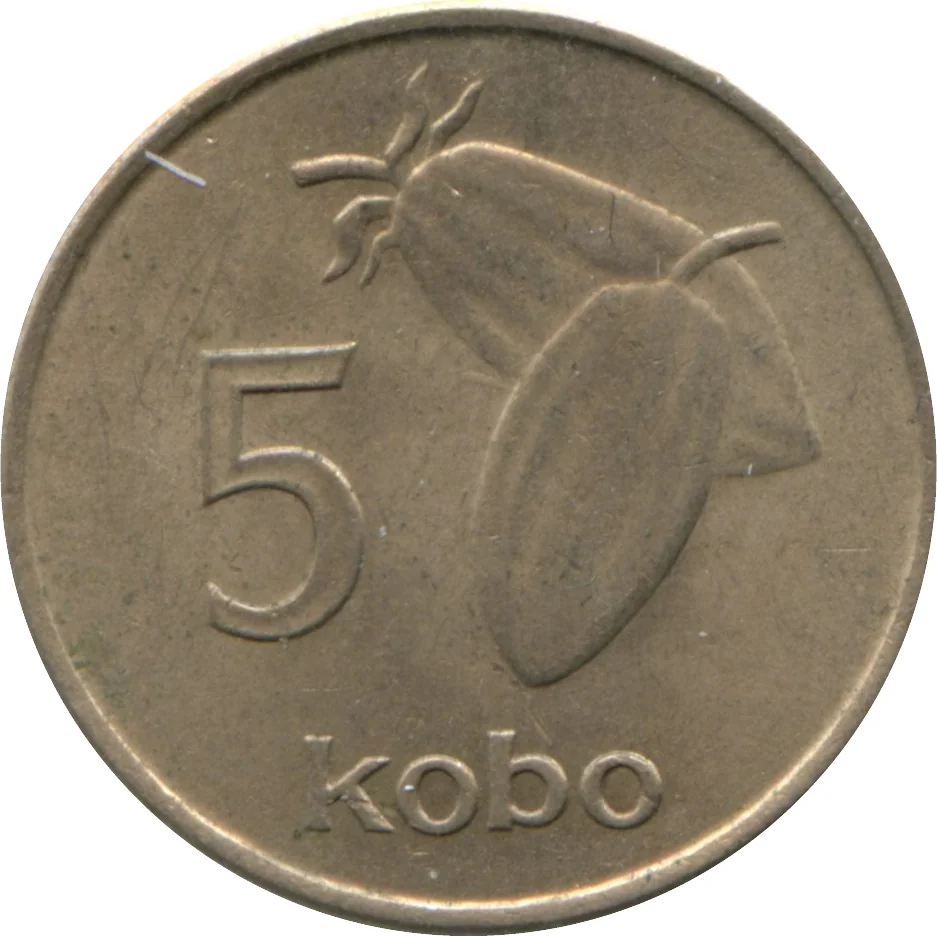
Exchange value: 0.05 NGN
Obverse
Description:
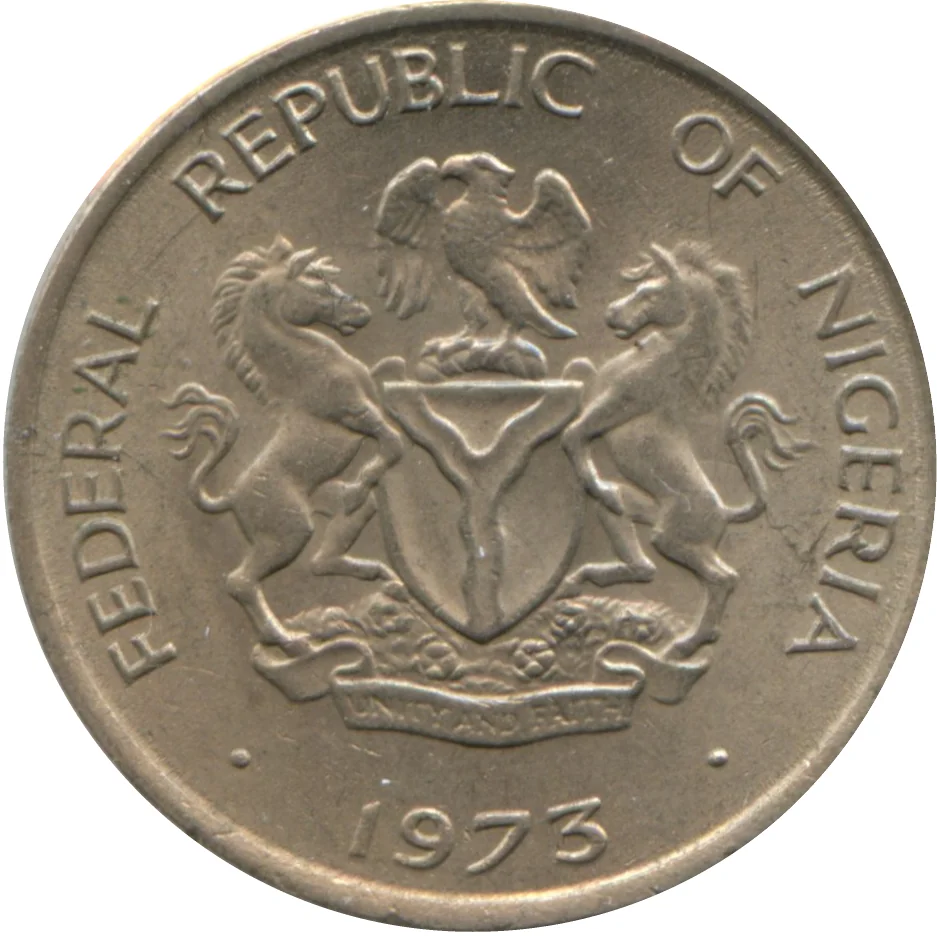
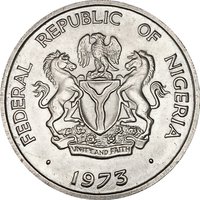
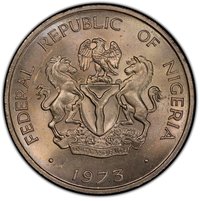
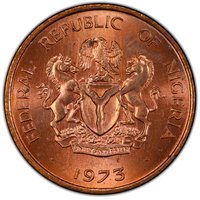
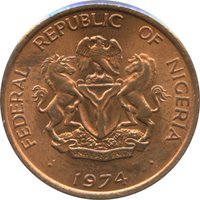
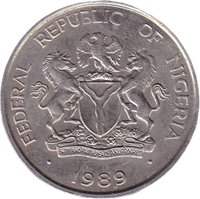
Coat of arms of Nigeria with date beneath.
Inscription:
FEDERAL REPUBLIC OF NIGERIA
UNITY AND FAITH
1973
UNITY AND FAITH
1973
Translation:
FEDERAL REPUBLIC OF NIGERIA
UNITY AND FAITH
1973
UNITY AND FAITH
1973
Script: Latin
Language: English
Engraver: Geoffrey Colley
Reverse
Edge
Reeded
Mints
| Name | Mark |
|---|---|
| Nigerian Security Printing and Minting Company Limited | — |
| Royal Mint | — |
Mintings
| Year | Mint Mark | Mintage | Quality | Collection |
|---|---|---|---|---|
| 1973 | — | 96,920,000 | ||
| 1973 | — | 10,000 | Proof | |
| 1974 | — | — | ||
| 1976 | — | 9,800,000 | ||
| 1986 | — | — |
Historical background
In 1973, Nigeria's currency situation was fundamentally shaped by the global oil boom and the nation's recent transition to a decimal currency system. Just two years prior, in 1971, Nigeria had introduced the Naira and kobo, replacing the pound sterling at a rate of two naira to one pound. This move symbolised a break from the colonial monetary legacy and was part of a broader post-independence assertion of economic sovereignty. The new currency was initially strong, backed by growing foreign reserves and a stable agricultural export base, notably from cocoa and palm oil.
However, the defining event of the period was the 1973 oil price shock following the Yom Kippur War and the OPEC embargo. As a major and growing producer, Nigeria experienced a dramatic influx of petrodollars, which began to fundamentally distort the economy. Government revenue skyrocketed, leading to massive increases in public spending on infrastructure and imports. This sudden wealth created intense inflationary pressures and began to erode the competitiveness of the non-oil sectors, a phenomenon later known as "Dutch Disease." The Naira, while stable on official exchanges, started to face underlying pressures as the economy became overwhelmingly dependent on a single, volatile commodity.
Consequently, 1973 stands as a pivotal, optimistic, yet ultimately cautionary year in Nigeria's monetary history. It was a period of apparent strength, with the new currency buoyed by unprecedented oil wealth, fostering a sense of economic potential and modernization. Yet, beneath the surface, the foundations were being laid for future macroeconomic challenges, including inflation, import dependency, and a neglect of agricultural exports, which would culminate in severe economic difficulties within the following decade. The currency's fate became inextricably linked to the international oil market, setting a precedent that would define Nigeria's economic trajectory for decades to come.
However, the defining event of the period was the 1973 oil price shock following the Yom Kippur War and the OPEC embargo. As a major and growing producer, Nigeria experienced a dramatic influx of petrodollars, which began to fundamentally distort the economy. Government revenue skyrocketed, leading to massive increases in public spending on infrastructure and imports. This sudden wealth created intense inflationary pressures and began to erode the competitiveness of the non-oil sectors, a phenomenon later known as "Dutch Disease." The Naira, while stable on official exchanges, started to face underlying pressures as the economy became overwhelmingly dependent on a single, volatile commodity.
Consequently, 1973 stands as a pivotal, optimistic, yet ultimately cautionary year in Nigeria's monetary history. It was a period of apparent strength, with the new currency buoyed by unprecedented oil wealth, fostering a sense of economic potential and modernization. Yet, beneath the surface, the foundations were being laid for future macroeconomic challenges, including inflation, import dependency, and a neglect of agricultural exports, which would culminate in severe economic difficulties within the following decade. The currency's fate became inextricably linked to the international oil market, setting a precedent that would define Nigeria's economic trajectory for decades to come.
Series: 1973 Nigeria circulation coins
🌱 Very Common