

5 Centimes – Belgium
Belgium
Context

Material
References
KM: #Click to copy to clipboard5.1
Numista: #268
Value
Exchange value: 0.05 BEF
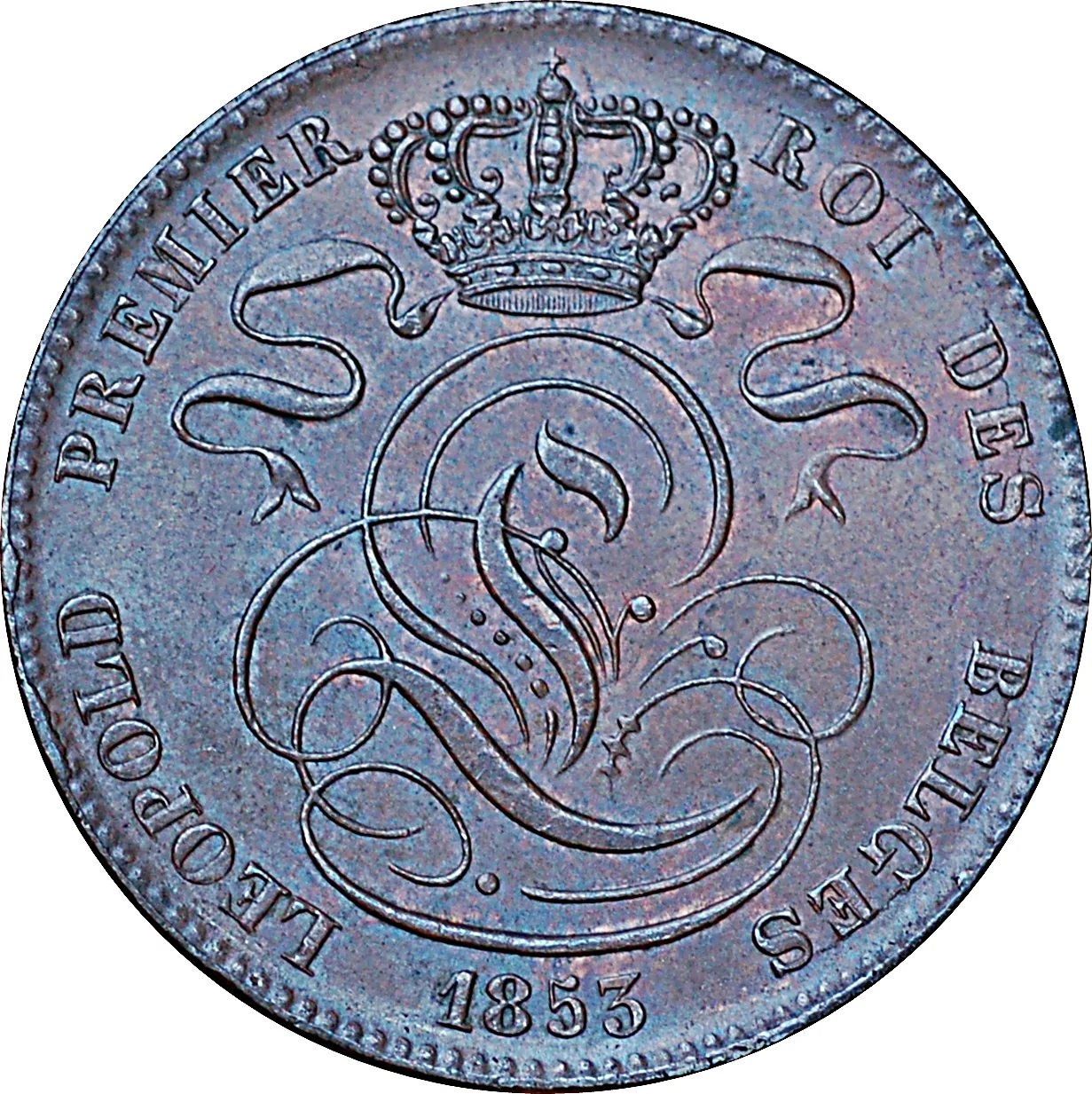
Obverse
Description:
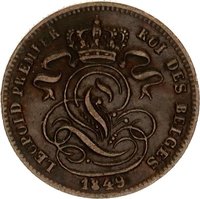
French lettering surrounds the royal monogram, with the date below.
Inscription:
LEOPOLD PREMIER ROI DES BELGES
1853
1853
Translation:
Leopold the First King of the Belgians
1853
1853
Script: Latin
Language: French
Engraver: Joseph-Pierre Braemt
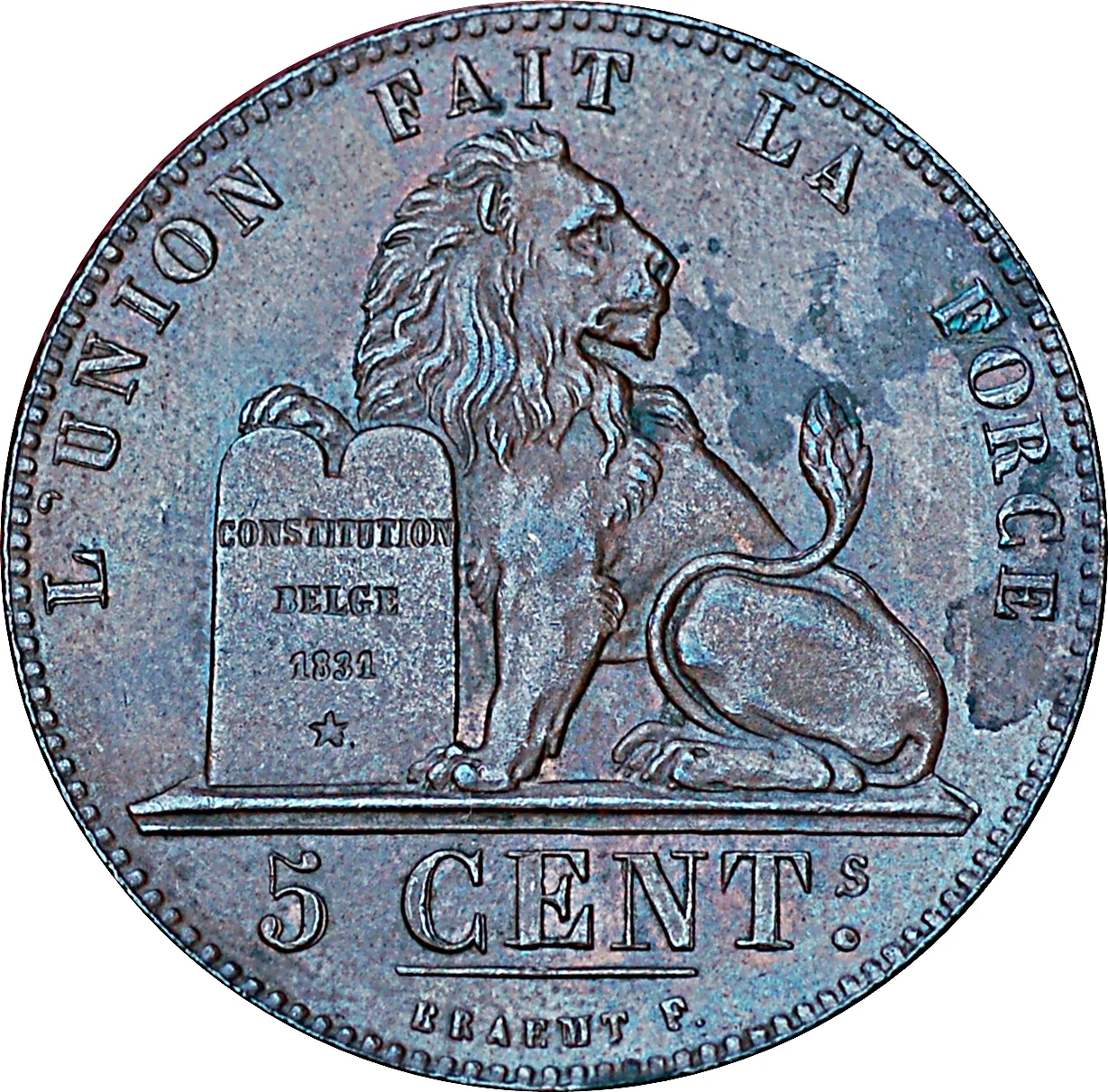
Reverse
Description:
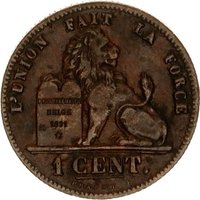
Belgian lion with paw on 1831 Constitution, surrounded by French motto. Value and designer below.
Inscription:
L'UNION FAIT LA FORCE
CONSTITUTION BELGE 1831*
5 CENTs
BRAEMT F.
CONSTITUTION BELGE 1831*
5 CENTs
BRAEMT F.
Translation:
Union makes strength
Belgian Constitution 1831*
5 Cents
BRAEMT F.
Belgian Constitution 1831*
5 Cents
BRAEMT F.
Script: Latin
Language: French
Engraver: Joseph-Pierre Braemt
Edge
Reeded
Mints
| Name | Mark |
|---|---|
| Royal Mint of Belgium | — |
Mintings
| Year | Mint Mark | Mintage | Quality | Collection |
|---|---|---|---|---|
| 1811 | — | — | ||
| 1833 | — | — | ||
| 1834 | — | 2,514,616 | ||
| 1835 | — | — | ||
| 1837 | — | 12,037,595 | ||
| 1838 | — | — | ||
| 1841 | — | 2,508,518 | ||
| 1842 | — | 5,536,540 | ||
| 1847 | — | 1,130,524 | ||
| 1848 | — | 1,845,154 | ||
| 1849 | — | — | ||
| 1850 | — | — | ||
| 1851 | — | — | ||
| 1852 | — | 1,942,901 | ||
| 1853 | — | 704,853 | ||
| 1855 | — | 264,870 | ||
| 1856 | — | 5,656,880 | ||
| 1857 | — | 2,299,303 | ||
| 1858 | — | — | ||
| 1859 | — | — | ||
| 1860 | — | 198,997 |
Historical background
In 1811, Belgium was not an independent nation but part of the French Empire, having been formally annexed by Napoleon Bonaparte in 1795. As such, its monetary system was fully integrated into the French franc system, governed by the law of 7 Germinal, Year XI (28 March 1803). This law established the franc de germinal (or franc germinal), a bimetallic currency based on a fixed ratio of gold to silver, which brought much-needed stability after the hyperinflation of the revolutionary assignat period.
The official currency in circulation was the French franc, divided into 100 centimes. Coins minted in France, bearing Napoleon's effigy, were the standard legal tender. However, the monetary landscape was not entirely uniform. Older coins from the Austrian Netherlands, the Dutch Republic, and other pre-revolutionary states still circulated at officially decreed rates, reflecting the lingering complexity of unifying the currencies of recently annexed territories. Furthermore, the demands of Napoleon's continuous warfare placed a strain on the economy, leading to occasional shortages of small change and prompting some local reliance on older, familiar coins for daily transactions.
Overall, the currency situation in Belgium in 1811 was one of imposed French standardization under the Consulate and Empire. While the franc system provided a stable and unified framework, the complete integration was still a work in progress, with a practical mix of new imperial and older regional coins in everyday use. This period cemented the franc as the base of the monetary system, a legacy that would persist long after French rule ended, lasting in Belgium until the introduction of the euro in 2002.
The official currency in circulation was the French franc, divided into 100 centimes. Coins minted in France, bearing Napoleon's effigy, were the standard legal tender. However, the monetary landscape was not entirely uniform. Older coins from the Austrian Netherlands, the Dutch Republic, and other pre-revolutionary states still circulated at officially decreed rates, reflecting the lingering complexity of unifying the currencies of recently annexed territories. Furthermore, the demands of Napoleon's continuous warfare placed a strain on the economy, leading to occasional shortages of small change and prompting some local reliance on older, familiar coins for daily transactions.
Overall, the currency situation in Belgium in 1811 was one of imposed French standardization under the Consulate and Empire. While the franc system provided a stable and unified framework, the complete integration was still a work in progress, with a practical mix of new imperial and older regional coins in everyday use. This period cemented the franc as the base of the monetary system, a legacy that would persist long after French rule ended, lasting in Belgium until the introduction of the euro in 2002.
🌱 Very Common