

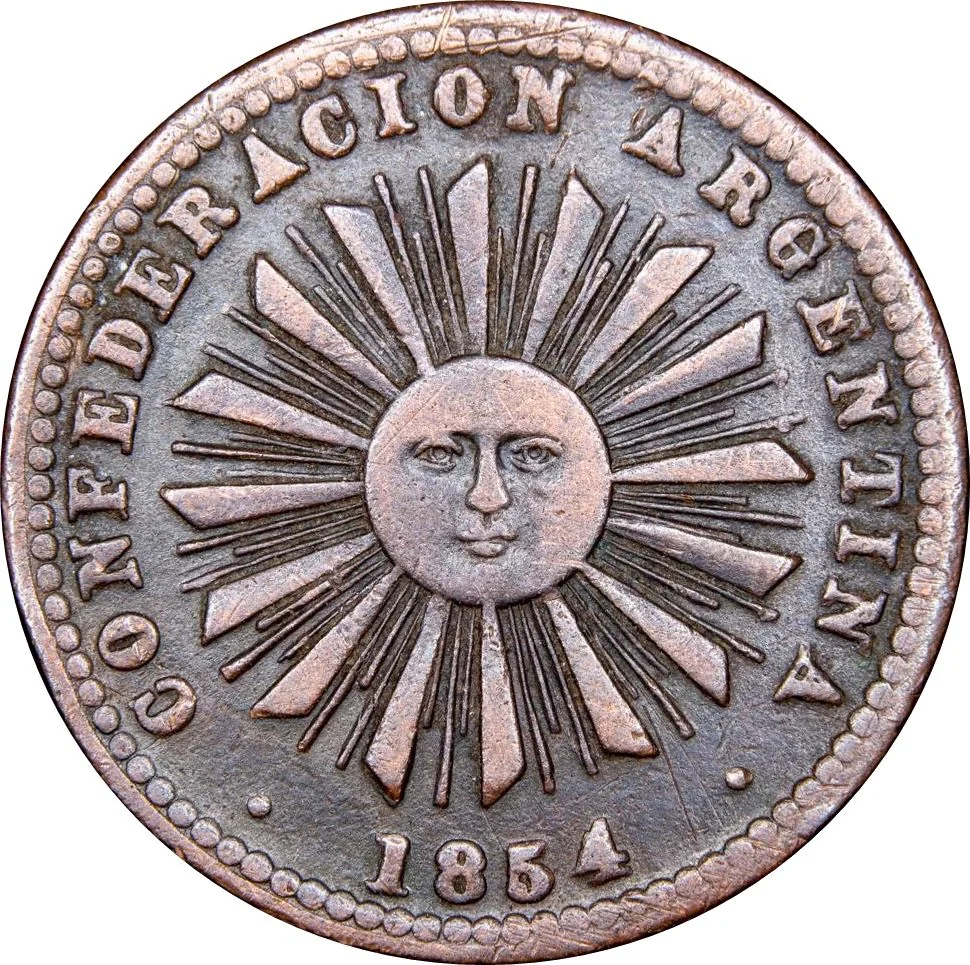
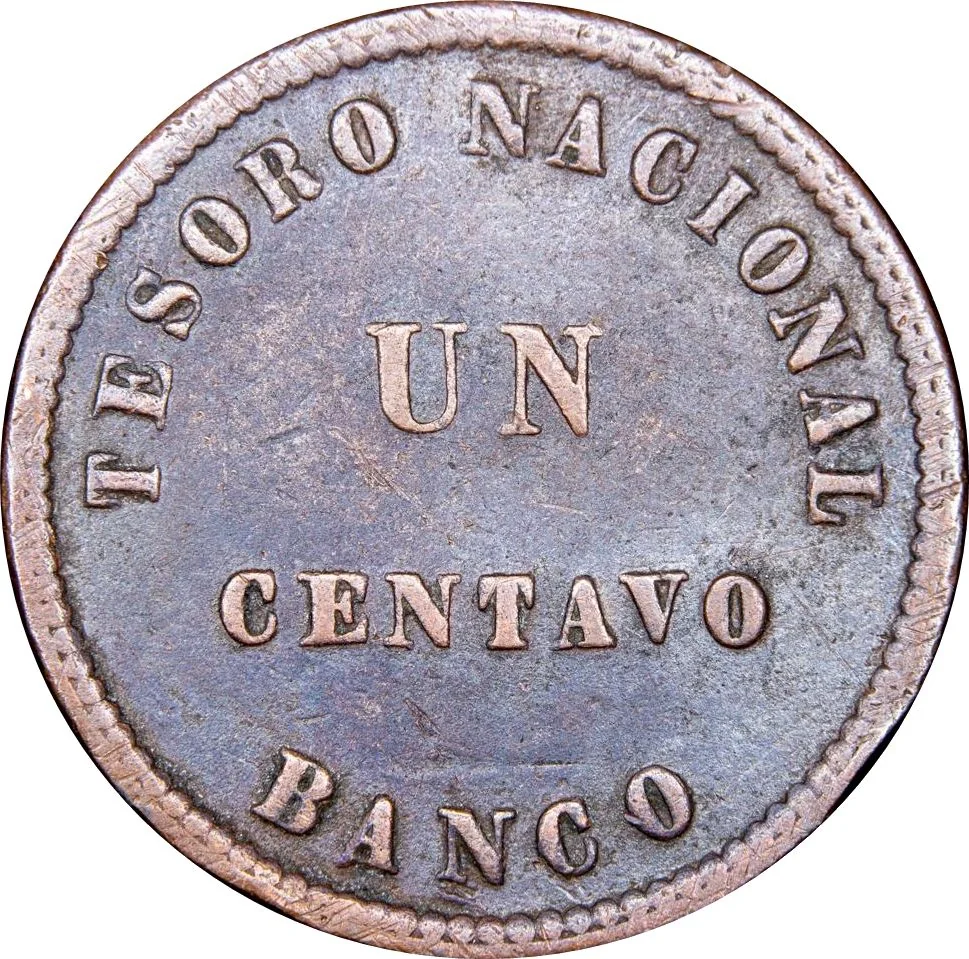
1 Centavo – Argentine Confederation
Argentina
Context
Year: 1854
Country: Argentina 
Issuer: Argentine Confederation
Period:
(1853—1861)
Currency:
(1853—1862)
Demonetized: Yes
Material
References
KM: #Click to copy to clipboard23
Numista: #26714
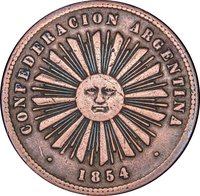
Obverse
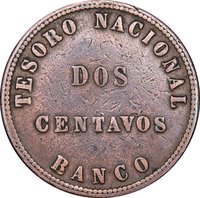
Reverse
Edge
Plain
Mints
| Name | Mark |
|---|---|
| Heaton and Sons / The Mint Birmingham | — |
Mintings
| Year | Mint Mark | Mintage | Quality | Collection |
|---|---|---|---|---|
| 1854 | — | — |
Historical background
The currency situation in the Argentine Confederation in 1854 was one of profound disorder and fragmentation, a direct legacy of the political disintegration following independence. The absence of a strong central authority since the fall of Juan Manuel de Rosas in 1852 meant there was no unified national monetary system. Instead, the economy operated on a chaotic mix of metallic coins (primarily gold ounces and silver pesos from other nations), a vast array of privately issued paper notes from provincial banks and commercial houses, and the heavily devalued paper money from the Rosas era. This created a complex and unreliable monetary environment where the value of money differed drastically from one province to another.
The government of the Confederation, under President Justo José de Urquiza, recognized this crisis as a major impediment to commerce, credit, and state finances. A key early effort was the establishment of the "Casa de Moneda de la Confederación" (Mint of the Confederation) in 1854, located in the capital of Paraná. Its primary mission was to restore confidence by minting high-quality, standardized silver and gold coins bearing the symbols of the Confederation, such as the "Escudo de la Confederación Argentina." These new coins, known as pesos fuertes, were intended to provide a stable, trusted metallic base for the economy and to symbolize the authority of the new federal government.
However, the impact of these measures in 1854 was limited and largely symbolic. The volume of new precious metal coins minted was insufficient to displace the entrenched sea of disparate paper and foreign coinage in circulation. The fundamental issues of budget deficits and a lack of centralized banking authority remained unresolved. Consequently, while 1854 marked an important first step toward monetary unification with the establishment of a national mint, the currency situation on the ground remained overwhelmingly chaotic, a tangible reflection of the Confederation's ongoing struggle to achieve true political and economic integration.
The government of the Confederation, under President Justo José de Urquiza, recognized this crisis as a major impediment to commerce, credit, and state finances. A key early effort was the establishment of the "Casa de Moneda de la Confederación" (Mint of the Confederation) in 1854, located in the capital of Paraná. Its primary mission was to restore confidence by minting high-quality, standardized silver and gold coins bearing the symbols of the Confederation, such as the "Escudo de la Confederación Argentina." These new coins, known as pesos fuertes, were intended to provide a stable, trusted metallic base for the economy and to symbolize the authority of the new federal government.
However, the impact of these measures in 1854 was limited and largely symbolic. The volume of new precious metal coins minted was insufficient to displace the entrenched sea of disparate paper and foreign coinage in circulation. The fundamental issues of budget deficits and a lack of centralized banking authority remained unresolved. Consequently, while 1854 marked an important first step toward monetary unification with the establishment of a national mint, the currency situation on the ground remained overwhelmingly chaotic, a tangible reflection of the Confederation's ongoing struggle to achieve true political and economic integration.
🌟 Uncommon