

10 pounds – Syria
Add to wishlist
Syria
Context
Material
Diameter: 27 mm
Weight: 9.5 g
Thickness: 2.16 mm
Shape: Round
Composition: Nickel brass
Magnetic: No
Techniques: Latent image, Milled
Alignment: Medal alignment
flip
References
KM: #
Numista: #2667
Value
Exchange value: 10 SYP
Obverse
Description:
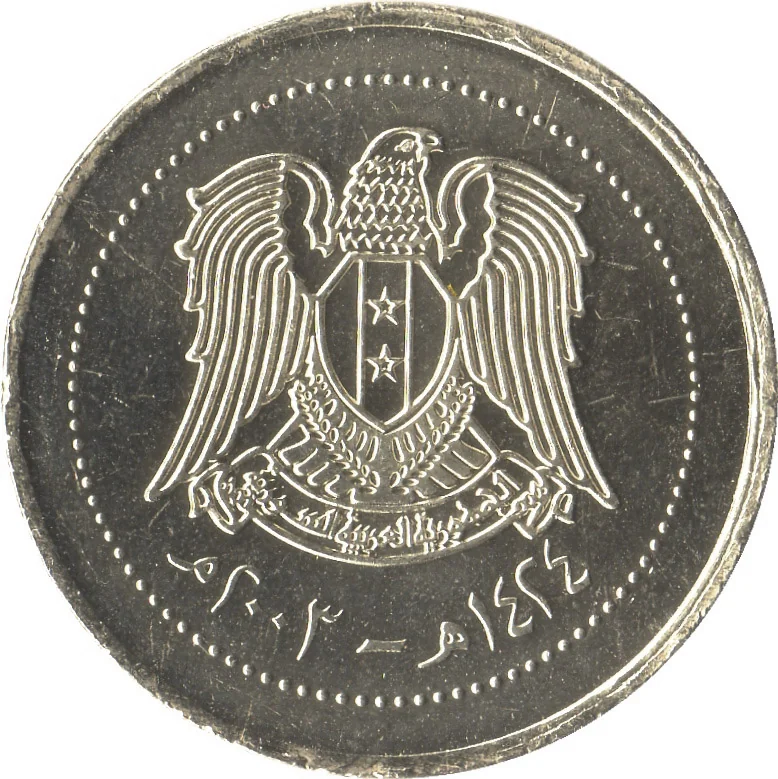
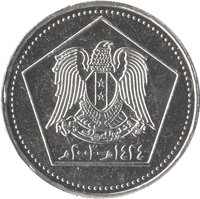
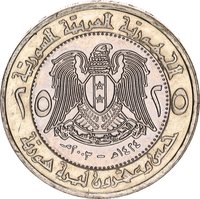
Syria's coat of arms inside a dotted circle: the Quraish hawk holding a shield with two stars and a scroll reading "Syrian Arab Republic" in Arabic. Arabic numerals for the Gregorian and Hijri dates are below.
Inscription:
الجمهورية العربية السورية
١٤٢٤ھ - ٢٠٠٣م
١٤٢٤ھ - ٢٠٠٣م
Translation:
Syrian Arab Republic
1424 H - 2003 AD
1424 H - 2003 AD
Script: Arabic
Language: Arabic
Reverse
Edge
Reeded with inscription
Legend:
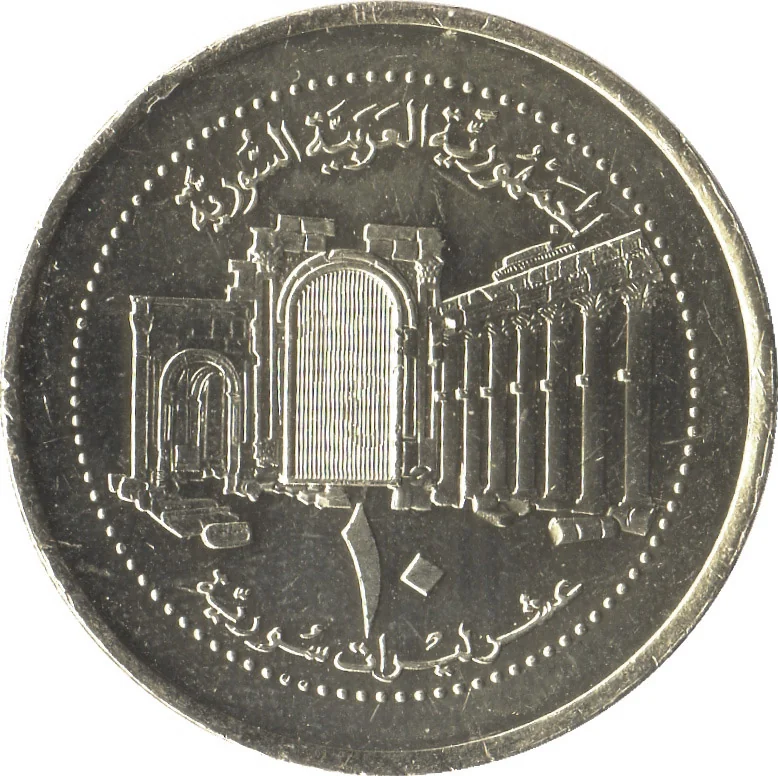
10 SYRIAN POUNDS *
Translation:
Ten Syrian Pounds *
Language: English
Categories
| Animal> Bird |
| Symbols> Coat of Arms |
Mints
| Name | Mark |
|---|---|
| Royal Mint | — |
Mintings
| Year | Mint Mark | Mintage | Quality | Collection |
|---|---|---|---|---|
| 2003 | — | — |
Historical background
In 2003, the Syrian pound (SYP) operated under a tightly controlled official exchange rate, pegged by the Central Bank of Syria at approximately 11.2 pounds to the U.S. dollar for government transactions and essential imports. This system was a legacy of the state-dominated, socialist-oriented economy that had been in place for decades. However, this official rate did not reflect economic reality. A significant parallel black market for currency had emerged and grown, driven by factors including limited foreign investment, economic inefficiencies, and international sanctions that began to intensify following the U.S. invasion of Iraq, which placed Syria under greater regional and economic pressure.
The disparity between the official and black-market rates created a two-tier economy. While the government used the fixed rate for budgetary purposes and to subsidize key commodities, businesses and individuals needing hard currency for non-essential imports or capital flight were forced to use the black market, where the pound traded at a substantial discount. This gap, often around 20-30% weaker than the official rate, encouraged corruption and rent-seeking as access to cheap official dollars became a valuable privilege. The economy, further strained by a severe drought beginning in the late 1990s and a rapidly growing population, was struggling to generate sufficient foreign exchange earnings from its declining oil exports and other sectors.
Overall, the currency situation in 2003 was one of mounting strain beneath a facade of stability. The fixed exchange rate was an increasingly unsustainable policy, artificially propping up the pound while draining foreign reserves. The growing black market served as a clear indicator of underlying economic weaknesses and the pressures of early sanctions, foreshadowing the severe monetary crises that would follow in subsequent years. The regime of Bashar al-Assad, still in its early years, faced the difficult choice between maintaining control through subsidies and a fixed rate or embarking on uncertain economic liberalization.
The disparity between the official and black-market rates created a two-tier economy. While the government used the fixed rate for budgetary purposes and to subsidize key commodities, businesses and individuals needing hard currency for non-essential imports or capital flight were forced to use the black market, where the pound traded at a substantial discount. This gap, often around 20-30% weaker than the official rate, encouraged corruption and rent-seeking as access to cheap official dollars became a valuable privilege. The economy, further strained by a severe drought beginning in the late 1990s and a rapidly growing population, was struggling to generate sufficient foreign exchange earnings from its declining oil exports and other sectors.
Overall, the currency situation in 2003 was one of mounting strain beneath a facade of stability. The fixed exchange rate was an increasingly unsustainable policy, artificially propping up the pound while draining foreign reserves. The growing black market served as a clear indicator of underlying economic weaknesses and the pressures of early sanctions, foreshadowing the severe monetary crises that would follow in subsequent years. The regime of Bashar al-Assad, still in its early years, faced the difficult choice between maintaining control through subsidies and a fixed rate or embarking on uncertain economic liberalization.
🌱 Very Common