

10 euro (Johan Vilhelm Snellman) – Finland
Add to wishlist
Non-circulating coins
Commemoration: 200th Anniversary of Johan Vilhelm Snellman
Series: Europa Star
Finland
Context
Material
References
KM: #
Numista: #13332
Value
Exchange value: 10 EUR
Bullion value: $60.27
Inflation-adjusted value: 14.84 EUR
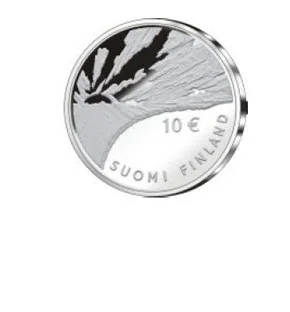
Obverse
Description:
Sunrise over a landscape.
Inscription:
10 €
SUOMI - FINLAND
SUOMI - FINLAND
Translation:
SUOMI - FINLAND
Script: Latin
Engraver: Tapio Kettunen
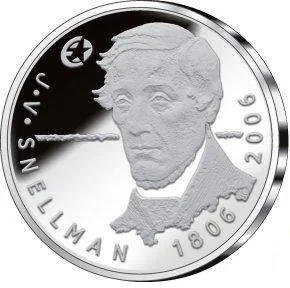
Reverse
Description:
Portrait of statesman and philosopher Johan Vilhelm Snellman.
Inscription:
J. V. SNELLMANE 1806 - 2006
Script: Latin
Engraver: Tapio Kettunen
Edge
Plain
Categories
| Event> Birth anniversary |
| Person> Politician |
| Person> Philosopher |
Mints
| Name | Mark |
|---|---|
| Mint of Finland | — |
Mintings
| Year | Mint Mark | Mintage | Quality | Collection |
|---|---|---|---|---|
| 2006 | — | 7,000 | ||
| 2006 | — | 29,000 | Proof |
Historical background
In 2006, Finland was a full and established member of the Eurozone, having adopted the euro as its sole legal tender five years earlier in 2002. The period of transition from the Finnish markka (FIM) was complete, and the euro was fully integrated into everyday economic life. The country's monetary policy was no longer determined domestically but by the European Central Bank (ECB) in Frankfurt, which focused on price stability for the entire Eurozone. For Finland, this meant interest rates and broader monetary conditions were set with the needs of a diverse bloc of economies in mind, rather than being tailored specifically to the Finnish economic cycle.
The Finnish economy in 2006 was performing strongly, experiencing robust GDP growth driven by key sectors like technology (notably Nokia), forestry, and metal engineering. This growth, however, created a slight policy tension: while the national economy was booming, the ECB's one-size-fits-all interest rate policy was considered relatively accommodative for Finland's specific conditions. This contributed to rising household debt and a rapidly heating housing market, as low euro-denominated borrowing costs fueled credit growth and increased property prices. There was little public debate about reverting to the markka, but discussions focused on the challenges of managing a national economy within a supranational currency union during a period of asymmetric growth.
Overall, the currency situation was one of stability and successful integration, but with emerging concerns about macroeconomic imbalances. The euro facilitated trade and investment within Finland's most important market, the EU, and provided transactional simplicity. The focus for policymakers had shifted from currency management to navigating the constraints and benefits of Eurozone membership, ensuring fiscal discipline at home, and addressing domestic financial stability risks that were amplified by the common monetary policy. The year was a calm chapter in Finland's euro history, situated between the initial adoption challenges and the far greater stress test that would come with the global financial crisis of 2008-2009 and the subsequent European debt crisis.
The Finnish economy in 2006 was performing strongly, experiencing robust GDP growth driven by key sectors like technology (notably Nokia), forestry, and metal engineering. This growth, however, created a slight policy tension: while the national economy was booming, the ECB's one-size-fits-all interest rate policy was considered relatively accommodative for Finland's specific conditions. This contributed to rising household debt and a rapidly heating housing market, as low euro-denominated borrowing costs fueled credit growth and increased property prices. There was little public debate about reverting to the markka, but discussions focused on the challenges of managing a national economy within a supranational currency union during a period of asymmetric growth.
Overall, the currency situation was one of stability and successful integration, but with emerging concerns about macroeconomic imbalances. The euro facilitated trade and investment within Finland's most important market, the EU, and provided transactional simplicity. The focus for policymakers had shifted from currency management to navigating the constraints and benefits of Eurozone membership, ensuring fiscal discipline at home, and addressing domestic financial stability risks that were amplified by the common monetary policy. The year was a calm chapter in Finland's euro history, situated between the initial adoption challenges and the far greater stress test that would come with the global financial crisis of 2008-2009 and the subsequent European debt crisis.
Series: Europa Star
⭐ Somewhat Rare