

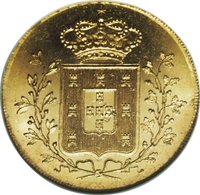
Obverse
Description:
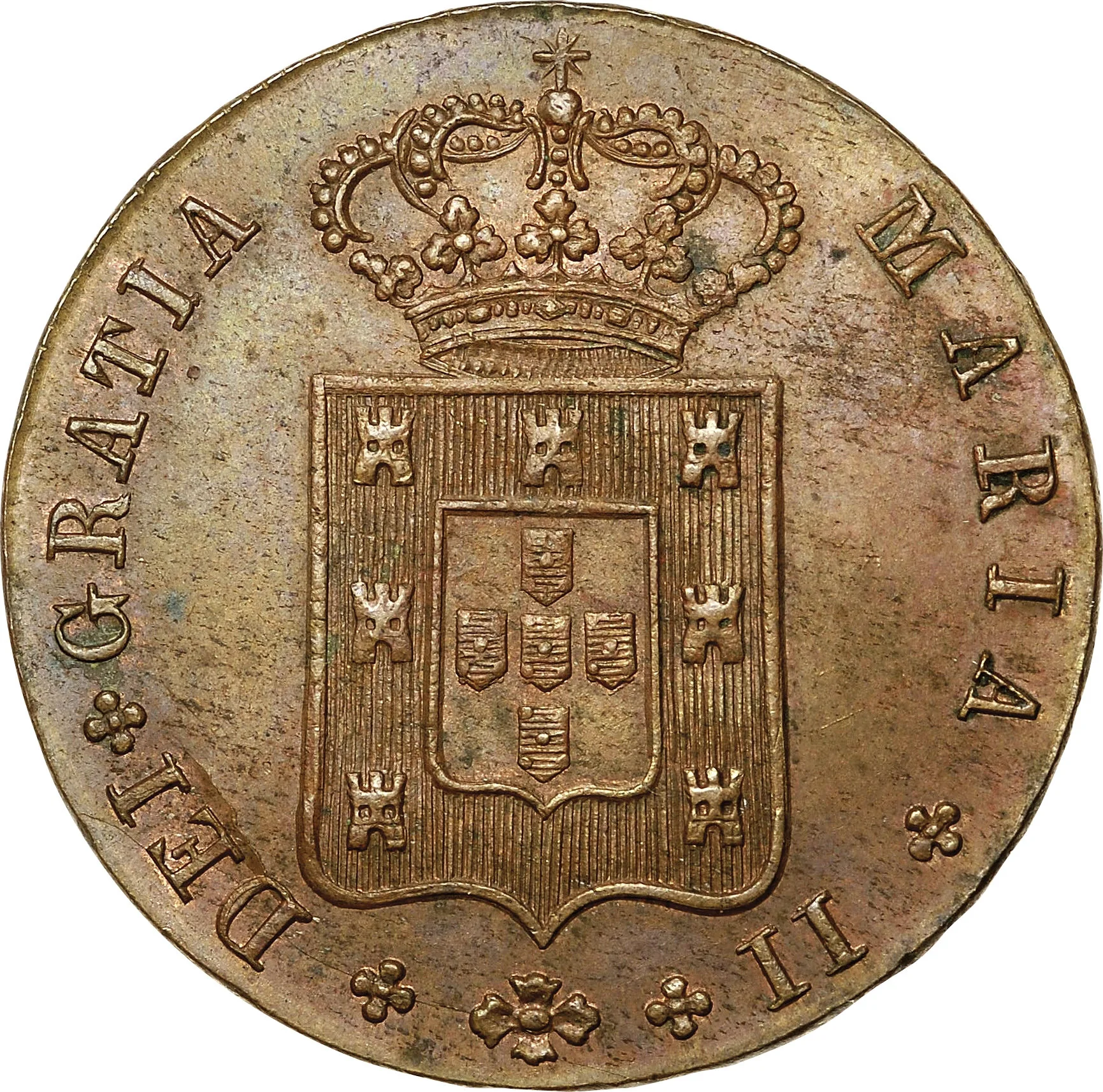
Shield with a crown.
Inscription:
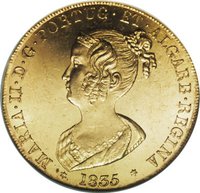
MARIA II DEI GRATIA
Translation:
Maria II by the Grace of God
Script: Latin
Language: Latin
Engraver: William Wyon
Reverse
Description:
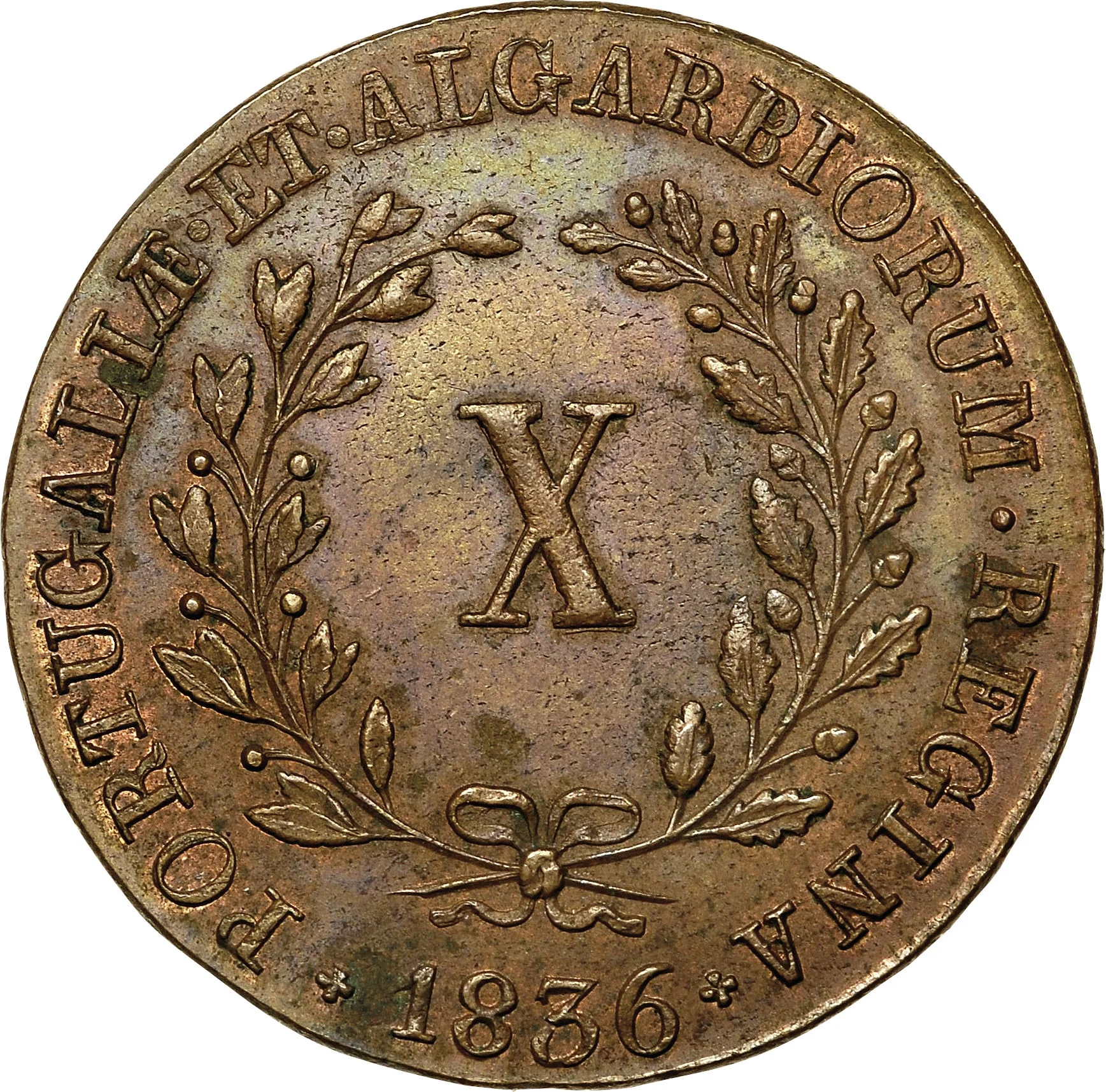
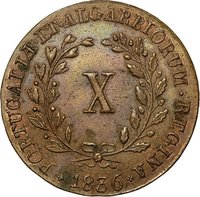
Wreath value X
Inscription:
PORTUGALÆ · ET · ALGARBIORUM · REGINA
1836
1836
Translation:
Queen of Portugal and the Algarves
1836
1836
Script: Latin
Language: Latin
Engraver: William Wyon
Edge
Plain
Mints
| Name | Mark |
|---|---|
| Imprensa Nacional - Casa da Moeda | — |
Mintings
| Year | Mint Mark | Mintage | Quality | Collection |
|---|---|---|---|---|
| 1835 | — | — | ||
| 1836 | — | — | ||
| 1837 | — | — | ||
| 1838 | — | 645,495 | ||
| 1839 | — | 469,323 |
Historical background
In 1835, Portugal's currency situation was a direct legacy of the political and economic turmoil of the preceding decades, particularly the Liberal Wars (1828-1834). The victorious Liberal government, having secured the throne for Queen Maria II, inherited a state on the brink of financial collapse. The treasury was depleted by war expenses, public debt was enormous, and the monetary system was chaotic, characterized by a severe shortage of precious metal coinage in circulation. This scarcity was exacerbated by the widespread hoarding of gold and silver during the conflict and the circulation of heavily debased copper coins, leading to significant inflation and a crisis of confidence in the currency.
The monetary landscape was a complex patchwork. The official unit was the real (plural réis), but transactions often involved a confusing mix of old Portuguese coins, foreign currency (especially British gold sovereigns and Brazilian coins), and privately issued paper notes of dubious value. The government itself had resorted to issuing paper money, the apólices, to finance the war, but these were trading at a steep discount to their face value. This fragmentation and lack of a uniform, trusted medium of exchange severely hampered domestic commerce and international trade, creating an urgent need for monetary reform and stabilization.
Consequently, the mid-1830s became a period of foundational reform. The government, led by statesmen like the Marquês de Sá da Bandeira, recognized that a stable currency was essential for national reconstruction. While comprehensive reform would crystallize later with the 1846 decree establishing the real as a decimal currency fully backed by gold and silver, the efforts of 1835 were focused on laying the groundwork: consolidating the chaotic public debt, attempting to manage the paper money in circulation, and planning for a return to a metallic standard to restore public trust and facilitate economic recovery in the post-war era.
The monetary landscape was a complex patchwork. The official unit was the real (plural réis), but transactions often involved a confusing mix of old Portuguese coins, foreign currency (especially British gold sovereigns and Brazilian coins), and privately issued paper notes of dubious value. The government itself had resorted to issuing paper money, the apólices, to finance the war, but these were trading at a steep discount to their face value. This fragmentation and lack of a uniform, trusted medium of exchange severely hampered domestic commerce and international trade, creating an urgent need for monetary reform and stabilization.
Consequently, the mid-1830s became a period of foundational reform. The government, led by statesmen like the Marquês de Sá da Bandeira, recognized that a stable currency was essential for national reconstruction. While comprehensive reform would crystallize later with the 1846 decree establishing the real as a decimal currency fully backed by gold and silver, the efforts of 1835 were focused on laying the groundwork: consolidating the chaotic public debt, attempting to manage the paper money in circulation, and planning for a return to a metallic standard to restore public trust and facilitate economic recovery in the post-war era.
⭐ Rare