

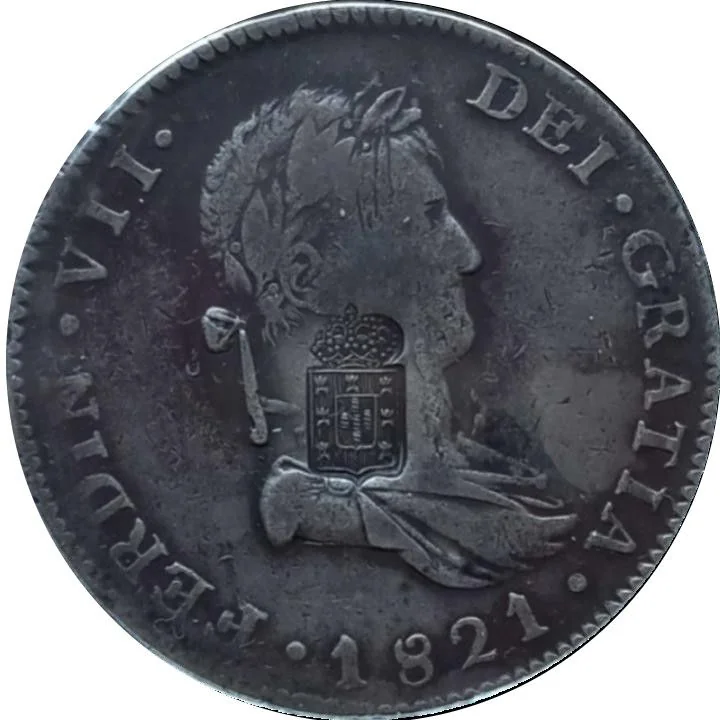
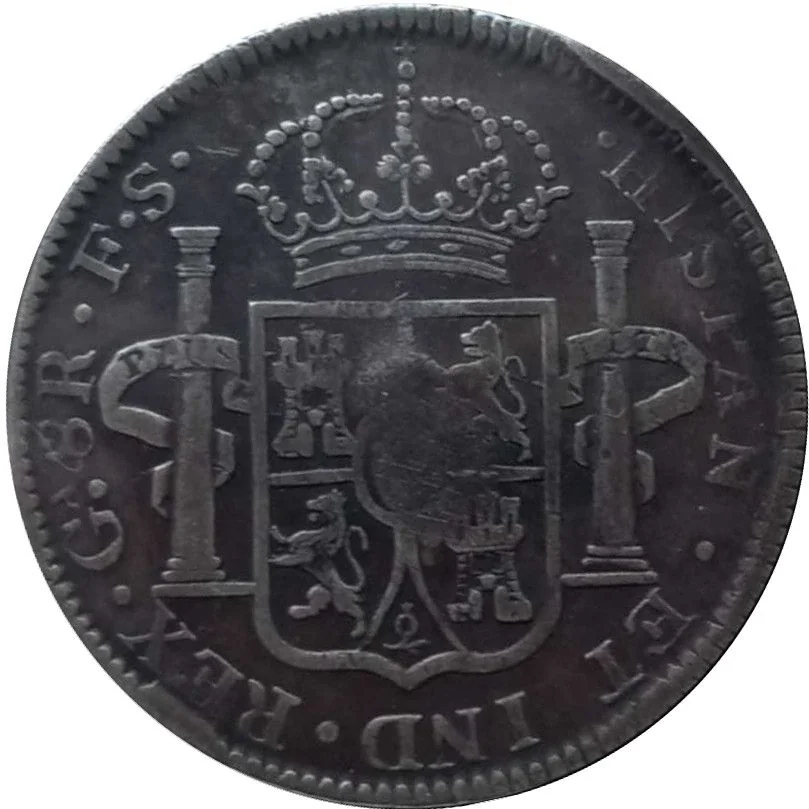
870 Réis – Portugal
Portugal

Material
Diameter: 27 mm
Weight: 38 g
Silver weight: 34.31 g
Shape: Round
Composition: 90.3% Silver
Magnetic: No
Techniques: Milled, Countermarked
Alignment: Medal alignment
flip
References
KM: #Click to copy to clipboard440.15
Numista: #18069
Value
Bullion value: $95.12
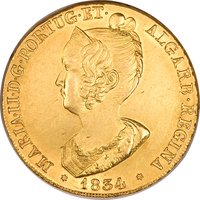
Obverse
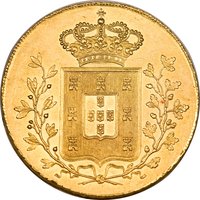
Reverse
Edge
Mints
| Name | Mark |
|---|---|
| Guadalajara | Gª F.S. |
Mintings
| Year | Mint Mark | Mintage | Quality | Collection |
|---|---|---|---|---|
| 1834 | — | — | ||
| 1834 | — | — | BU |
Historical background
In 1834, Portugal's currency situation was deeply unstable, a direct consequence of the recently concluded Liberal Wars (1828-1834). The civil war between liberal constitutionalists and absolutist traditionalists had devastated the economy, drained the state treasury, and led to a severe debasement of the currency. The victorious liberal government of Queen Maria II, now consolidated in Lisbon, inherited a monetary system in chaos, characterized by a severe shortage of precious metals and a proliferation of paper money of questionable value issued by both sides during the conflict.
The cornerstone of the problem was the real, the base unit of Portuguese currency, which existed in both copper (real preto) and silver (real branco) forms. However, the state's financial desperation had led to the over-minting of debased copper coinage, while silver coins were hoarded or exported, leading to a classic instance of Gresham's Law ("bad money drives out good"). Furthermore, the paper notes issued by the Banco de Lisboa, the forerunner to the Bank of Portugal (founded in 1846), were not fully trusted and circulated at a significant discount to their face value, causing inflation and hindering commerce.
Facing this crisis, the liberal government recognized that monetary reform was essential for national recovery and economic credibility. The period immediately following 1834 was thus one of transition and attempted stabilization, laying the groundwork for more systematic reforms. Efforts focused on restoring confidence by gradually withdrawing the most debased coinage and attempting to re-establish a reliable link between the currency and metallic value, a process that would culminate in the major monetary reform of 1847 which introduced the real as a decimal-based silver standard.
The cornerstone of the problem was the real, the base unit of Portuguese currency, which existed in both copper (real preto) and silver (real branco) forms. However, the state's financial desperation had led to the over-minting of debased copper coinage, while silver coins were hoarded or exported, leading to a classic instance of Gresham's Law ("bad money drives out good"). Furthermore, the paper notes issued by the Banco de Lisboa, the forerunner to the Bank of Portugal (founded in 1846), were not fully trusted and circulated at a significant discount to their face value, causing inflation and hindering commerce.
Facing this crisis, the liberal government recognized that monetary reform was essential for national recovery and economic credibility. The period immediately following 1834 was thus one of transition and attempted stabilization, laying the groundwork for more systematic reforms. Efforts focused on restoring confidence by gradually withdrawing the most debased coinage and attempting to re-establish a reliable link between the currency and metallic value, a process that would culminate in the major monetary reform of 1847 which introduced the real as a decimal-based silver standard.
💎 Extremely Rare