

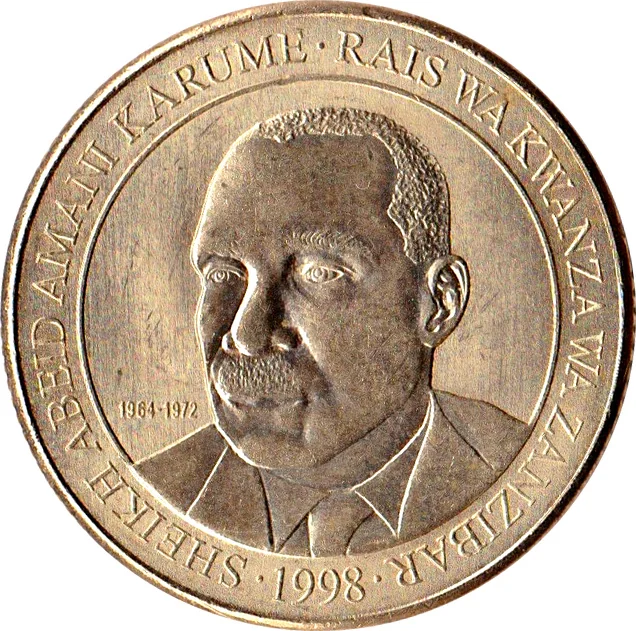
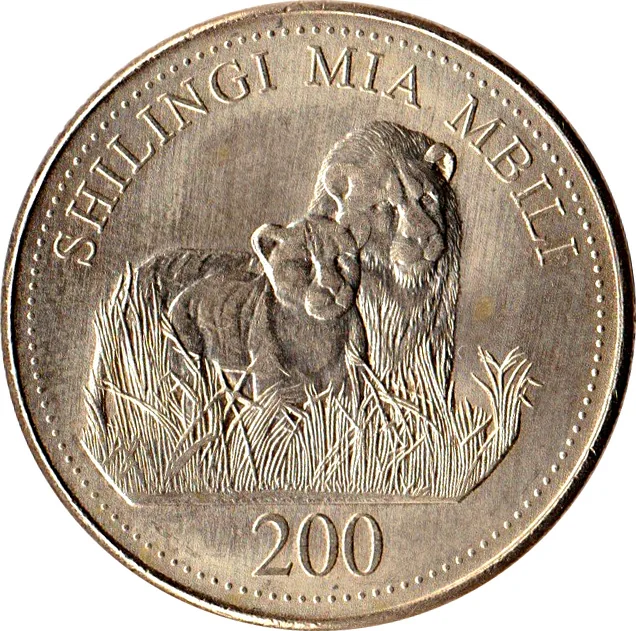
200 shilingi – Tanzania
Add to wishlist
Tanzania
Context
Material
Diameter: 26.9 mm
Weight: 8 g
Thickness: 1.95 mm
Shape: Round
Composition: Nickel brass
Magnetic: No
Technique: Milled
Alignment: Medal alignment
flip
References
KM: #
Numista: #2660
Value
Exchange value: 200 TZS
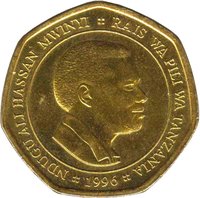
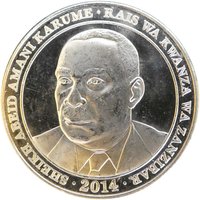
Obverse
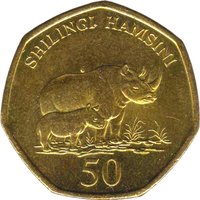
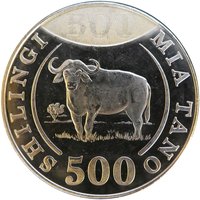
Reverse
Edge
Segmented reeding (5 sections each)
Categories
| Animal> Feline |
| Person> Politician |
Mintings
| Year | Mint Mark | Mintage | Quality | Collection |
|---|---|---|---|---|
| 1998 | — | — | ||
| 2008 | — | — | ||
| 2014 | — | — |
Historical background
In 1998, Tanzania's currency situation was characterized by a period of relative stability and consolidation following a major monetary reform. Just two years prior, in 1996, the country had introduced the new Tanzanian shilling (TZS), replacing the old shilling at a rate of 1:1000. This redenomination was a crucial step to simplify transactions, restore public confidence in the currency, and curb high inflation that had plagued the economy in the early 1990s. By 1998, the new shilling was firmly established as the sole legal tender, and the government, under President Benjamin Mkapa, was actively pursuing structural adjustment programs endorsed by the IMF and World Bank.
The macroeconomic context was one of cautious optimism. Inflation, which had exceeded 30% in the early 1990s, was brought down to approximately 12-15% by 1998 through tight fiscal and monetary policies. The exchange rate regime was a managed float, with the Bank of Tanzania intervening to smooth out excessive volatility. The shilling experienced a gradual and controlled depreciation against major currencies like the US dollar, a trend considered necessary to maintain export competitiveness but managed to avoid the sharp, destabilizing devaluations of the past. This stability was supported by improved foreign exchange reserves and ongoing donor support for economic reforms.
However, underlying challenges persisted. The economy remained heavily dependent on agriculture and vulnerable to external shocks. While the formal currency market was stable, a significant parallel foreign exchange market still existed, though less dominant than in previous years. The government's focus was on deepening financial sector reforms, improving revenue collection, and encouraging private investment to foster sustainable growth. Thus, the currency situation in 1998 reflected a transitional phase—having moved beyond the crises of the past but still grappling with the foundational reforms needed for long-term monetary stability and economic development.
The macroeconomic context was one of cautious optimism. Inflation, which had exceeded 30% in the early 1990s, was brought down to approximately 12-15% by 1998 through tight fiscal and monetary policies. The exchange rate regime was a managed float, with the Bank of Tanzania intervening to smooth out excessive volatility. The shilling experienced a gradual and controlled depreciation against major currencies like the US dollar, a trend considered necessary to maintain export competitiveness but managed to avoid the sharp, destabilizing devaluations of the past. This stability was supported by improved foreign exchange reserves and ongoing donor support for economic reforms.
However, underlying challenges persisted. The economy remained heavily dependent on agriculture and vulnerable to external shocks. While the formal currency market was stable, a significant parallel foreign exchange market still existed, though less dominant than in previous years. The government's focus was on deepening financial sector reforms, improving revenue collection, and encouraging private investment to foster sustainable growth. Thus, the currency situation in 1998 reflected a transitional phase—having moved beyond the crises of the past but still grappling with the foundational reforms needed for long-term monetary stability and economic development.
🌱 Very Common