

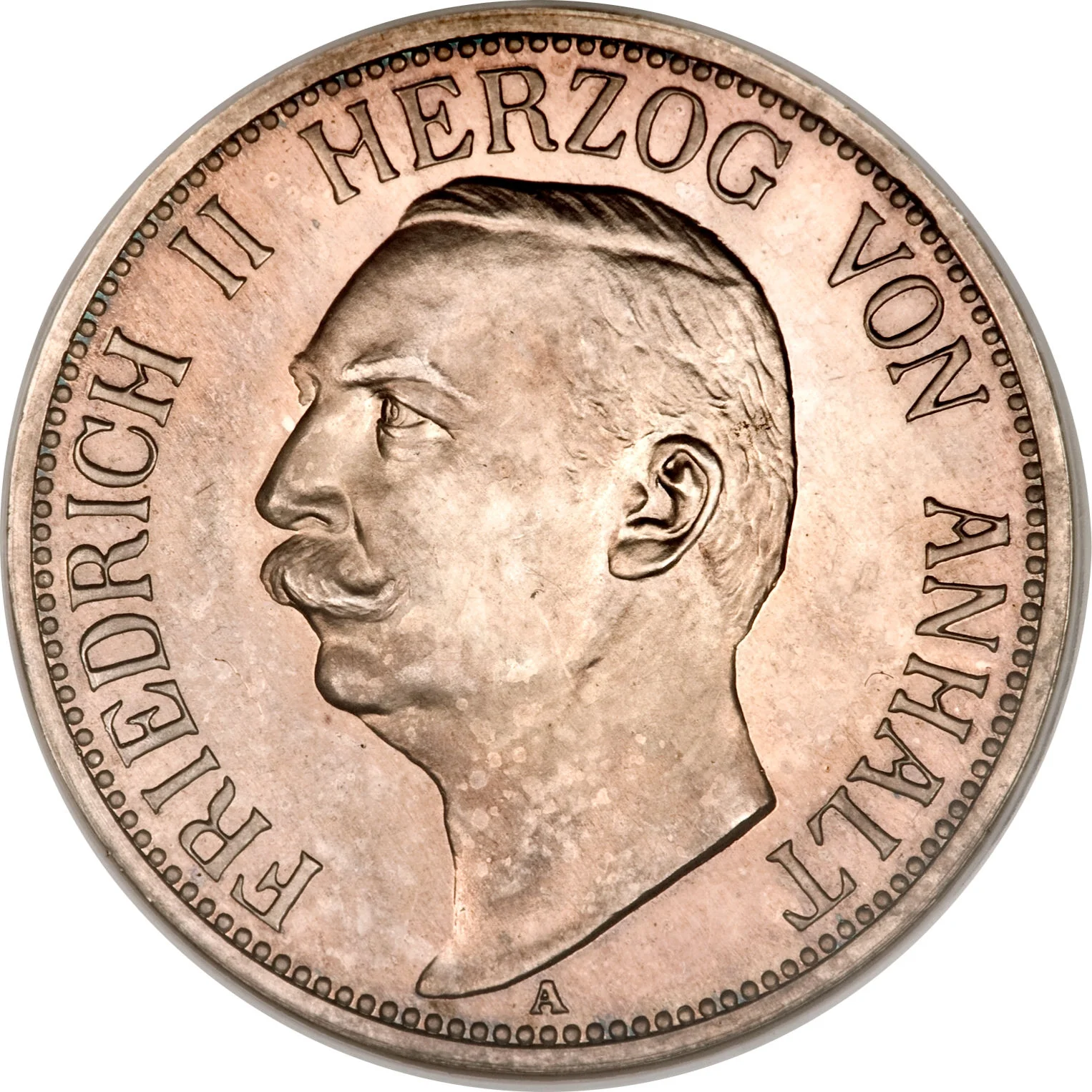
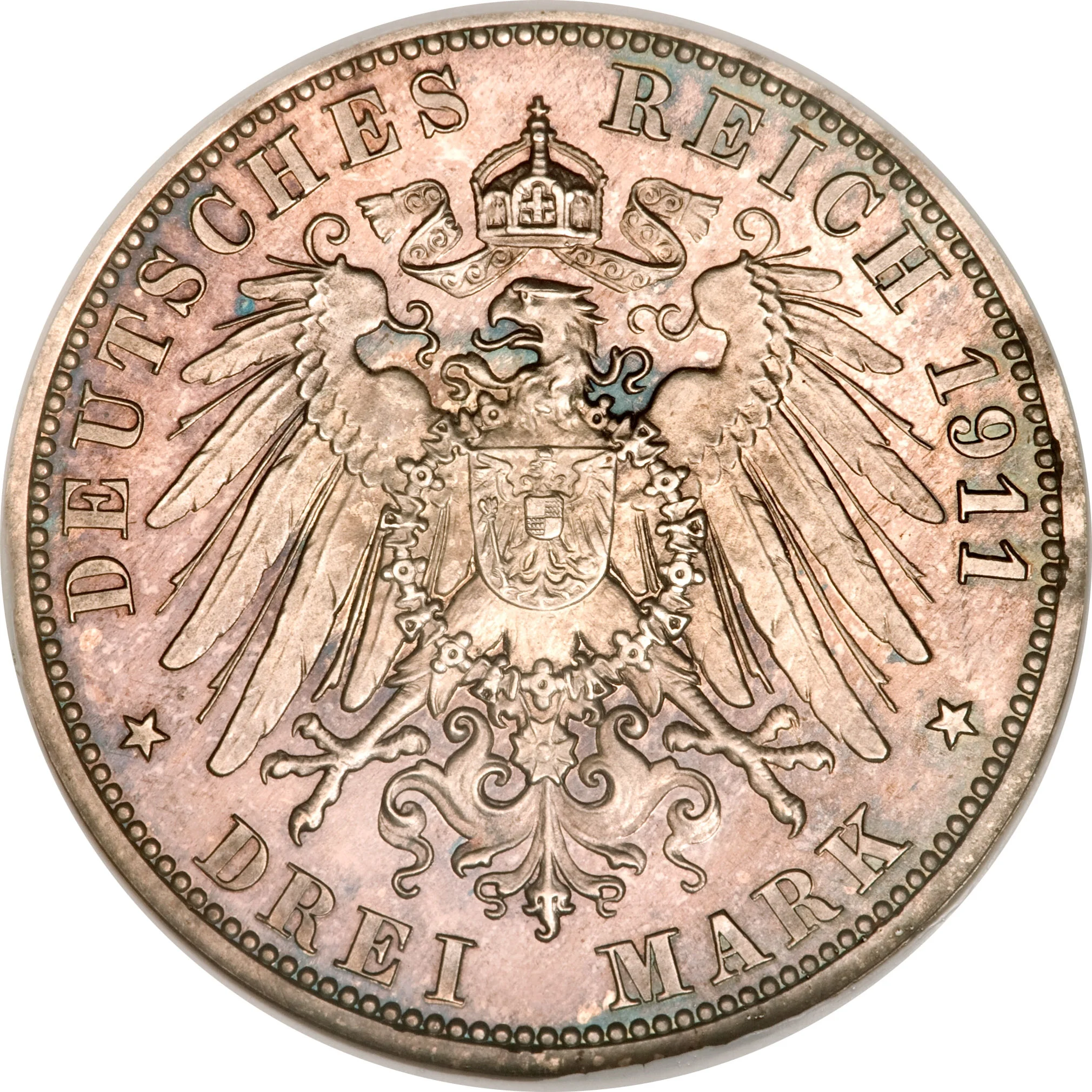
3 mark – Anhalt-Dessau
Add to wishlist
Germany
Context
Years: 1909–1911
Country: Germany
Issuer: Anhalt-Dessau
Ruler: Frederick II
Currency:
Demonetized: Yes
Total mintage: 200,000
Material
References
KM: #
Numista: #26551
Value
Bullion value: $38.19
Obverse
Reverse
Edge
Categories
| Mustache/Beard |
Mints
| Name | Mark |
|---|---|
| Berlin | A |
Historical background
In 1909, the currency situation in the Duchy of Anhalt-Dessau, like all states within the German Empire, was defined by the uniform national system established by the Reich. Following the unification of Germany in 1871, the Reichsmark, divided into 100 Pfennig, had been instituted as the sole legal tender, replacing the myriad of regional thalers, gulden, and kreuzers. As such, the Duchy no longer issued its own independent currency or possessed autonomous monetary policy. The physical coins and banknotes in circulation in Dessau in 1909 were imperial issues, bearing the insignia of the German Empire, though some low-denomination coins (like Pfennigs) might still have featured the portrait or crest of Duke Friedrich II of Anhalt, issued under imperial authority and strictly regulated.
The monetary environment was one of notable stability, underpinned by the gold standard to which the Reichsmark was firmly anchored. This guaranteed the currency's value internationally and fostered strong economic confidence. For the citizens and businesses of Anhalt-Dessau, this meant predictable prices, reliable savings, and seamless financial transactions with neighbouring states and trading partners across the Reich. The local economy, with its mix of agriculture, nascent industry, and the ducal court, operated within this secure and integrated national financial framework.
However, this integration also meant that Anhalt-Dessau was entirely subject to the fiscal and monetary decisions made in Berlin by the Reichsbank. Any broader economic shifts or inflationary pressures affecting the Empire would be directly felt in the duchy. By 1909, the stable pre-war era was nearing its end; the costs of military and naval expansion were beginning to strain public finances, a subtle pressure point within the otherwise robust system. Thus, while Anhalt-Dessau itself faced no unique currency crisis or circumstance, it participated fully in the solid, yet increasingly stressed, monetary order of Wilhelmine Germany on the eve of the Great War.
The monetary environment was one of notable stability, underpinned by the gold standard to which the Reichsmark was firmly anchored. This guaranteed the currency's value internationally and fostered strong economic confidence. For the citizens and businesses of Anhalt-Dessau, this meant predictable prices, reliable savings, and seamless financial transactions with neighbouring states and trading partners across the Reich. The local economy, with its mix of agriculture, nascent industry, and the ducal court, operated within this secure and integrated national financial framework.
However, this integration also meant that Anhalt-Dessau was entirely subject to the fiscal and monetary decisions made in Berlin by the Reichsbank. Any broader economic shifts or inflationary pressures affecting the Empire would be directly felt in the duchy. By 1909, the stable pre-war era was nearing its end; the costs of military and naval expansion were beginning to strain public finances, a subtle pressure point within the otherwise robust system. Thus, while Anhalt-Dessau itself faced no unique currency crisis or circumstance, it participated fully in the solid, yet increasingly stressed, monetary order of Wilhelmine Germany on the eve of the Great War.
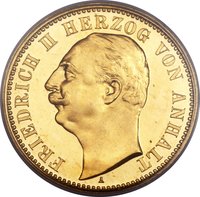
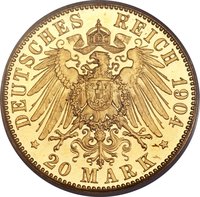
⭐ Somewhat Rare