

Obverse
Description:
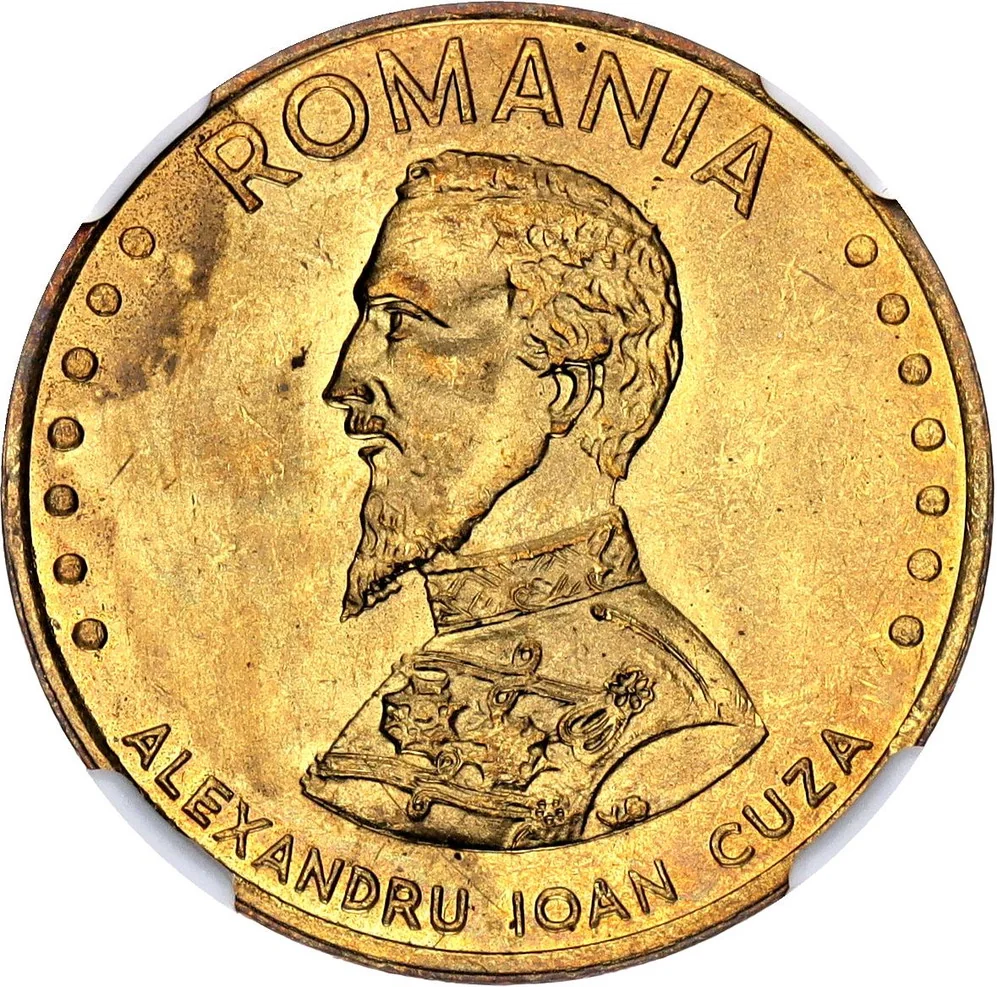
ROMANIA, two seven pearl sectors, portrait of Alexandru Ioan Cuza left.
Inscription:
ROMANIA
V.G.
ALEXANDRU IOAN CUZA
V.G.
ALEXANDRU IOAN CUZA
Script: Latin
Engraver: Vasile Gabor
Reverse
Edge
Plain
Mints
| Name | Mark |
|---|---|
| State Mint | — |
Mintings
| Year | Mint Mark | Mintage | Quality | Collection |
|---|---|---|---|---|
| 1991 | — | 29,600,000 | ||
| 1992 | — | 70,800,000 | ||
| 1993 | — | 34,600,000 | ||
| 1994 | — | 30,000,000 | ||
| 1995 | — | 20,000,000 | ||
| 1996 | — | 4,900,000 | ||
| 2000 | — | 4,500 | Proof | |
| 2002 | — | 1,500 | Proof | |
| 2003 | — | 2,000 | Proof |
Historical background
In 1991, Romania was grappling with the severe economic and social aftermath of the December 1989 revolution, which had overthrown the communist regime of Nicolae Ceaușescu. The economy was in a state of deep crisis, characterized by acute shortages, obsolete industry, and a crippling foreign debt inherited from the previous government. The new, reform-minded government under Prime Minister Petre Roman attempted a "shock therapy" transition to a market economy, but this led to a dramatic decline in industrial output, hyperinflation, and a collapse in living standards, setting a turbulent stage for monetary policy.
The currency situation was defined by the continued use of the Romanian leu (ROL), which was non-convertible and suffering from rapidly eroding value. Inflation soared to over 200% annually, fueled by price liberalization, the printing of money to cover budget deficits, and the breakdown of traditional trade within the former Eastern Bloc. A dual currency system existed in practice, with a vastly overvalued official exchange rate set by the National Bank of Romania and a thriving black market where the leu traded for a fraction of its official value against hard currencies like the US dollar. This disparity created major distortions, encouraged corruption, and hampered legitimate foreign trade and investment.
Recognizing the need for stabilization, the government took a significant step in 1991 by introducing a partial convertibility of the leu for current account transactions through the "Foreign Exchange Certificate" system. However, full liberalization and a unified, market-driven exchange rate would not be achieved until later in the decade. Thus, the currency situation in 1991 remained one of instability and transition, mirroring the country's painful and uncertain first steps toward a capitalist system.
The currency situation was defined by the continued use of the Romanian leu (ROL), which was non-convertible and suffering from rapidly eroding value. Inflation soared to over 200% annually, fueled by price liberalization, the printing of money to cover budget deficits, and the breakdown of traditional trade within the former Eastern Bloc. A dual currency system existed in practice, with a vastly overvalued official exchange rate set by the National Bank of Romania and a thriving black market where the leu traded for a fraction of its official value against hard currencies like the US dollar. This disparity created major distortions, encouraged corruption, and hampered legitimate foreign trade and investment.
Recognizing the need for stabilization, the government took a significant step in 1991 by introducing a partial convertibility of the leu for current account transactions through the "Foreign Exchange Certificate" system. However, full liberalization and a unified, market-driven exchange rate would not be achieved until later in the decade. Thus, the currency situation in 1991 remained one of instability and transition, mirroring the country's painful and uncertain first steps toward a capitalist system.
🌱 Very Common